The foundational technology for modern volumetric concrete mixers was first widely developed and commercialized in the 1960s. While the earliest automated designs emerged in Europe in the late 1950s, it was during the following decade that manufacturers in North America began building their own versions, driven by the need for more convenient and flexible on-site concrete production.
The invention of the volumetric mixer in the 1960s marked a fundamental shift in concrete production, moving the mixing process from a central plant directly to the job site to solve the inherent limitations of traditional ready-mix trucks.
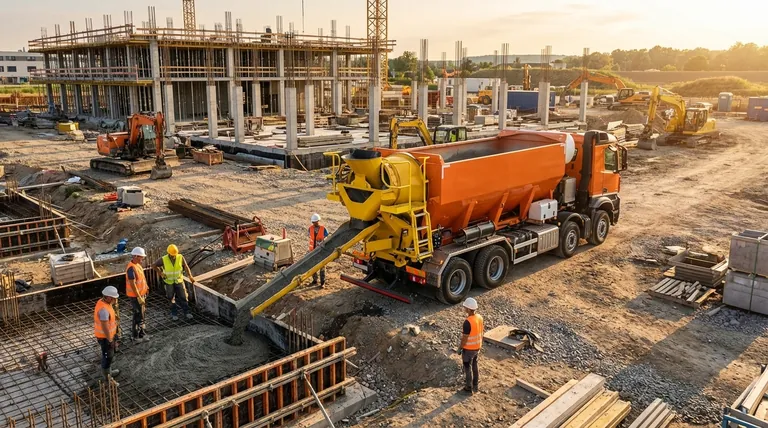
The Genesis of On-Demand Concrete
The development of the volumetric mixer was a direct response to the challenges posed by traditional concrete delivery methods. Understanding this context reveals why the technology was so disruptive.
Limitations of Traditional Drum Mixers
For decades, the industry relied on drum mixers, which have been in use since the early 1900s. These trucks are loaded with a pre-determined batch of concrete at a central plant and must deliver it within a tight time frame.
This model created issues with delivery delays, the potential for "hot loads" (concrete beginning to set), and significant waste if the entire batch wasn't used.
The European Precursor (Late 1950s)
The very first designs for a mobile, automated mixer that carried unmixed materials appeared in Europe toward the end of the 1950s.
This concept was the seed for what would become the modern volumetric mixer, demonstrating that it was possible to create a "concrete plant on wheels."
The North American Boom (1960s)
The technology was imported to North America, and by the mid-1960s, a number of companies began engineering and building their own versions.
This decade marked the true birth of the commercial volumetric mixer, as manufacturers refined the designs to create reliable machines that could meet the demands of various construction projects.
From Invention to Industry Standard
The transition from a novel invention to a recognized industry tool involved both technological refinement and the establishment of official standards.
The Key Technological Shift
The core innovation of the volumetric mixer is its ability to carry sand, stone, cement, and water in separate compartments.
Materials are mixed on-site and on-demand to the exact volume and mix design required. This provides fresh, high-quality concrete for every pour and allows for instant adjustments.
Formalization of the Industry
As the technology matured and gained adoption, the need for industry-wide standards became clear.
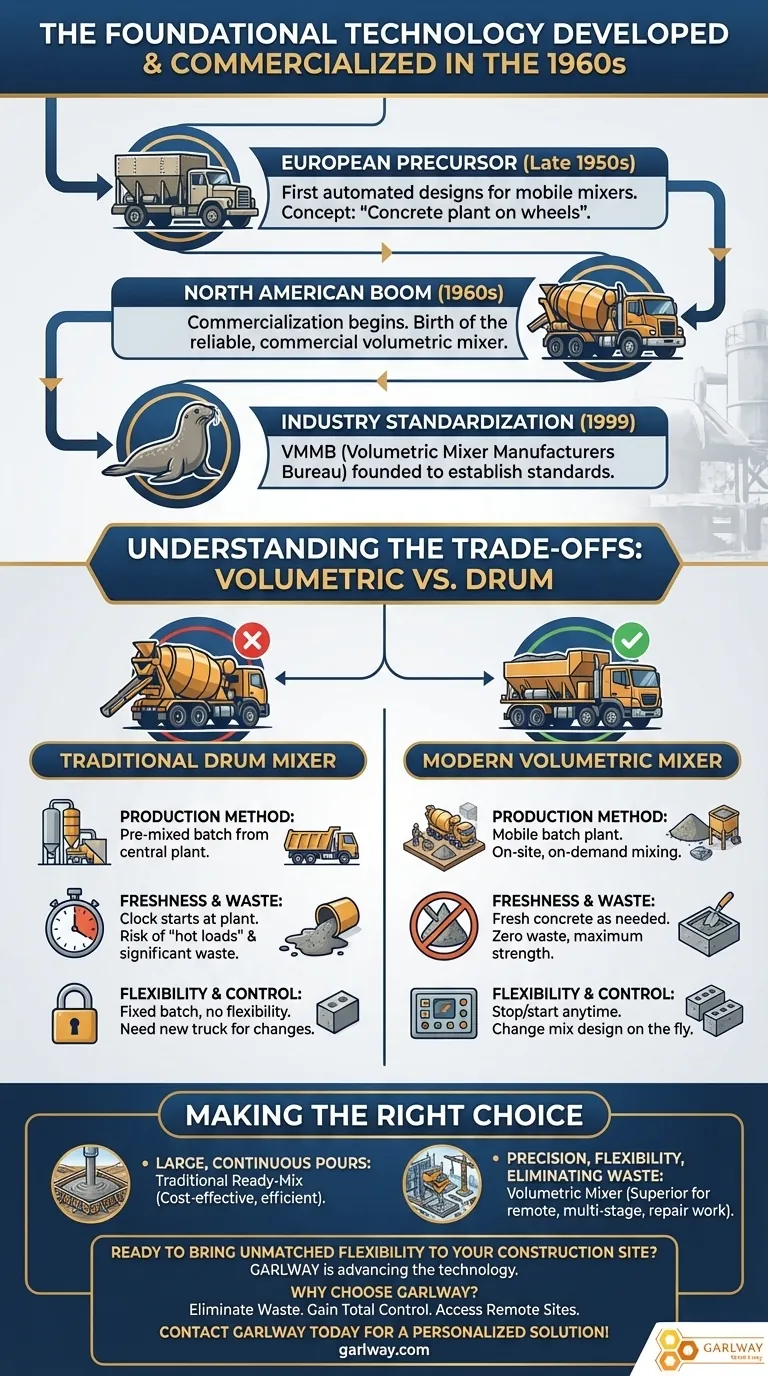
In 1999, equipment manufacturers founded the Volumetric Mixer Manufacturers Bureau (VMMB). This trade association was created to establish standards and promote the advantages of volumetric mixing technology.
Understanding the Trade-offs: Volumetric vs. Drum
The historical development was driven by a need for a different solution. The core differences between the two technologies highlight their respective strengths.
Production Method
A drum mixer delivers a pre-mixed batch of a single concrete design from a central plant.
A volumetric mixer functions as a mobile batch plant, capable of producing any volume of concrete and multiple mix designs at the job site.
Freshness and Waste
With a traditional ready-mix truck, the clock starts ticking the moment water is added at the plant. Any unused concrete is wasted.
Volumetric mixers produce fresh concrete as it's needed, completely eliminating waste from over-ordering and ensuring maximum concrete strength.
Flexibility and Control
The fixed batch in a drum mixer offers no flexibility. If project needs change, a new truck must be ordered.
An operator can stop a pour from a volumetric mixer at any time and start again hours or even days later. They can also change the mix design on the fly for different project requirements.
Making the Right Choice for Your Goal
The origins of the volumetric mixer highlight its role as a problem-solving tool. Choosing between it and a drum mixer depends entirely on the specific demands of your project.
- If your primary focus is large, continuous pours of a single mix design: Traditional ready-mix from a drum mixer is often the most cost-effective and efficient solution.
- If your primary focus is precision, flexibility, and eliminating waste: A volumetric mixer is the superior choice, especially for remote locations, multi-stage projects, or repair work.
Understanding the history of this technology allows you to leverage its specific advantages for better project outcomes.
Summary Table:
| Key Event | Time Period | Significance |
|---|---|---|
| European Precursor | Late 1950s | First automated designs for mobile mixers appeared. |
| North American Boom | 1960s | Technology was commercialized, marking the birth of the modern volumetric mixer. |
| Industry Standardization | 1999 | Volumetric Mixer Manufacturers Bureau (VMMB) was founded to establish standards. |
Ready to Bring Unmatched Flexibility to Your Construction Site?
Just as the volumetric mixer revolutionized concrete delivery in the 1960s, GARLWAY is advancing the technology today. We specialize in providing robust construction machinery, including volumetric mixers, winches, and concrete batching plants, for construction companies and contractors globally.
Why Choose GARLWAY?
- Eliminate Waste: Produce only the concrete you need, when you need it.
- Gain Total Control: Adjust mix designs on the fly for different project phases.
- Access Remote Sites: Our mobile solutions deliver high-quality concrete anywhere.
Let's build your next project with precision and efficiency. Contact GARLWAY today for a personalized solution!
Visual Guide
Related Products
- Belle Cement Mixer JS2000 Volumetric Concrete Mixer for Harbor Freight
- JS1000 Volumetric Concrete Mortar Mixer for Sale Skid Steer Cement Mixer
- Harbor Freight JS1500 On Site Concrete Mixing Volumetric Cement Mixer
- Portable Concrete Mixer Machine Equipment for Mixing Concrete
- HZS25 Best Cement Mixer for Quick Mix Concrete at Bunnings
People Also Ask
- What is a volumetric concrete mixer? A Mobile Concrete Batch Plant for On-Demand Mixing
- What is the predicted future for volumetric concrete mixers? Growth Driven by On-Demand Efficiency
- How does a volumetric concrete mixer contribute to sustainability? Reduce Waste, Water, and Emissions On-Site
- How does volumetric concrete compare to ready-mix concrete? Choose the Right Method for Your Project
- What types of concrete can be produced with volumetric mixers? Achieve On-Demand Mixing for Any Project