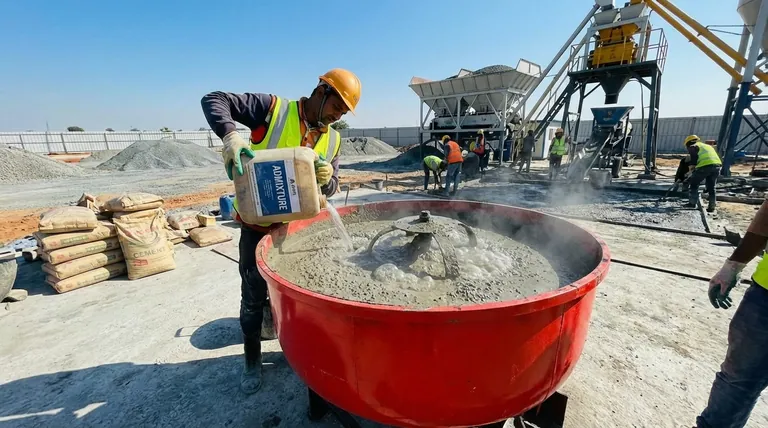
In concrete mixing, admixtures are specialty chemicals added to the mix to precisely modify its properties. Their purpose is to solve specific challenges by enhancing characteristics like durability against harsh weather, overall strength, workability during placement, or the speed at which the concrete sets and hardens.
Admixtures are not simply additives; they are engineering tools that transform generic concrete into a high-performance material. They solve distinct problems, from surviving freeze-thaw cycles to enabling complex pours, but their effectiveness hinges on precise dosage and understanding their potential side effects.
The Primary Functions of Concrete Admixtures
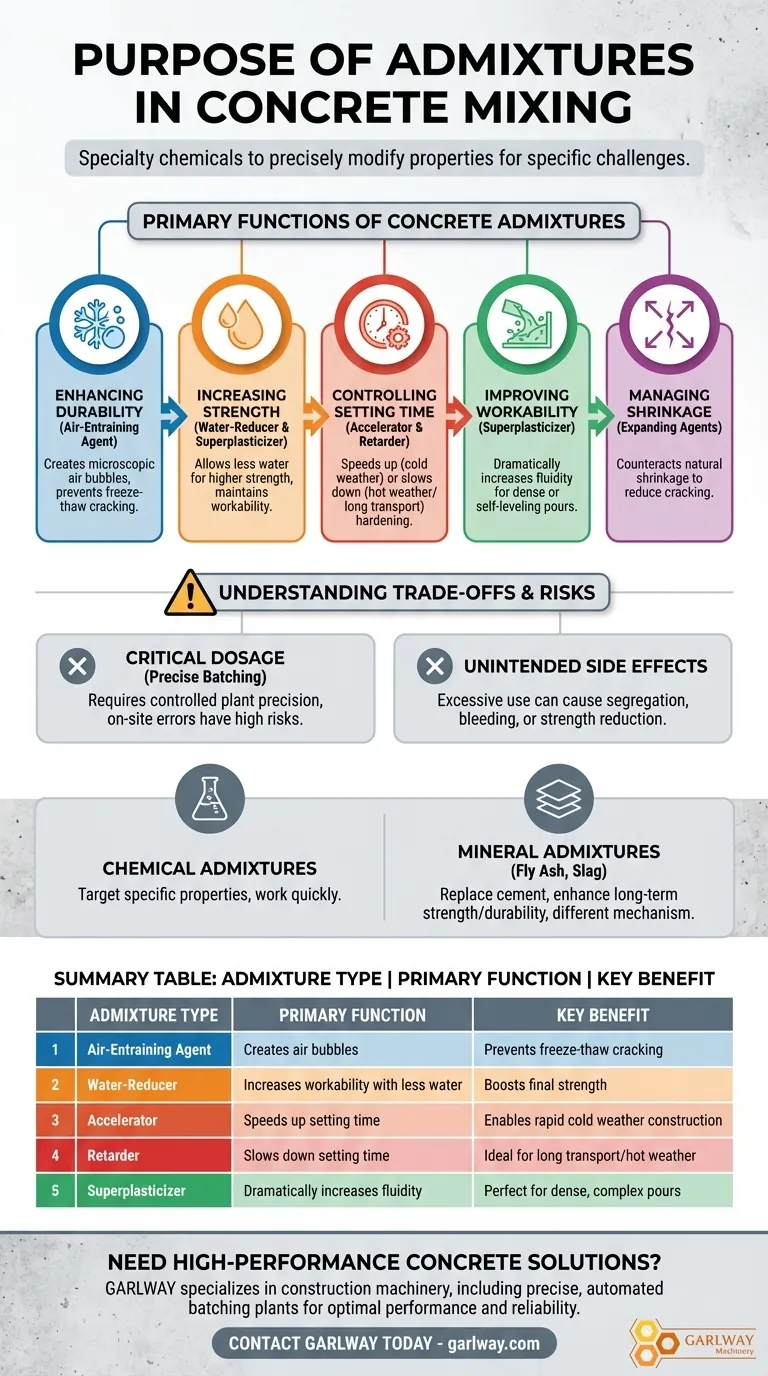
Admixtures are categorized by the function they perform. Each type targets a specific property of either the fresh (plastic) concrete or the final hardened product.
Enhancing Durability
The most common and critical use of admixtures is to improve durability, particularly in environments with freezing temperatures.
An air-entraining agent creates a network of microscopic, stable air bubbles throughout the concrete. These bubbles act as tiny pressure-relief valves, giving water space to expand when it freezes and preventing internal cracking.
Increasing Strength
The strength of concrete is fundamentally linked to its water-to-cement ratio. Less water means stronger concrete.
Water-reducing admixtures (plasticizers) allow a mix to remain workable and flowable with significantly less water. This directly increases the final compressive strength without sacrificing ease of placement. Superplasticizers are a high-range version of these admixtures used for self-leveling concrete.
Controlling Setting Time
The rate at which concrete hardens is critical for scheduling and logistics. Admixtures provide direct control over this process.
Accelerators are used to speed up the hydration process, leading to faster strength gain. This is vital in cold weather or when forms need to be removed quickly.
Retarders slow down the setting time. This is essential for long transport distances, hot weather pours, or complex finishing work that requires the concrete to remain plastic for longer.
Improving Workability
Superplasticizers dramatically increase the fluidity of concrete without adding more water. This allows for placement in densely reinforced structures or for creating self-leveling mixes that require minimal vibration.
Managing Shrinkage
Concrete naturally shrinks as it dries, which can cause cracking. Expanding agents counteract this by causing a slight expansion during the setting process, which helps to reduce overall shrinkage and improve strength.
Understanding the Trade-offs and Risks
While powerful, admixtures are not a magic bullet. Their use requires technical understanding and precision, as incorrect application can harm the concrete.
The Critical Role of Dosage
Admixtures are highly concentrated and dosed in very small quantities. This requires the precision of a controlled batching plant.
Attempting to add these chemicals during on-site mixing is highly discouraged, as even a small error in dosage can have significant negative consequences.
Unintended Side Effects
Each admixture comes with potential downsides if used improperly.
Excessive use of a water reducer can cause segregation, where the heavy aggregates separate from the cement paste, and bleeding, where water rises to the surface. Both phenomena weaken the final product.
While air entrainment is crucial for freeze-thaw durability, it can also cause a slight reduction in compressive strength.
Improper use of a retarder can also lead to a decrease in the concrete's ultimate strength.
Chemical vs. Mineral Admixtures
It is important to distinguish chemical admixtures from mineral admixtures like fly ash or slag powder.
These minerals are often used to replace a portion of the cement in a mix. They can enhance long-term strength and durability but work through a different mechanism and on a different timeline than chemical admixtures.
Making the Right Choice for Your Goal
Selecting the correct admixture is about clearly defining the primary challenge you need to overcome for your specific project.
- If your primary focus is durability in cold climates: An air-entraining agent is essential to protect the concrete from freeze-thaw damage.
- If your primary focus is achieving maximum strength: A water-reducing admixture is the most effective tool, as it allows you to lower the critical water-cement ratio.
- If your primary focus is managing a difficult pour (e.g., long transport or hot weather): A retarder will extend the setting time, giving your team more time to place and finish the concrete.
- If your primary focus is rapid construction and early form removal: An accelerator will speed up the hydration process to help you meet tight schedules.
Ultimately, using admixtures correctly elevates concrete from a simple building material to an engineered solution tailored to its environment and purpose.
Summary Table:
| Admixture Type | Primary Function | Key Benefit |
|---|---|---|
| Air-Entraining Agent | Creates microscopic air bubbles | Prevents cracking from freeze-thaw cycles |
| Water-Reducer | Increases workability with less water | Boosts final compressive strength |
| Accelerator | Speeds up setting time | Enables rapid construction in cold weather |
| Retarder | Slows down setting time | Ideal for long transport or hot weather pours |
| Superplasticizer | Dramatically increases fluidity | Perfect for dense, complex pours |
Need High-Performance Concrete Solutions for Your Project?
Choosing the right admixture is critical for achieving the strength, durability, and workability your project demands. GARLWAY specializes in construction machinery, including concrete batching plants designed for the precise, automated dosing of admixtures. This ensures optimal performance and eliminates the risks of on-site errors.
Let us help you engineer the perfect concrete mix. Contact GARLWAY today to discuss your specific needs and discover how our equipment can bring precision and reliability to your construction site.
Visual Guide
Related Products
- Construction Products Concrete Plant Machine Mixing Concrete Mixer
- Concrete Cement Mixer Machine Drum Mixer for Construction
- Hydraulic Concrete Mixer Machine Cement Mixing Equipment for Mixture Concrete
- HZS180 Ready Mix Concrete Plant for Foundations with Sand and Cement
- HZS35 Small Cement Concrete Mixing Batch Plant
People Also Ask
- What factors should be considered when choosing between volumetric and traditional mixers? Optimize Your Concrete Project Strategy
- What is the difference between pan and planetary mixers? Choose the Right Mixer for Your Concrete Project
- When was the first concrete mixer developed and by whom? Discover the 1900 Breakthrough
- What is the average lifespan of a concrete mixer? Maximize Your Equipment's Lifespan & ROI
- What are the two broad types of concrete mixers? Choose the Right Mixer for Your Project