
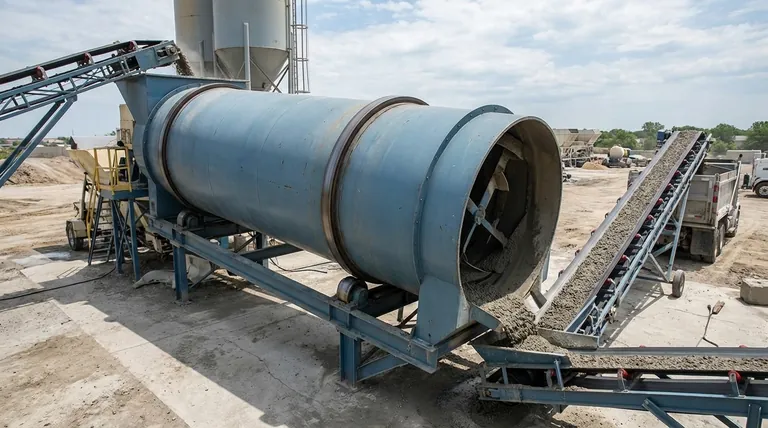
At its core, a continuous mixer drum is configured as a long, rotating cylinder set at a slight downward angle. Ingredients are fed continuously into the higher end, and the combination of the drum's rotation and its gravitational tilt simultaneously mixes and conveys the material until it discharges as a finished product from the lower end.
The entire configuration of a continuous mixer drum is engineered for one purpose: to create an uninterrupted, assembly-line-style process where loading, mixing, and discharging happen simultaneously, not in separate steps.
The Mechanics of Continuous Mixing
The genius of the continuous mixer lies in its simple, yet highly effective, mechanical design. Each component of the drum configuration plays a critical role in maintaining a constant, uniform flow of material.
The Angled Drum Orientation
The most crucial configuration element is the angle of inclination. The drum is purposefully tilted downwards from the inlet to the outlet.
This slight angle harnesses gravity to pull material through the system. This design choice is fundamental to the "continuous" aspect of the mixer's operation.
Low-Speed Rotational Action
Continuous mixer drums rotate at a relatively low speed, typically around 8 to 10 RPM.
This slow, constant tumbling is not for speed but for consistency. It gently lifts and drops the materials, allowing them to blend thoroughly without aggressive force, which also reduces energy consumption.
Internal Mixing Flights
Fixed to the inside wall of the drum are blades or fins known as mixing flights.
As the drum turns, these flights catch and lift the material. As the material reaches the top of the rotation, it cascades back down, mixing with the rest of the contents. This ensures a uniform blend rather than just having material slide along the bottom of the drum.
Fixed Inlet and Outlet
Unlike a batch mixer that tilts to load and discharge, a continuous mixer has a stationary inlet and outlet.
Raw materials are continuously fed into the opening at the high end, often by screw feeders. The fully blended product exits at the low end without ever stopping the machine, enabling massive production volumes.
A Key Variant: The Stationary Drum
It's important to note another common configuration that achieves the same goal through a different mechanism: the stationary drum with an internal screw.
The Auger-Based System
In this design, the drum itself does not rotate. Instead, a large, screw-type blade (an auger) spins constantly inside the stationary drum.
This powerful screw is responsible for both blending the materials and actively conveying them from the inlet to the outlet. This design is often used when a more forceful mixing action is required.
Understanding the Trade-offs
The continuous mixer configuration is a purpose-built tool, and its design comes with distinct advantages and limitations compared to traditional batch mixing.
Advantage: Unmatched Throughput
The primary benefit is extremely high production volume. By eliminating the stop-start cycle of batching, these mixers are ideal for large-scale projects like dams, bridges, and high-volume material manufacturing.
Advantage: Process Consistency
Once calibrated, a continuous mixer produces a highly consistent end product. The residence time for material in the drum is fixed, leading to predictable and uniform results hour after hour.
Limitation: Lack of Flexibility
This design is not well-suited for projects requiring frequent changes in mix formulas. Cleaning the long drum between different recipes is more involved than with a simple batch mixer. It is optimized for long runs of a single, consistent product.
Making the Right Choice for Your Goal
Understanding the drum configuration allows you to select the right tool based on your project's fundamental requirements.
- If your primary focus is massive-scale production with a single, consistent formula: The inclined, rotating drum continuous mixer offers unparalleled efficiency and throughput.
- If your primary focus is flexibility for multiple small batches or highly precise recipes: A traditional, non-continuous batch mixer provides superior control and ease of changeover.
- If your primary focus is continuous flow for materials that require more aggressive blending: The stationary drum with an internal mixing screw may be the more effective configuration.
By matching the mixer's core design principles to your operational needs, you can ensure optimal efficiency and quality.
Summary Table:
| Configuration Feature | Function | Benefit |
|---|---|---|
| Angled Drum | Uses gravity to convey material from inlet to outlet. | Enables continuous, non-stop flow. |
| Low-Speed Rotation | Gently tumbles and lifts materials. | Ensures uniform mixing with low energy use. |
| Internal Mixing Flights | Blades that lift and cascade material. | Creates a consistent, homogenous blend. |
| Stationary Inlet/Outlet | Fixed points for continuous feeding and discharge. | Maximizes throughput for large-scale projects. |
Ready to Scale Up Your Production with a Continuous Mixer?
If your construction company or contracting business requires high-volume, consistent output for large-scale projects, GARLWAY's continuous mixers are engineered for your success. We specialize in durable construction machinery, including concrete batching plants and mixers, designed to deliver unmatched efficiency and reliability.
Contact our experts today to discuss how a GARLWAY continuous mixer can be configured to meet your specific production goals and drive your project forward.
Visual Guide

Related Products
- JS1000 Volumetric Concrete Mortar Mixer for Sale Skid Steer Cement Mixer
- Concrete Cement Mixer Machine Drum Mixer for Construction
- Belle Mixer Drum Self Loading Mortar Mixers JS3000
People Also Ask
- What is the basic working principle of volumetric concrete mixers? On-Demand Mixing for Zero Waste
- What are the advantages of using volumetric mixers for small concrete jobs? Save Costs and Gain On-Site Control
- What are the advantages of volumetric concrete mixers compared to drum mixers? Achieve On-Demand Mixing & Zero Waste
- What are some innovations in volumetric concrete mixers? Boost Efficiency with On-Demand Production
- Why do volumetric mixers provide better ROI? Maximize Profit with On-Demand Concrete Production


