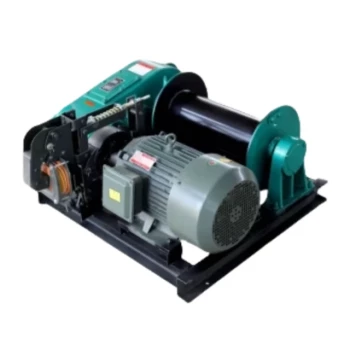
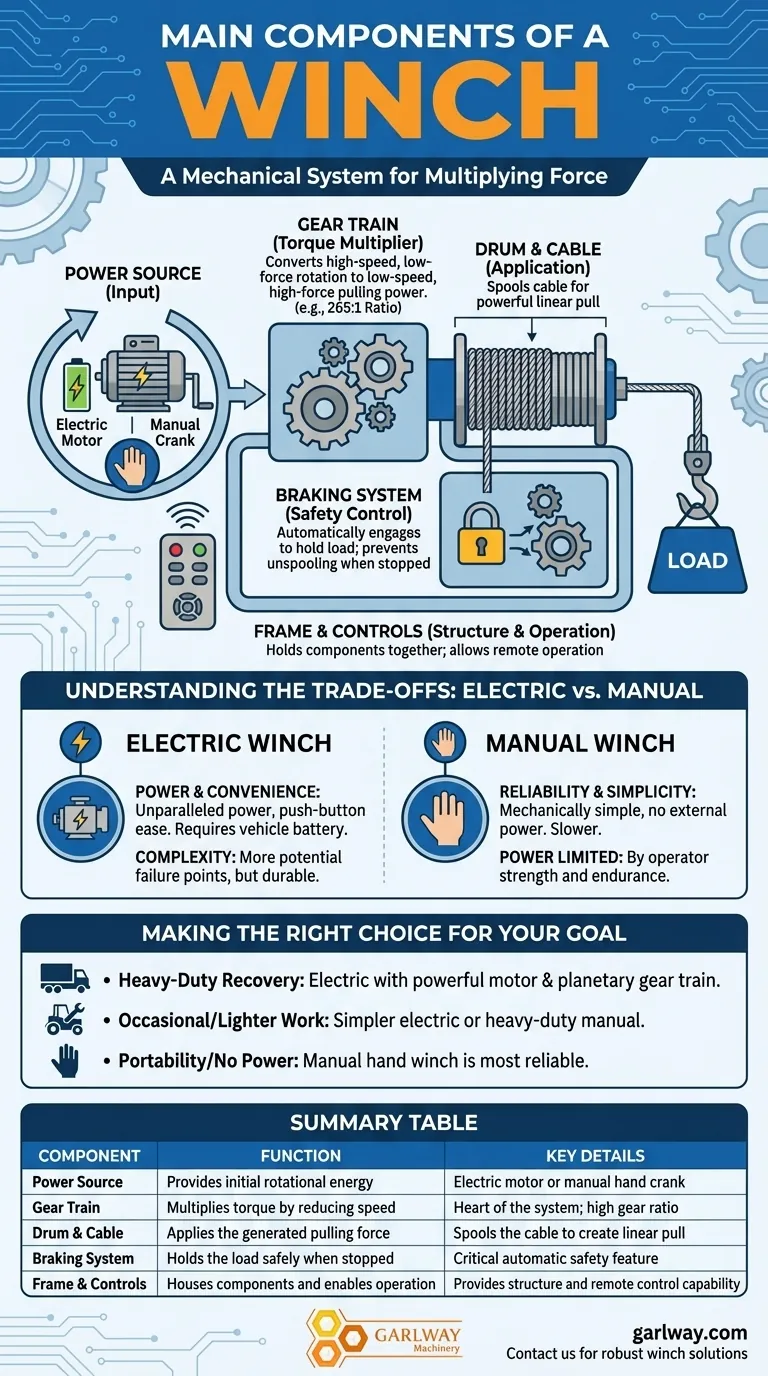
At its core, a winch is a mechanical system designed to multiply force. While designs vary, every winch operates using the same fundamental components: a power source (like a motor or hand crank), a gear train to increase torque, a drum to spool a cable, and a braking system to safely hold a load.
A winch does not create energy; it converts high-speed, low-force rotational energy into low-speed, high-force pulling power. The key to this transformation lies in the gear train, which acts as a torque multiplier.
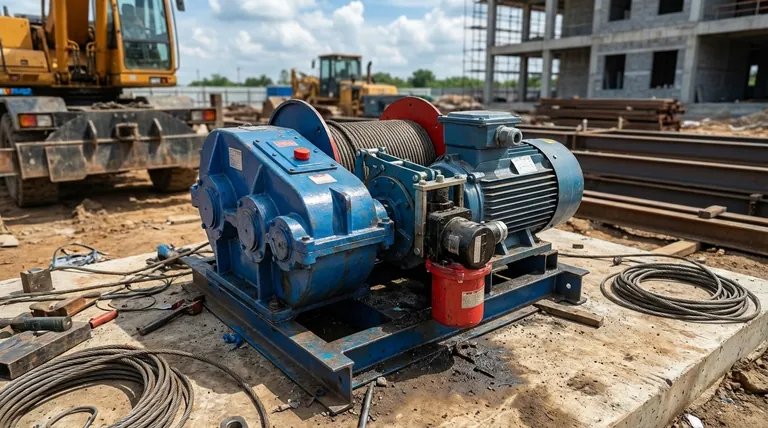
The Anatomy of a Winch: How Force is Multiplied
Each component in a winch serves a distinct and critical function. Understanding how they interact reveals the simple physics behind the machine's immense pulling capability.
The Power Source: The Initial Input
The entire process begins with a source of rotational energy. This is most commonly an electric motor in modern winches, which draws significant power from a vehicle's electrical system.
Alternatively, a manual winch uses a hand crank, relying on human power as the initial input.
The Gear Train: The Heart of the System
This is the most crucial component for generating pulling power. The gear train, also called a gearbox or reduction gear, takes the high-speed rotation from the motor or crank and converts it into slow, powerful rotation.
This process of gear reduction trades speed for torque. A high gear ratio (e.g., 265:1) means the motor has to turn 265 times to make the drum turn once, multiplying the force immensely.
The Drum and Cable: The Point of Application
The drum is the spool that the wire rope or synthetic cable winds onto. As the slow, high-torque gear train turns the drum, the cable is reeled in, creating the powerful linear pull needed to move a heavy object.
The drum and cable are responsible for applying the force generated by the motor and gear train directly to the load.
The Braking System: The Critical Safety Control
The brake is a non-negotiable safety feature. Its job is to automatically engage when the motor stops, preventing the drum from unspooling under load.
This ensures that a heavy load doesn't slip backward the moment you stop pulling, providing essential control and safety during operation.
The Frame and Controls: The Supporting Structure
The frame (or housing) is the foundation that holds all of these components together, providing structural integrity and protecting them from the elements.
Controls, typically a wired or wireless remote, allow the operator to safely engage the motor to wind the drum in or out from a distance.
Understanding the Trade-offs: Electric vs. Manual
While the core principles are the same, the choice between a power source introduces critical differences in performance and application.
Power and Convenience
Electric winches offer unparalleled power and ease of use. They can pull thousands of pounds with the simple push of a button but require a robust power source, typically a vehicle battery.
Reliability and Simplicity
Manual winches are mechanically simpler, lighter, and do not depend on an external power source. Their pulling power is limited by the operator's physical strength and endurance, making them much slower.
Complexity and Maintenance
With motors, couplings, and electrical wiring, electric winches have more potential points of failure than their manual counterparts. However, they are built to be durable and withstand harsh conditions.
Making the Right Choice for Your Goal
The ideal winch configuration depends entirely on your intended use case.
- If your primary focus is heavy-duty vehicle recovery: An electric winch with a powerful motor and a multi-stage planetary gear train is essential for maximum power and reliability.
- If your primary focus is occasional, lighter-duty work: A simpler electric winch or a heavy-duty manual winch can provide sufficient power without the cost and complexity of a premium model.
- If your primary focus is portability and use without a power source: A manual hand winch is the most reliable choice, as its components require no external energy.
Understanding how these core components work together empowers you to select and operate the right tool for any pulling task.
Summary Table:
| Component | Function | Key Details |
|---|---|---|
| Power Source | Provides initial rotational energy | Electric motor or manual hand crank |
| Gear Train | Multiplies torque by reducing speed | Heart of the system; high gear ratio for high force |
| Drum & Cable | Applies the generated pulling force | Spools the cable to create linear pull |
| Braking System | Holds the load safely when stopped | Critical automatic safety feature |
| Frame & Controls | Houses components and enables operation | Provides structure and remote control capability |
Ready to harness reliable pulling power for your projects? As GARLWAY, a specialist in construction machinery, we provide robust winches, concrete mixers, and batching plants designed for the demanding needs of construction companies and contractors worldwide. Our equipment ensures safety, efficiency, and durability on your job site. Contact GARLWAY today to discuss your specific requirements and find the perfect winch solution for your business.
Visual Guide
Related Products
- Warn Winch Windlass Boat Trailer Winch
- Electric and Hydraulic Winch for Heavy Duty Applications
- Small Electric Winch 120V and 240V for Compact Applications
- Quick Windlass Portable Winch for Truck and Boat Best Boat Winch
- Hydraulic Winding Engine Harbor Freight Winch
People Also Ask
- What are the main components of a boat trailer winch? A Guide to Safe & Efficient Boat Loading
- What factors should be considered when choosing a boat trailer winch? Ensure Safe and Effortless Boat Loading
- What is the purpose of boat trailer winches? Safely and Efficiently Load Your Boat
- What are the two main types of boat trailer winches? Manual vs. Electric Explained
- How often should a boat trailer winch be replaced? Your Guide to Safety and Longevity