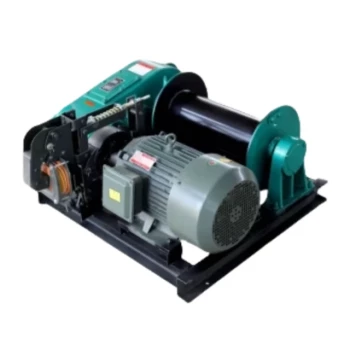
At their core, winches are mechanical devices used for two fundamental purposes: pulling heavy loads horizontally and lifting materials vertically. They are indispensable tools across a vast range of sectors, including off-road vehicle recovery, construction, mining, marine operations, and forestry, with different types designed for specific power and portability needs.
A winch is more than just a pulling tool; it's a force multiplier. Understanding its common uses is less about listing industries and more about recognizing the fundamental problems it solves—overcoming immense weight and resistance in environments from remote trails to massive industrial sites.
The Two Fundamental Roles of a Winch
While winches are used in countless scenarios, their function almost always boils down to one of two primary actions.
Horizontal Pulling and Recovery
This is the most widely recognized use, especially in recreational and utility contexts. It involves pulling a load across a surface.
Common examples include recovering a stuck vehicle in an off-road setting, loading heavy equipment onto a trailer, or dragging logs in a forestry operation.
Vertical Lifting and Hoisting
In industrial and construction settings, winches are critical for lifting materials. They can be used as standalone units or as integral components within larger machinery.
This includes hoisting construction materials to upper floors, lifting components in manufacturing, or raising and lowering equipment in mining shafts.
Key Industries Where Winches are Essential
The versatility of pulling and lifting makes winches a staple tool in demanding professional environments.
Off-Road and Vehicle Recovery
Electric and ATV/UTV winches are standard equipment for off-road enthusiasts. They provide a crucial self-recovery method when a vehicle gets stuck in mud, sand, or ditches.
Construction and Infrastructure
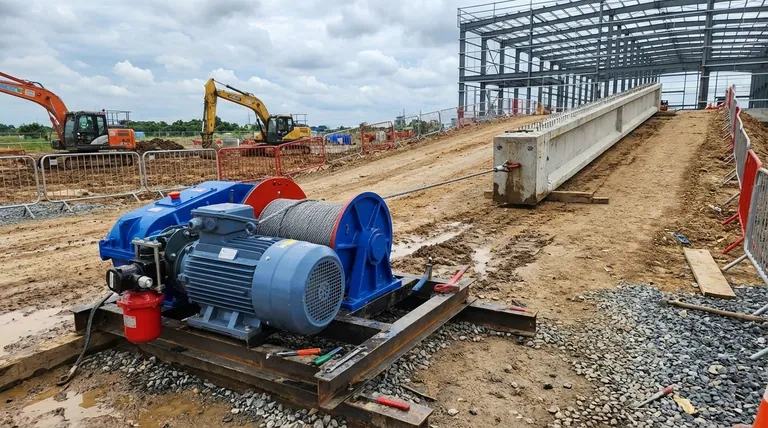
Winches are used on construction sites, road and bridge projects, and in the development of water conservancy or hydroelectric installations. They lift heavy materials and pull structural components into place.
Marine and Shipping
On docks and marine craft, winches are used for mooring, anchoring, and managing heavy cargo nets or fishing equipment. Their ability to handle heavy loads in harsh, wet environments is critical.
Natural Resource Extraction
Industries like mining, forestry, logging, and oil and gas rely heavily on powerful hydraulic winches. They are used for everything from hoisting mined materials to managing heavy drilling equipment and logging operations.
Understanding the Trade-offs: Matching the Winch to the Job
The choice of winch is dictated by the task's power requirements, duty cycle, and the available energy source.
Hydraulic Winches: For Maximum Power
Hydraulic winches deliver immense, continuous power and are ideal for the most demanding, heavy-duty applications.
They are the standard in industrial settings like mining, large construction, and oil rigs where a hydraulic power source is readily available and maximum pulling strength is non-negotiable.
Electric Winches: The Versatile Standard
Electric winches are the most common type, valued for their excellent balance of power, convenience, and versatility.
They are the go-to choice for vehicle recovery, utility work, and general industrial tasks. Their main limitation is their reliance on a vehicle's battery and electrical system, which can be strained under heavy, prolonged use.
Manual Winches: For Simplicity and Portability
Hand-operated winches are perfect for light-duty applications or situations where no electrical or hydraulic power is available.
They are relatively inexpensive, easy to maintain, and highly portable, making them useful for small workshops, boating, or as a backup recovery tool.
Making the Right Choice for Your Goal
Selecting the right type of winch ensures you have the power and reliability required for your specific application.
- If your primary focus is vehicle recovery or off-roading: An electric winch offers the best combination of power and ease of installation for most consumer and utility vehicles.
- If your primary focus is heavy industrial lifting or continuous operation: A hydraulic winch is the only choice for its sustained power, durability, and ability to handle extreme loads.
- If your primary focus is light-duty tasks in remote areas without power: A manual winch provides reliable, simple operation that is independent of any external energy source.
By understanding these core uses and types, you can select the right winch not just for the task, but for the environment in which it must perform.
Summary Table:
| Winch Type | Best For | Key Characteristics |
|---|---|---|
| Hydraulic Winch | Heavy-duty industrial lifting, mining, continuous operation | Maximum power, sustained performance, requires hydraulic power source |
| Electric Winch | Vehicle recovery, utility work, general industrial tasks | Versatile, good power-to-convenience balance, uses vehicle battery |
| Manual Winch | Light-duty tasks, remote areas, backup recovery | Simple, portable, no external power needed, cost-effective |
Need a reliable winch for your construction or industrial project? GARLWAY specializes in high-performance construction machinery, including robust winches designed for demanding environments. Our experts can help you select the perfect model to enhance safety and efficiency on your job site. Contact GARLWAY today for a personalized solution!
Visual Guide

Related Products
- Warn Winch Windlass Boat Trailer Winch
- Small Electric Winch 120V and 240V for Compact Applications
- Quick Windlass Portable Winch for Truck and Boat Best Boat Winch
- Electric and Hydraulic Winch for Heavy Duty Applications
- Portable Small Trailer Winch
People Also Ask
- What are the main components of a boat trailer winch? A Guide to Safe & Efficient Boat Loading
- What factors should be considered when choosing a boat trailer winch? Ensure Safe and Effortless Boat Loading
- What is the purpose of boat trailer winches? Safely and Efficiently Load Your Boat
- What are the two main types of boat trailer winches? Manual vs. Electric Explained
- How often should a boat trailer winch be replaced? Your Guide to Safety and Longevity