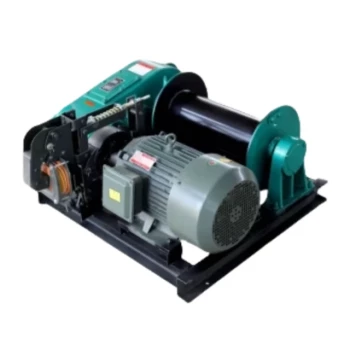
At its core, a basic hydraulic winch is a system for converting fluid pressure into immense pulling force. The main mechanical components housed within the winch unit itself are the hydraulic motor, a planetary gearbox, a drum to hold the cable, a multi-disc brake, and a support shaft. These parts work in concert, powered by an external hydraulic system.
The key to understanding a hydraulic winch is to see it not as a single device, but as the final stage of a larger power system that leverages your vehicle's running engine to perform continuous, heavy-duty work.

The Hydraulic Power System: The Engine's Extension
Before the winch can do any work, it needs a source of high-pressure fluid. This power doesn't come from a battery but is generated by the vehicle's main engine.
The Power Source and Pump
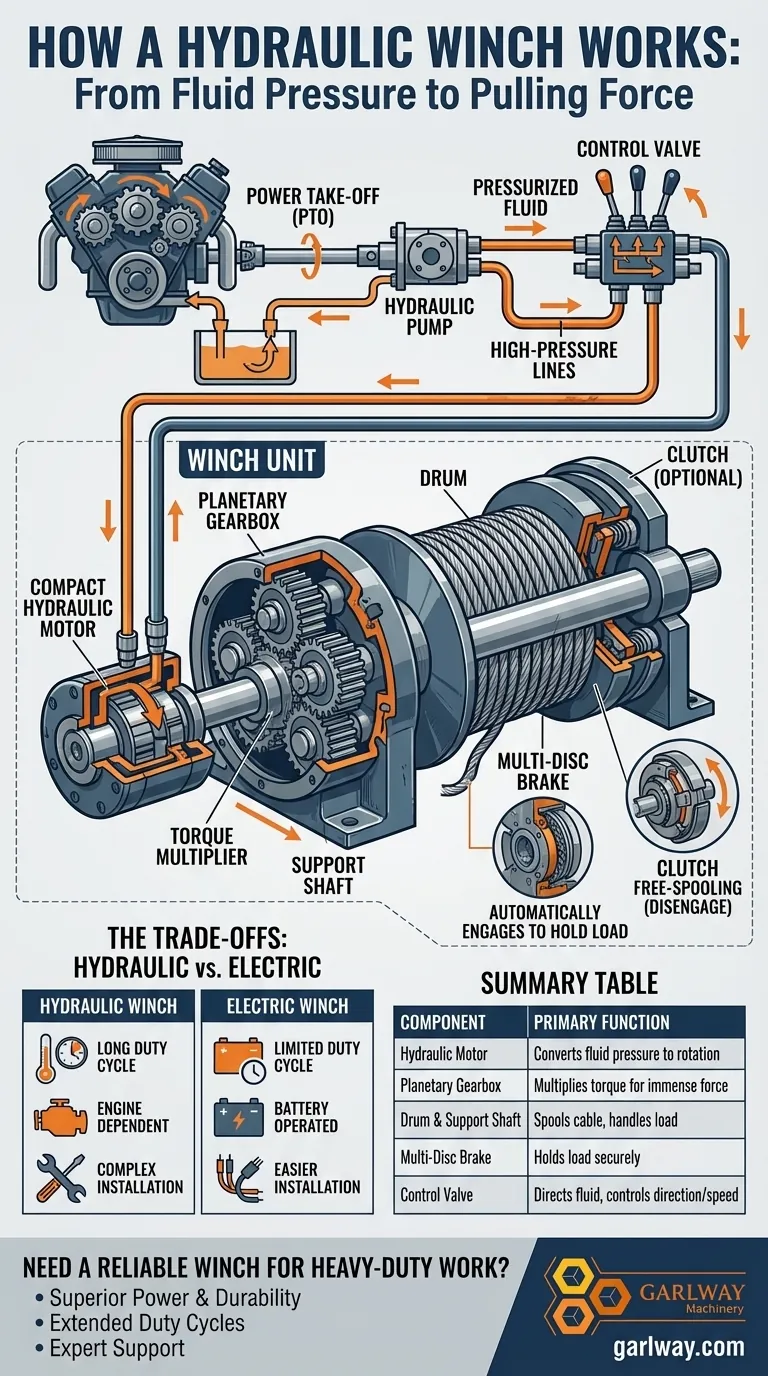
A hydraulic winch taps into the vehicle's power through a Power Take-Off (PTO) unit on the transmission or directly via the power steering pump. This rotational energy drives a hydraulic pump, which is the true start of the system.
The pump's job is to draw hydraulic fluid from a tank or reservoir and pressurize it.
High-Pressure Lines and Control Valve
This pressurized fluid travels through high-pressure lines to a control valve. This valve, often operated by levers, is the user's interface with the winch.
By manipulating the valve, an operator can direct the flow of hydraulic fluid, controlling the winch's direction (in or out) and speed.
The Winch Unit: Converting Fluid to Force
Once the pressurized fluid reaches the winch unit, the mechanical components take over to perform the actual pulling.
The Hydraulic Motor
The hydraulic motor is the heart of the winch. It's a precision-built component that converts the pressure and flow of the hydraulic fluid into rotational motion, much like a water wheel turns from the flow of a river.
The Planetary Gearbox
The raw speed from the motor is too fast and lacks the necessary torque for heavy pulling. The motor's output shaft connects to a planetary gearbox (or gear train).
This set of gears acts as a torque multiplier. It drastically reduces the rotational speed while massively increasing the rotational force, providing the raw power needed to pull heavy loads.
The Drum and Support Shaft
The slow, high-torque rotation from the gearbox turns the drum. The drum is the large cylinder that the steel cable or synthetic rope is spooled onto. It is supported by a robust support shaft.
The Braking System
For safety, a closed multi-disc brake is integrated into the system, often inside the drum itself. This brake automatically engages when hydraulic pressure is removed, securely holding the load in place and preventing it from slipping.
The Clutch (Optional)
Many winches include a clutch. When disengaged, the clutch disconnects the drum from the gearbox, allowing it to spin freely. This is used to quickly pull out the cable by hand before a pull, a process known as "free-spooling."
Understanding the Trade-offs: Hydraulic vs. Electric
The design of a hydraulic winch creates distinct advantages and disadvantages compared to its more common electric counterpart.
The Power and Duty Cycle Advantage
Because they are powered by the vehicle's engine and cooled by the circulating hydraulic fluid, hydraulic winches can pull for very long periods without overheating. This long duty cycle makes them ideal for industrial, recovery, or commercial applications where sustained power is critical.
The Installation Complexity
The primary trade-off is complexity. Installing a hydraulic winch requires tapping into the vehicle's power steering or transmission, running high-pressure lines, and ensuring the pump and fluid reservoir are correctly sized. This is generally a more involved process than wiring an electric winch to a battery.
The Engine Dependency
A hydraulic winch will only operate when the vehicle's engine is running, as the engine powers the hydraulic pump. While an electric winch can operate off the battery for short periods with the engine off, a stalled engine renders a hydraulic winch inoperable.
Making the Right Choice for Your Goal
Selecting the right type of winch depends entirely on your intended application and how you value power versus simplicity.
- If your primary focus is heavy, continuous use: A hydraulic winch is superior due to its long duty cycle and resistance to overheating in commercial or recovery scenarios.
- If your primary focus is simplicity and occasional use: An electric winch is often easier to install and provides more than enough power for recreational off-roading or intermittent tasks.
Understanding these core components allows you to look beyond the winch itself and evaluate the entire system for the power and reliability your work demands.
Summary Table:
| Component | Primary Function |
|---|---|
| Hydraulic Motor | Converts fluid pressure into rotational motion. |
| Planetary Gearbox | Multiplies torque for immense pulling force. |
| Drum & Support Shaft | Spools the cable and handles the load. |
| Multi-Disc Brake | Automatically holds the load securely when not in use. |
| Control Valve | Directs fluid flow to control winch direction and speed. |
Need a reliable winch for heavy-duty, continuous work?
GARLWAY specializes in robust construction machinery, including hydraulic winches designed for the toughest jobs. Our winches are built for construction companies and contractors who demand power that won't quit.
Partner with GARLWAY to get:
- Superior Power & Durability: Engineered for maximum pulling force and long-term reliability.
- Extended Duty Cycles: Perform continuous work without overheating, ideal for commercial and recovery applications.
- Expert Support: From selection to installation, our team ensures you get the right solution for your project.
Let's discuss your specific needs. Contact our experts today for a consultation and discover the GARLWAY difference.
Visual Guide
Related Products
- Hydraulic Winding Engine Harbor Freight Winch
- Electric and Hydraulic Winch for Heavy Duty Applications
- Small Electric Winch 120V and 240V for Compact Applications
- Electric 120V Boat Winch by Badlands
- 12000 lb Electric Boat Trailer Winch with Windlass Anchor Warn
People Also Ask
- What role does hydraulic fluid play in hydraulic winches? It's the Lifeblood of Your Heavy-Duty Pulling Power
- What vehicles commonly use hydraulic winches? For Industrial Trucks Needing Unmatched Power
- What are the features of hydraulic winches? Unmatched Power and Continuous Duty for Heavy Loads
- What preventive measures can be taken to avoid oil leakage in hydraulic winches? Ensure Long-Term Reliability
- What does 'power out' mean in a hydraulic winch? Achieve Absolute Control When Lowering Heavy Loads