
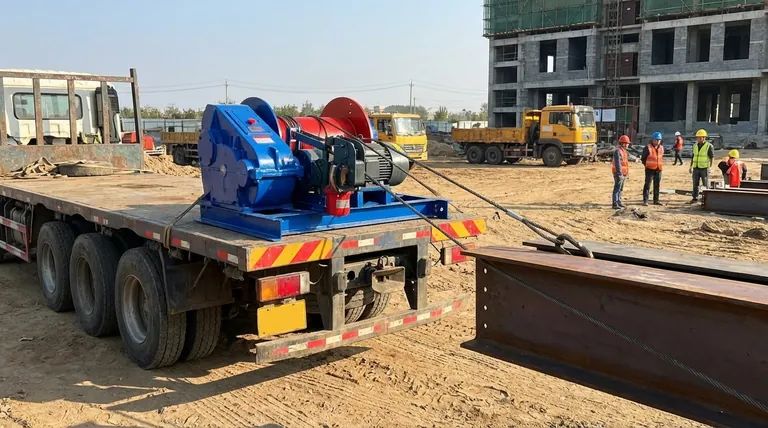
At its core, an electric winch is a compact and versatile pulling machine defined by its reliance on an electrical power source. Its primary characteristics include a high power-to-size ratio, operational simplicity, and the ability to be easily mounted on vehicles or structures, making it a go-to tool for lifting, pulling, and towing heavy loads.
An electric winch is fundamentally a force multiplier. It uses the electrical energy from a battery to power a motor through a gear reduction system, converting high-speed, low-torque rotation into the low-speed, high-torque force needed to pull immense weight.
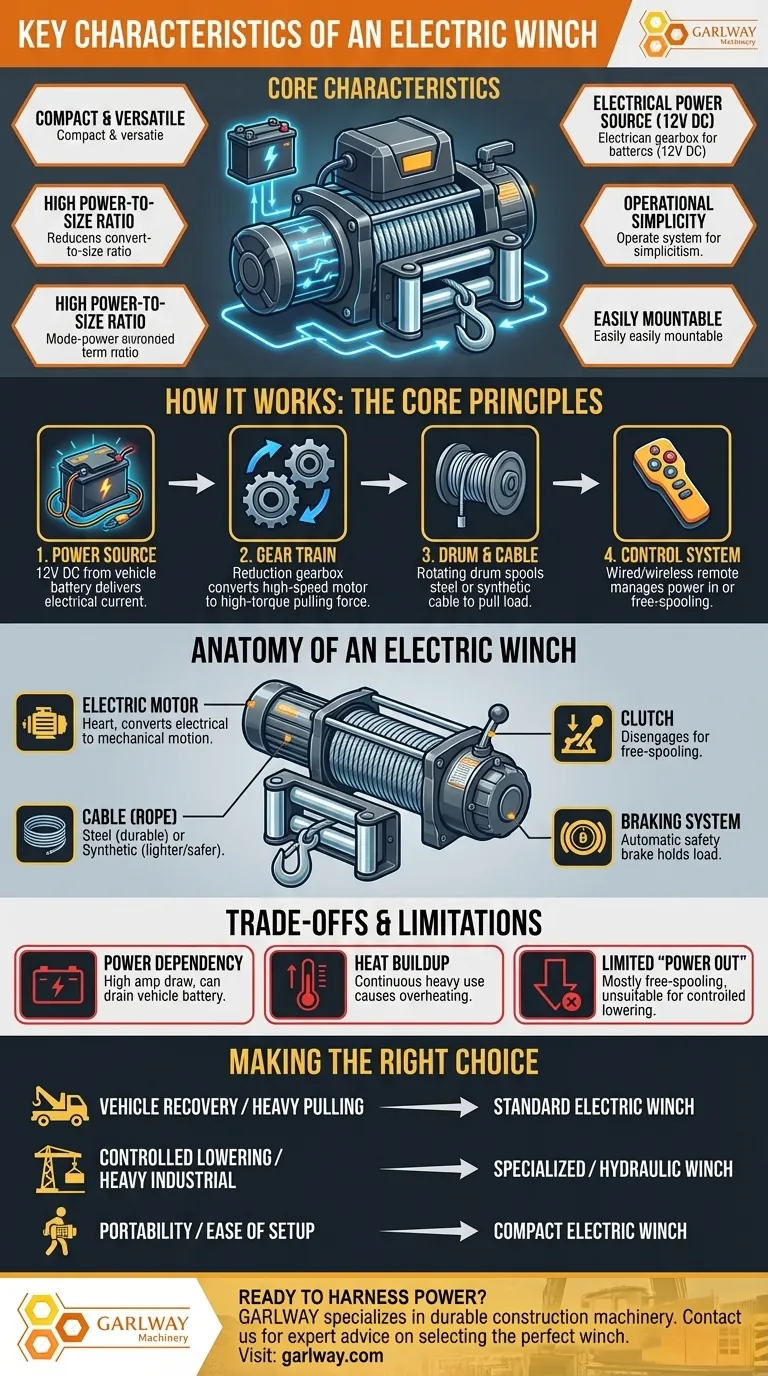
How an Electric Winch Works: The Core Principles
Understanding an electric winch begins with grasping how it converts electrical current into mechanical pulling power. The process is a straightforward application of electromechanical principles.
The Power Source
The vast majority of electric winches, especially those used for vehicles, are designed to run on a 12-volt DC power supply. This allows them to connect directly to a car or truck battery, providing significant power in a portable package.
The Gear Train
The electric motor spins at a very high RPM but with relatively low torque. A reduction gearbox is used to translate this speed into power, employing high gear ratios to slow the output speed while dramatically increasing the pulling force (torque).
The Drum and Cable
The gearbox turns a cylindrical drum, onto which a steel or synthetic cable is wound. As the drum rotates, it spools the cable, pulling the attached load. The size of the drum influences both winding speed and the total length of cable it can hold.
The Control System
Operation is typically managed through a wired or wireless remote control. This allows the user to stand at a safe distance while engaging the motor to either power in (reel the cable in) or release the clutch for freewheeling (allowing the cable to be pulled out manually).
Anatomy of an Electric Winch: Key Components
While designs vary, every electric winch is built around a set of essential components that work in unison.
The Electric Motor
This is the heart of the winch, responsible for converting electrical energy from the battery into the mechanical motion that drives the gear train.
The Cable (Rope)
The pulling line can be either traditional steel wire or modern synthetic rope. Steel is highly durable and abrasion-resistant, while synthetic rope is lighter, safer if it snaps, and easier to handle.
The Clutch
The clutch disengages the drum from the gearbox. This allows for "free spooling," where the cable can be pulled out by hand quickly without running the motor, saving time and battery power.
The Braking System
A critical safety feature, an automatic brake engages the moment the motor stops. This prevents the drum from releasing under load, securely holding the object being pulled.
Understanding the Trade-offs and Limitations
While incredibly useful, electric winches have inherent operational limitations that are crucial to understand for safe and effective use.
Power Dependency
An electric winch places a significant demand on the power source. During heavy pulls, it can draw hundreds of amps, rapidly draining a vehicle's battery if the engine is not running to power the alternator.
Heat Buildup
The electric motor generates substantial heat under load. Continuous, heavy use without a cool-down period can lead to overheating, which can permanently damage the motor and reduce its lifespan.
Limited "Power Out" Functionality
Most electric winches do not have a powered reverse ("power out"). Releasing the line is typically done by free-spooling. This makes them unsuitable for tasks that require the slow, controlled lowering of a heavy load.
Making the Right Choice for Your Application
Selecting the right equipment depends entirely on the intended task.
- If your primary focus is vehicle recovery or occasional heavy pulling: The standard electric winch is an ideal tool, as it integrates directly with your vehicle's power system and provides immense on-demand pulling power.
- If your primary focus is controlled lowering or frequent, heavy industrial use: You should seek out a specialized winch with a dedicated "power out" feature or consider hydraulic alternatives that are better suited for continuous duty cycles.
- If your primary focus is portability and ease of setup: The compact, lightweight nature of many electric winches makes them a superior choice for tasks requiring quick deployment and transfer between locations.
Ultimately, the electric winch excels by providing a powerful, simple, and self-contained pulling solution for a vast range of applications.
Summary Table:
| Key Characteristic | Description |
|---|---|
| Power Source | Typically 12V DC, connects directly to a vehicle battery. |
| Core Mechanism | Electric motor drives a gear train to convert speed into high pulling force (torque). |
| Primary Function | Lifting, pulling, and towing heavy loads via a cable wound on a drum. |
| Key Components | Electric motor, cable (steel or synthetic), clutch, automatic brake. |
| Main Limitation | High battery drain and potential for motor overheating during continuous heavy use. |
Ready to harness the power of an electric winch for your projects?
GARLWAY specializes in durable and high-performance construction machinery. Our range of electric winches is engineered for reliability and power, making them the ideal choice for construction companies and contractors who demand equipment they can count on.
Let us help you select the perfect winch for your specific lifting, pulling, and towing needs.
Contact GARLWAY today for expert advice and to discover how our solutions can enhance your operational efficiency and safety.
Visual Guide
Related Products
- Electric 120V Boat Winch by Badlands
- Electric and Hydraulic Winch for Heavy Duty Applications
- Small Electric Winch 120V and 240V for Compact Applications
- 12000 lb Electric Boat Trailer Winch with Windlass Anchor Warn
- Electric Hoist Winch Boat Anchor Windlass for Marine Applications
People Also Ask
- How do electric boat winches work? Unlock Effortless Launching & Retrieval
- How much current does an electric boat winch draw? Plan Your Electrical System for Peak Performance
- Can I run a winch straight from a battery? Essential Power Setup for Safe Operation
- What are the types of electric winches available? Choose the Right Winch for Your Job
- What are the uses of electric winches in mining and tunneling? Enhance Safety and Efficiency Underground





