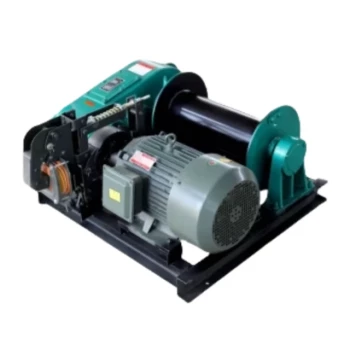
At its core, a winch for lifting engineering is a device designed to exert significant pulling force through a rope or cable spooled on a drum. Its primary characteristics are a large traction force for moving heavy loads, a compact and versatile structure, and an operational focus on safety, reliability, and precise control.
The true value of a winch in a professional lifting context is not just its raw power, but its ability to apply that power with exceptional control and safety, ensuring heavy loads can be moved precisely and reliably.
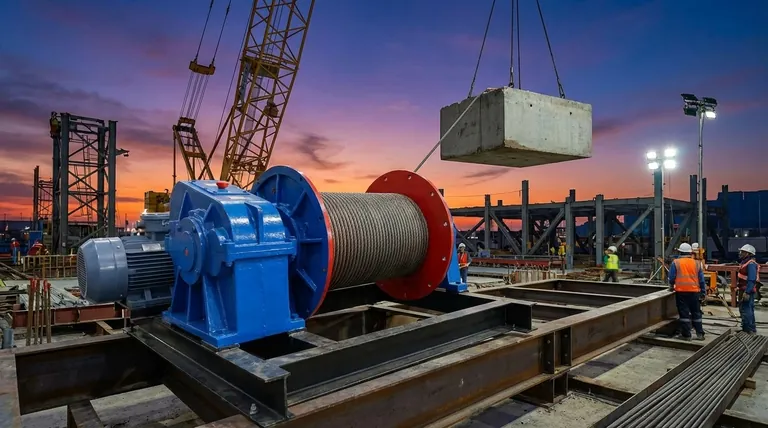
How a Winch Achieves Its Core Function
A winch operates on a simple yet powerful mechanical principle. Understanding this is key to appreciating its characteristics.
The Drum and Rope Mechanism
A winch uses a rope or cable anchored to a rotating drum. One end of the rope is attached to the load that needs to be moved.
When the drum is powered to turn, it either winds the rope in (spooling) or lets it out (unspooling). This action creates immense tension in the line, which is used to pull loads horizontally, lift them vertically, or move them along an incline.
The Power Source
While historically powered by hand or hydraulics, the modern standard in lifting engineering is the electric winch. This preference is due to the significant advantages in control, efficiency, and safety offered by electric motors.
The Defining Characteristics in Detail
Several key features distinguish a professional-grade lifting winch from a simple pulling device.
Large Traction Force
This is the winch's primary purpose. It is engineered to generate a substantial pulling force, measured in tons, enabling it to move loads that would otherwise be impossible to handle.
Compact and Versatile Structure
Despite their power, winches have a relatively small physical footprint. This compact design allows them to be installed in a wide variety of locations and integrated into complex lifting systems on construction sites, in factories, or on marine vessels.
Ease of Operation and Precise Control
Modern electric winches offer exceptional control over the load. Operators can manage speed with high precision, allowing for smooth starts and stops that prevent jarring or swinging. Remote control capabilities are also common, increasing operator safety and visibility.
Unwavering Safety and Reliability
In lifting engineering, failure is not an option. Winches are built with safety as a top priority, often incorporating features like braking systems that automatically engage if power is lost. Their robust construction ensures reliability under demanding conditions.
Understanding the Trade-off: Speed vs. Control
While some winches are capable of high speeds, this is often secondary in a lifting context. The real priority is control.
The "High Speed" Capability
A winch may be rated for high-speed operation, which can be useful for quickly paying out cable or retracting an unloaded line. This capability contributes to overall operational efficiency.
The "Slow Speed" Priority
However, for the actual lifting of a heavy load, slow-speed operation is generally used. Moving a multi-ton object requires deliberate, steady motion. Slow speeds provide the precision needed to place a load accurately and, most importantly, prevent dangerous shock loading or instability.
Why Electric Winches Dominate
The shift to electric winches is driven by clear operational advantages that align perfectly with the demands of modern engineering.
Superior Control and Efficiency
Electric motors offer variable speed control that is far more precise than other power sources. They are also more energy-efficient, consuming power only when in operation, which reduces running costs.
Lower Maintenance and Environmental Impact
With fewer moving parts than hydraulic or combustion-powered systems, electric winches require less maintenance. They also produce no emissions and operate quietly, making them ideal for a wider range of environments.
Making the Right Choice for Your Application
Selecting a winch requires matching its characteristics to your primary goal.
- If your primary focus is heavy, precision-critical lifts: Prioritize winches with excellent variable speed control, robust safety features, and a proven record of reliability over raw speed.
- If your primary focus is rapid material transfer with lighter loads: A winch with a higher speed rating may be suitable, but ensure its control and braking systems are still certified for lifting operations.
- If your primary focus is operational efficiency and versatility: An electric winch is the definitive choice for its precision, low maintenance, and environmental benefits.
Ultimately, a winch's value in lifting engineering is defined by its ability to deliver immense power with the utmost precision and safety.
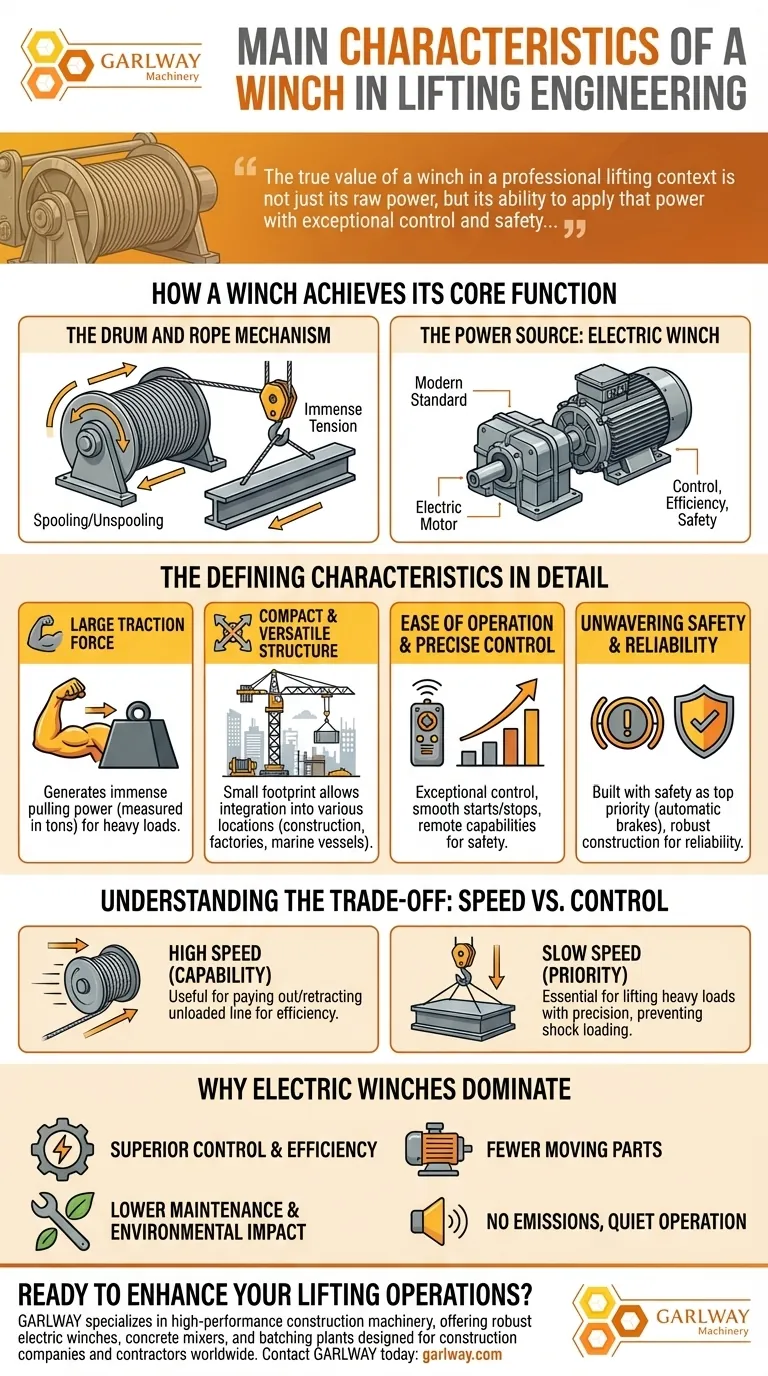
Summary Table:
| Key Characteristic | Description |
|---|---|
| Large Traction Force | Generates immense pulling power, measured in tons, for moving heavy loads. |
| Compact & Versatile | Small footprint allows integration into various sites like construction or marine vessels. |
| Precise Control | Electric motors enable smooth, variable speed operation for accurate load placement. |
| Safety & Reliability | Built with automatic brakes and robust construction to prevent failure under demanding conditions. |
Ready to enhance your lifting operations with precision and power?
GARLWAY specializes in high-performance construction machinery, offering robust electric winches, concrete mixers, and batching plants designed for construction companies and contractors worldwide. Our winches deliver the perfect balance of immense traction force and precise control, ensuring your projects are completed safely and efficiently.
Contact GARLWAY today to discuss your specific needs and discover how our reliable equipment can drive your success!
Visual Guide
Related Products
- Warn Winch Windlass Boat Trailer Winch
- Electric and Hydraulic Winch for Heavy Duty Applications
- Small Electric Winch 120V and 240V for Compact Applications
- Hydraulic Winding Engine Harbor Freight Winch
- Quick Windlass Portable Winch for Truck and Boat Best Boat Winch
People Also Ask
- What are the main components of a boat trailer winch? A Guide to Safe & Efficient Boat Loading
- What factors should be considered when choosing a boat trailer winch? Ensure Safe and Effortless Boat Loading
- What is the purpose of boat trailer winches? Safely and Efficiently Load Your Boat
- What are the two main types of boat trailer winches? Manual vs. Electric Explained
- How often should a boat trailer winch be replaced? Your Guide to Safety and Longevity