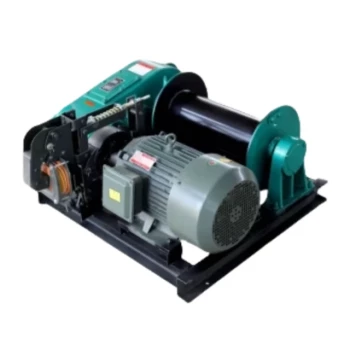
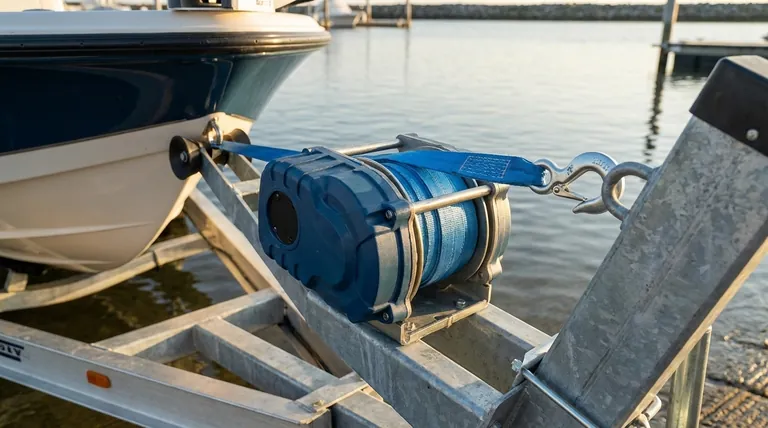
At its core, a boat trailer winch is a mechanical system designed for one purpose: providing the pulling power necessary to move your boat onto its trailer. It consists of a power source (either a manual crank or an electric motor), a gear system for mechanical advantage, a drum to hold the line, and a strap or cable that connects to the boat.
A winch is more than just a collection of parts; it's a critical safety system. Understanding how each component contributes to the whole is essential for selecting the right winch, ensuring proper installation, and operating it safely.
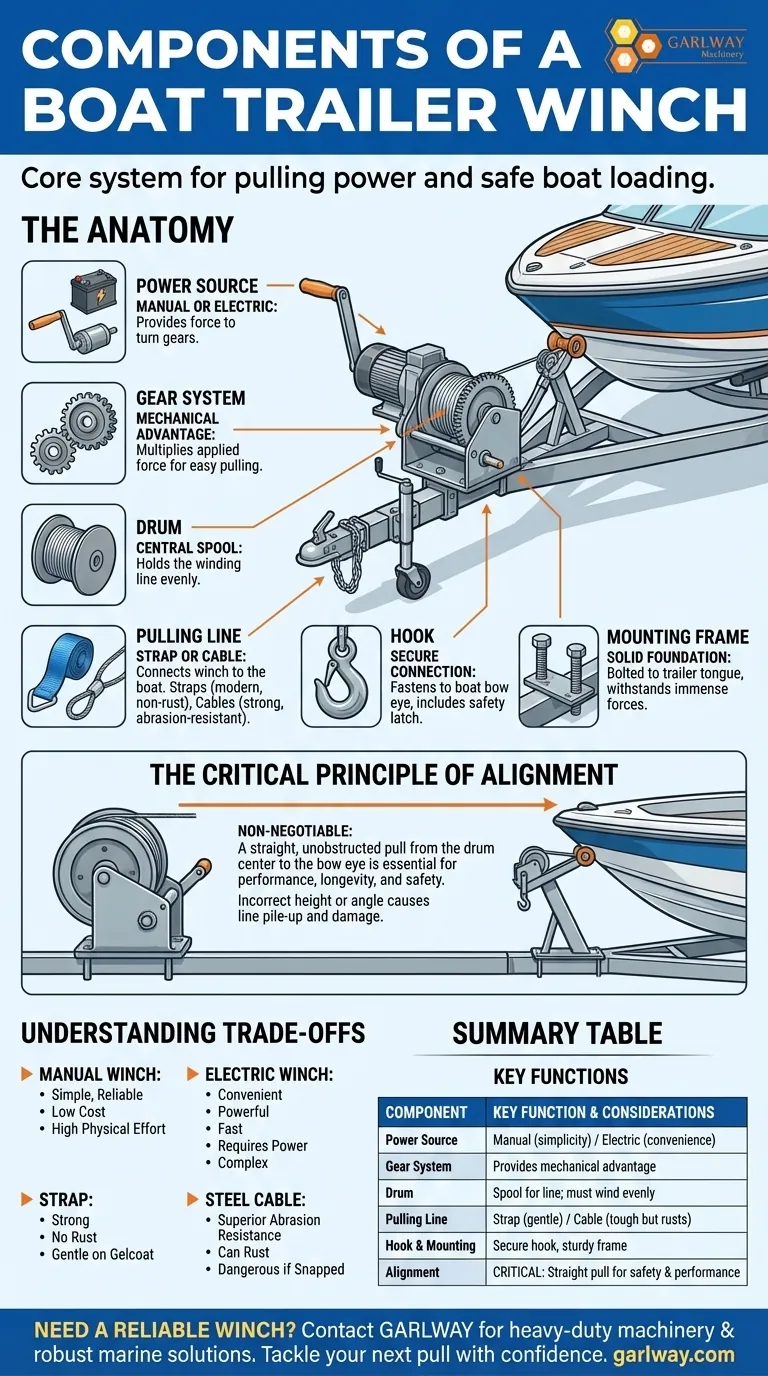
The Anatomy of a Boat Trailer Winch
A winch may seem simple, but each of its primary components plays a distinct and crucial role in its operation.
The Power Source: Manual vs. Electric
The most fundamental choice is how the winch is powered. A manual winch uses a hand-cranked handle to turn the gears. An electric winch uses a 12-volt motor, powered by the tow vehicle's battery, to do the work for you. Many electric models also include a wireless remote for added convenience.
The Gear System
This is the hidden hero of the winch. A system of internal gears creates mechanical advantage, multiplying the force you apply to the handle (or the force from the motor). This is what allows a person to pull a multi-thousand-pound boat with relative ease.
The Drum
The drum is the central spool that the winch strap or cable winds onto. Proper function depends on the line winding evenly across the drum's surface during retrieval.
The Pulling Line: Strap vs. Cable
This is the component that physically connects to the boat.
- Straps are flat, woven polyester lines that are strong, less likely to mar the boat's finish, and do not rust.
- Steel cables are exceptionally strong and abrasion-resistant but can develop rust and dangerous frayed wires ("burrs") over time.
The Hook
At the end of the strap or cable is a heavy-duty hook, which fastens to your boat's bow eye. A quality hook will include a spring-loaded safety latch to prevent it from accidentally disconnecting during the loading process.
The Mounting Frame
The entire winch assembly is bolted to a sturdy frame or stand. This stand is then securely bolted to the trailer's tongue, creating the solid foundation needed to withstand the immense forces of pulling the boat.
The Critical Principle of Alignment
The effectiveness and longevity of your winch system depend almost entirely on proper alignment. All components must work in a perfectly straight line.
Why a Straight Pull is Non-Negotiable
The winch must be positioned so the strap or cable pulls directly from the center of the drum in a straight, unobstructed line to the boat's bow eye. Any angle will cause the line to pile up on one side of the drum, which can damage the strap and the winch itself.
Matching Winch Height to the Bow Eye
The height of the winch post is also critical. The winch should be mounted so the strap pulls level with the bow eye. If it's too high, it will pull the bow down; if it's too low, it will pull the bow up, hindering a smooth loading process onto the trailer's bunks or rollers.
Understanding the Trade-offs
Choosing a winch involves balancing convenience, power, and maintenance.
Manual Winch: Simplicity and Reliability
The primary advantage of a manual winch is its simplicity. With fewer moving parts, there are fewer things that can break. They require no electrical wiring and are significantly less expensive. The obvious trade-off is the physical effort required.
Electric Winch: Convenience and Power
For larger, heavier boats, an electric winch is nearly essential. It makes loading effortless and much faster. However, it requires a power source, proper wiring, and is more complex, meaning more potential points of failure and a higher initial cost.
Strap vs. Steel Cable
Straps are the modern standard for most recreational boats. They are strong, don't rust, and are gentle on the boat's gelcoat. Steel cables offer superior resistance to abrasion but can be dangerous if they snap under load and require careful inspection for rust and broken strands.
Making the Right Choice for Your Boat
Your decision should be based on your boat's size and your personal priorities.
- If your primary focus is a small boat (under 2,000 lbs) or affordability: A single-speed manual winch with a strap is the most reliable and cost-effective solution.
- If your primary focus is a large, heavy boat or maximum convenience: An electric winch is the clear winner, saving you significant physical strain and making loading much safer.
- If your primary focus is durability in rugged conditions: A high-quality, UV-resistant strap is generally the best all-around choice, but a galvanized steel cable may be considered for its abrasion resistance if you frequently launch in rough areas.
Understanding how these components function as a system empowers you to select, install, and operate your winch with confidence.
Summary Table:
| Component | Key Function & Considerations |
|---|---|
| Power Source | Manual (crank) for simplicity; Electric (motor) for heavy boats/convenience. |
| Gear System | Provides mechanical advantage to pull heavy loads with less effort. |
| Drum | Spool for the line; must wind evenly for proper function and longevity. |
| Pulling Line | Strap (gentle on boat, no rust) or Steel Cable (abrasion-resistant but can rust). |
| Hook & Mounting | Secure hook with safety latch; sturdy frame bolted to the trailer tongue. |
| Alignment | Critical: A straight pull from drum to bow eye ensures safety and performance. |
Need a Reliable Winch for Your Construction or Marine Project?
At GARLWAY, we specialize in heavy-duty machinery, including robust winches built for demanding applications. Whether you're a contractor needing equipment for a job site or require a powerful solution for marine operations, our expertise ensures you get the right product for performance, safety, and durability.
Let us help you tackle your next big pull with confidence.
Contact GARLWAY today for a consultation and discover the right winch solution for your needs.
Visual Guide
Related Products
- 12000 lb Electric Boat Trailer Winch with Windlass Anchor Warn
- Warn Winch Windlass Boat Trailer Winch
- Electric 120V Boat Winch by Badlands
- 12000 lb Heavy Duty Electric Boat Winch
- Quick Windlass Portable Winch for Truck and Boat Best Boat Winch
People Also Ask
- How does an electric boat trailer winch differ from a manual one? Effort vs. Control Explained
- What size winch do I need for my boat? Get the Right Capacity for Safe Hauling
- How should a boat trailer winch be properly used? A Step-by-Step Guide for Safe Loading
- What maintenance steps are specific to boat trailer winches? Ensure Safety & Reliability at the Ramp
- How strong of a winch do I need for my boat? Get the Right Pulling Power for Trailering & Anchoring