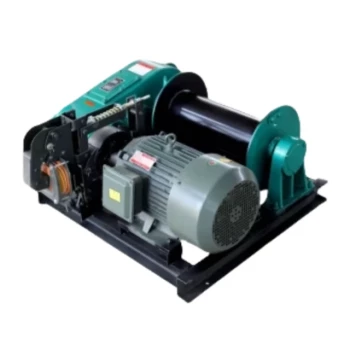
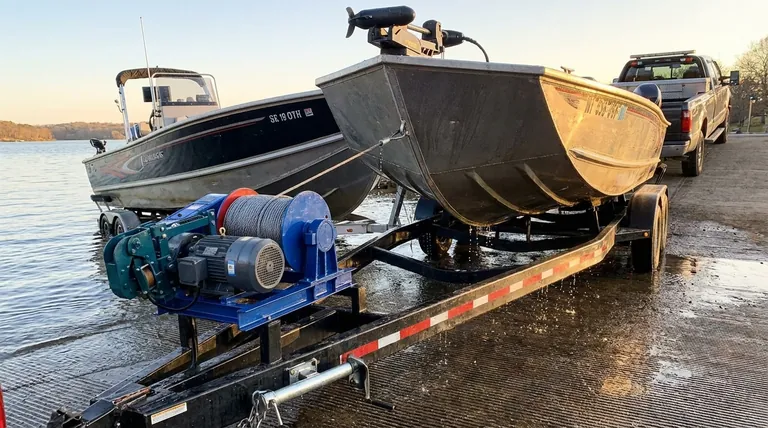
When it comes to securing your vessel to its trailer, the mechanism doing the work falls into one of two primary categories. The two main types of boat trailer winches are manual winches, which operate using a hand crank, and electric winches, which use a 12-volt motor powered by your tow vehicle. Manual winches depend on your physical effort, while electric winches automate the retrieval process with the push of a button.
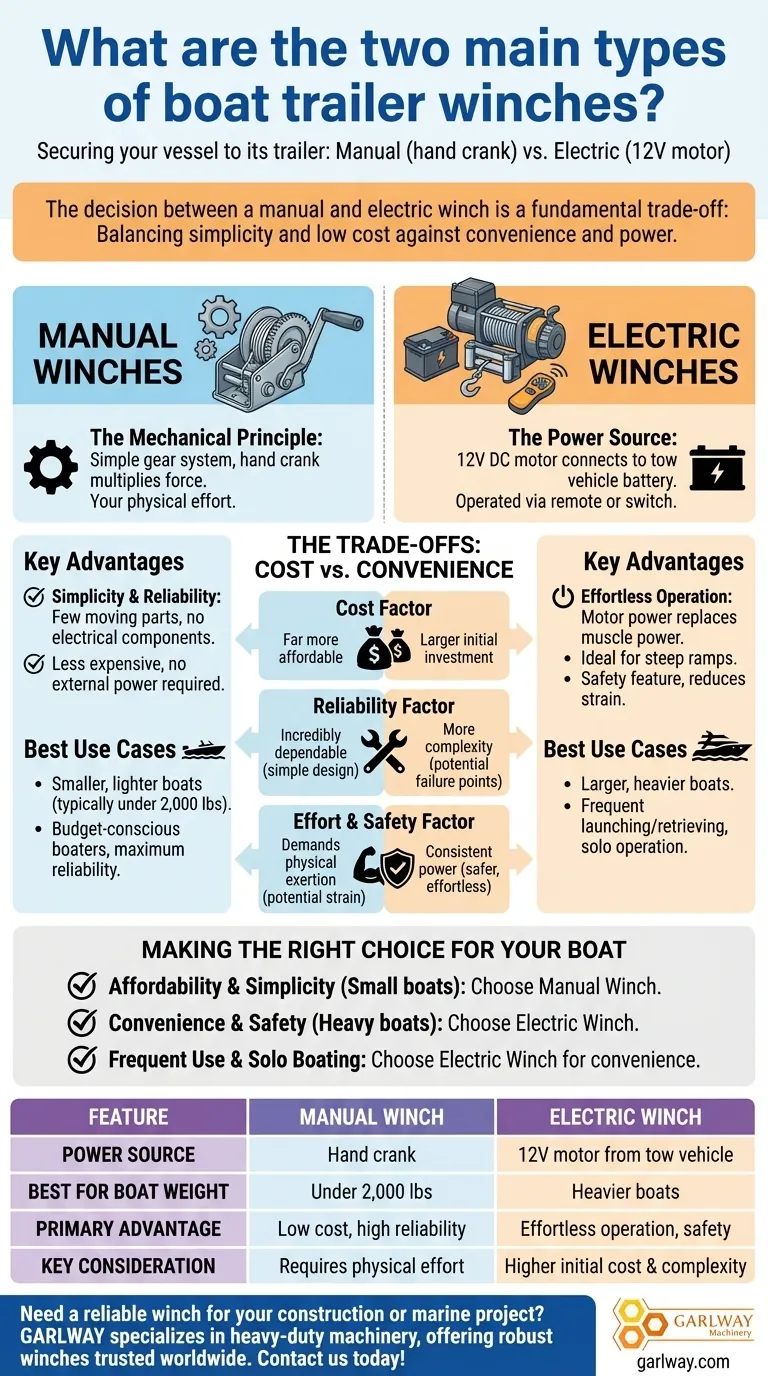
The decision between a manual and electric winch is not about which is universally "better," but about a fundamental trade-off. You are balancing the simplicity and low cost of a manual winch against the convenience and power of an electric one.
Understanding Manual Winches
A manual winch is the classic, time-tested solution for boat retrieval. Its design is straightforward, relying on mechanical advantage and your physical input to get the job done.
The Mechanical Principle
Manual winches operate using a simple gear system. Turning the hand crank engages a set of gears that multiply your force, making it possible to pull a heavy boat onto the trailer with manageable effort.
Key Advantages
The primary strengths of a manual winch are its simplicity and reliability. With fewer moving parts and no electrical components, there is very little that can break down. They are also significantly less expensive and require no external power source.
Best Use Cases
Manual winches are an excellent fit for smaller, lighter boats (typically under 2,000 lbs). They are also the go-to choice for boaters on a budget or those who value maximum reliability above all else.
Understanding Electric Winches
Electric winches replace muscle power with motor power, transforming the boat retrieval process from a physical task into a simple, automated one.
The Power Source
These winches are powered by a 12V DC motor that connects directly to your tow vehicle's battery. Operation is typically handled via a wired remote or a switch mounted on the winch itself.
Key Advantages
The most obvious benefit is effortless operation. An electric winch allows you to retrieve a heavy boat without breaking a sweat, which is especially valuable on steep or slick boat ramps. This automation can also be a significant safety feature, reducing physical strain and fatigue.
Best Use Cases
Electric winches are almost essential for larger, heavier boats. They are also a significant quality-of-life upgrade for anyone who launches and retrieves their boat frequently or often operates solo.
The Trade-offs: Cost vs. Convenience
Choosing the right winch requires a clear understanding of what you are gaining and what you are giving up with each option.
The Cost Factor
There is a significant price difference. Manual winches are far more affordable upfront. Electric winches represent a larger initial investment, and may sometimes require professional installation.
The Reliability Factor
A manual winch's simple mechanical design makes it incredibly dependable. An electric winch introduces more complexity—wiring, switches, and a motor—which creates more potential points of failure over its lifetime.
The Effort & Safety Factor
While a manual winch is reliable, it demands physical exertion. On a steep ramp with a heavy boat, this can lead to strain or accidents. An electric winch provides consistent power, making difficult retrievals safer and more predictable.
Making the Right Choice for Your Boat
Your boat's size, your budget, and how you use your vessel will determine the best winch for your needs.
- If your primary focus is affordability and simplicity: A manual winch is the most reliable and cost-effective solution for smaller boats.
- If your primary focus is convenience and safety with a heavier boat: An electric winch is a necessary investment that removes physical strain and makes retrievals much easier.
- If you launch frequently or often go boating alone: The sheer convenience of an electric winch will drastically improve your experience at the boat ramp.
Ultimately, choosing the right winch ensures your time at the ramp is as stress-free as your time on the water.
Summary Table:
| Feature | Manual Winch | Electric Winch |
|---|---|---|
| Power Source | Hand crank | 12V motor from tow vehicle |
| Best For Boat Weight | Under 2,000 lbs | Heavier boats |
| Primary Advantage | Low cost, high reliability | Effortless operation, safety |
| Key Consideration | Requires physical effort | Higher initial cost & complexity |
Need a reliable winch for your construction or marine project? GARLWAY specializes in heavy-duty machinery, offering robust winches, concrete mixers, and batching plants trusted by construction companies and contractors worldwide. Let our experts help you select the perfect equipment for your needs. Contact us today for a personalized solution!
Visual Guide
Related Products
- 12000 lb Electric Boat Trailer Winch with Windlass Anchor Warn
- Warn Winch Windlass Boat Trailer Winch
- Electric 120V Boat Winch by Badlands
- 12000 lb Heavy Duty Electric Boat Winch
- Quick Windlass Portable Winch for Truck and Boat Best Boat Winch
People Also Ask
- How does an electric boat trailer winch differ from a manual one? Effort vs. Control Explained
- What size winch do I need for my boat? Get the Right Capacity for Safe Hauling
- How should a boat trailer winch be properly used? A Step-by-Step Guide for Safe Loading
- What maintenance steps are specific to boat trailer winches? Ensure Safety & Reliability at the Ramp
- How strong of a winch do I need for my boat? Get the Right Pulling Power for Trailering & Anchoring