
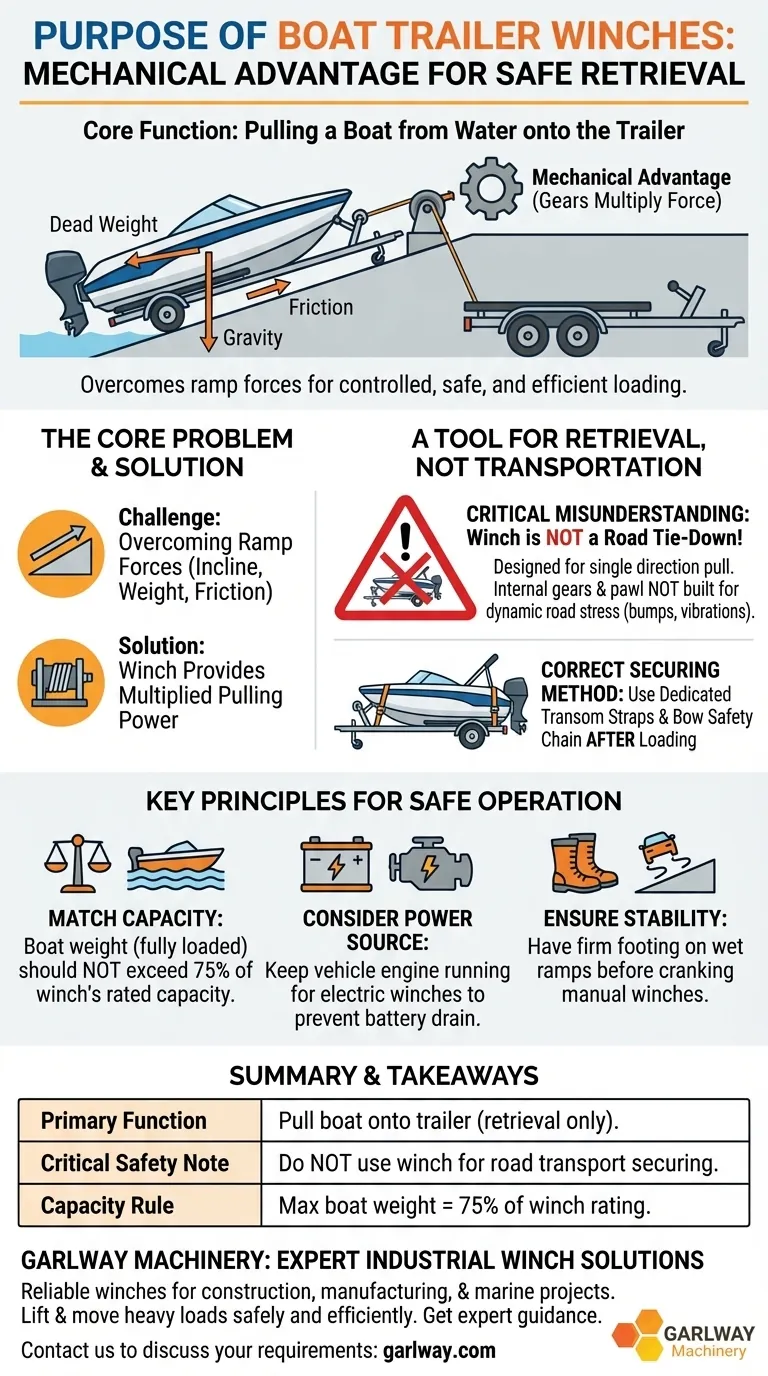
At its core, a boat trailer winch is a specialized mechanical tool with one primary purpose: to pull a boat from the water onto its trailer. It provides the mechanical advantage necessary to manage thousands of pounds of weight against the forces of gravity and friction, making the boat retrieval process safe, controlled, and efficient.
A boat trailer winch is an essential tool for loading a boat, but its job ends the moment the vessel is fully on the trailer. It is fundamentally a pulling device, not a securing device designed for the dynamic stresses of road travel.

The Core Problem: Overcoming Ramp Forces
To appreciate the purpose of a winch, you must first understand the physical challenge it solves. Retrieving a boat is a battle against powerful, competing forces.
The Challenge of the Launch Ramp
A boat launch ramp is an inclined plane. When you pull your boat out of the water, you are fighting against its dead weight, the gravitational pull from the ramp's angle, and the friction of the trailer bunks or rollers.
Doing this by hand would be incredibly strenuous and unsafe for all but the smallest watercraft.
How a Winch Provides Mechanical Advantage
A winch uses a system of gears to multiply force. A small amount of effort—either from you turning a handle or from a small electric motor—is translated into a massive amount of pulling power.
This allows a single person to carefully and methodically draw a heavy boat up the incline and into its correct position on the trailer.
A Tool for Retrieval, Not Transportation
One of the most critical misunderstandings about a boat trailer winch is its role after the boat is loaded. Confusing its function can lead to catastrophic failure.
The Winch Strap's Limited Job
The winch strap or cable is designed for a single, high-tension pull in one direction. Its job is to pull the boat forward until the bow rests securely against the trailer's bow stop.
Why Winches Fail as Tie-Downs
The internal gears and locking pawl of a winch are not designed to handle the violent, repetitive, and multidirectional forces of road travel. Bumps, vibrations, and sudden stops can cause the locking mechanism to slip or break entirely.
Relying on the winch to hold your boat in place during transit is a significant safety risk. The winch is simply not built for that kind of dynamic load.
The Necessity of Dedicated Tie-Downs
Once the boat is on the trailer and snug against the bow stop, the winch's work is done. You must then use separate, dedicated equipment—such as transom straps for the stern and a heavy-duty safety chain or turnbuckle for the bow—to secure the vessel for the road.
Key Principles for Safe Operation
Using a winch effectively requires understanding its limitations and adhering to best practices to ensure safety and equipment longevity.
Match Winch Capacity to Your Boat
A winch should never operate at its maximum limit. As a rule of thumb, your boat's total weight (including the engine, fuel, and gear) should not exceed 75% of the winch's rated capacity.
This safety margin ensures the winch can handle the load without excessive strain, especially on steeper ramps.
Consider the Power Source
Electric winches are convenient but draw significant power from your vehicle's battery. Always keep the vehicle's engine running during operation to prevent draining the battery.
For manual winches, ensure you have firm, stable footing on what is often a wet and slippery ramp surface before you begin cranking.
Making the Right Choice for Your Goal
To use your winch correctly, align your actions with the primary goals of safety and equipment preservation.
- If your primary focus is safety: Always use the winch strictly for loading, then secure your boat with separate, dedicated tie-down straps and a bow safety chain for transport.
- If your primary focus is equipment longevity: Select a winch with a capacity rating at least 25% greater than your boat's fully loaded weight to avoid over-straining its components.
- If your primary focus is retrieval efficiency: For electric winches, keep your tow vehicle's engine running to provide consistent power and prevent a dead battery at the ramp.
Understanding your winch as a specialized tool for a single task is the key to a safer and more seamless boating experience.
Summary Table:
| Aspect | Purpose & Key Takeaway |
|---|---|
| Primary Function | To pull a boat from the water onto the trailer using mechanical advantage. |
| Critical Safety Note | A winch is for retrieval only; it must not be used to secure the boat for road travel. |
| Correct Securing Method | After loading, use dedicated transom straps and a bow safety chain for transport. |
| Capacity Rule | Boat weight should not exceed 75% of the winch's rated capacity for safe operation. |
Need a Reliable Winch for Your Construction or Marine Project?
Just as a boat trailer winch is essential for safe boat retrieval, having the right industrial winch is critical for the success and safety of your construction, manufacturing, or marine operations.
GARLWAY specializes in engineering durable and powerful winches for a wide range of applications. Whether you're a contractor, a manufacturing plant manager, or managing a marine project, we provide solutions built for performance and safety.
Let us help you:
- Lift and move heavy loads safely with our robust winch systems.
- Increase worksite efficiency with reliable equipment designed for demanding environments.
- Get expert guidance in selecting the right winch capacity and features for your specific needs.
Don't compromise on safety or performance. Contact our experts today to discuss your requirements and discover the GARLWAY advantage.
Visual Guide
Related Products
- 12000 lb Electric Boat Trailer Winch with Windlass Anchor Warn
- Warn Winch Windlass Boat Trailer Winch
- Electric 120V Boat Winch by Badlands
- 12000 lb Heavy Duty Electric Boat Winch
- Quick Windlass Portable Winch for Truck and Boat Best Boat Winch
People Also Ask
- How does an electric boat trailer winch differ from a manual one? Effort vs. Control Explained
- What size winch do I need for my boat? Get the Right Capacity for Safe Hauling
- How should a boat trailer winch be properly used? A Step-by-Step Guide for Safe Loading
- What maintenance steps are specific to boat trailer winches? Ensure Safety & Reliability at the Ramp
- How strong of a winch do I need for my boat? Get the Right Pulling Power for Trailering & Anchoring




