
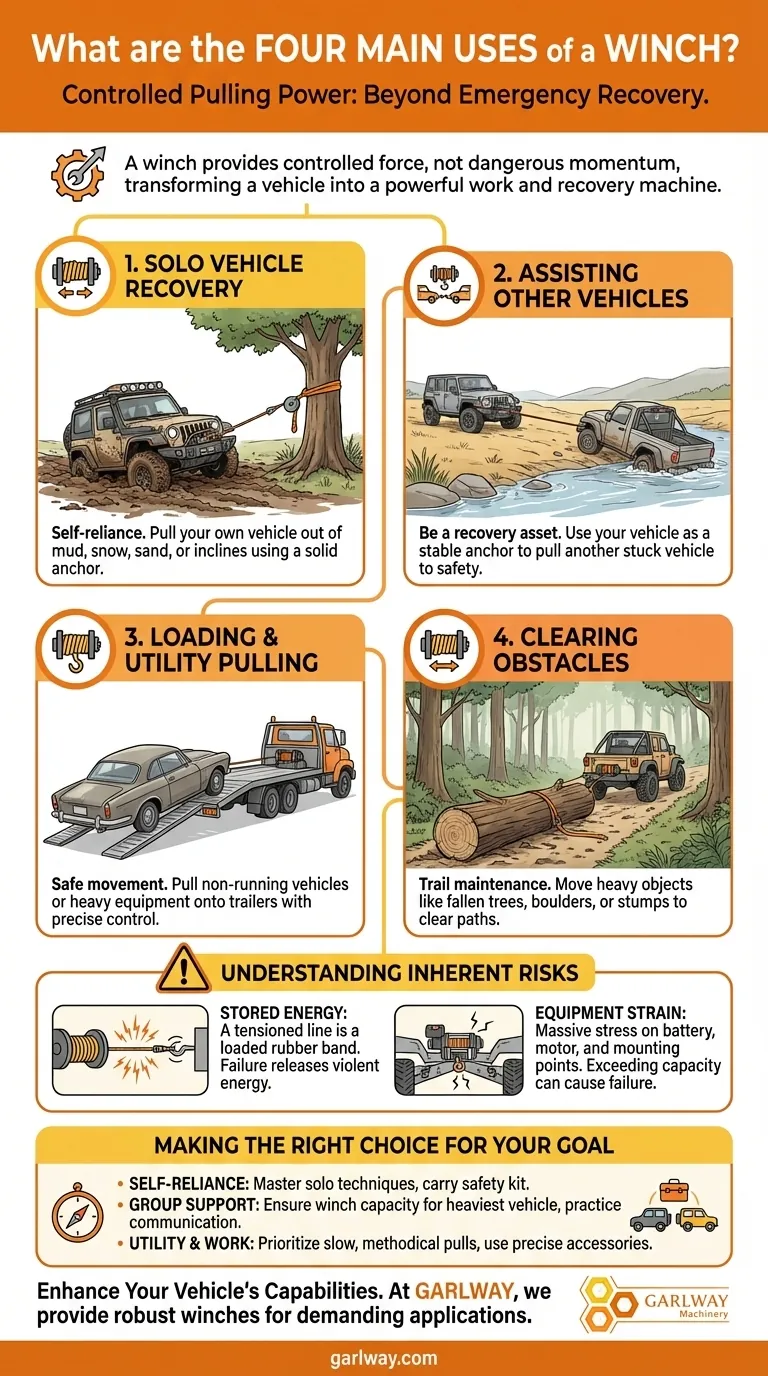
A winch is far more than an emergency tool for getting unstuck. Its core function is to provide controlled pulling power, which opens up four primary and distinct uses. The four main applications are self-recovery of your own vehicle, recovering another vehicle, loading vehicles or heavy equipment onto trailers, and moving heavy obstacles like fallen trees or boulders.
At its core, a winch transforms a vehicle from a simple mode of transport into a powerful work and recovery machine. It replaces dangerous momentum with slow, controlled force, giving you the ability to solve problems that would otherwise be impossible.
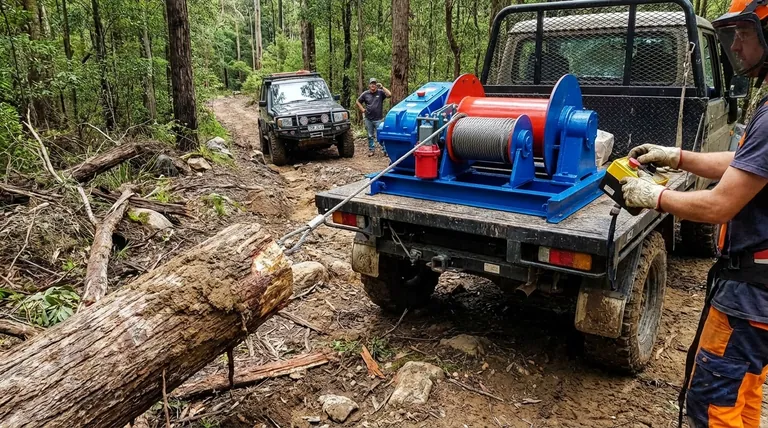
How a Winch Creates Controlled Power
Before exploring its uses, it's essential to understand how a winch works. It's not just a motor and a rope; it's a system designed for mechanical advantage.
The Key Components
A winch's power comes from a specific combination of parts. An electric motor provides the initial energy, but the real magic happens in the gear train.
This set of reduction gears amplifies the motor's high-speed, low-power output into a low-speed, high-torque force capable of pulling thousands of pounds. This force turns the drum, which spools the winch line (steel cable or synthetic rope) to perform the pull.
Force, Not Momentum
The fundamental advantage of a winch is its ability to apply immense, steady force. Trying to "rock" or "gun" a stuck vehicle often leads to wheel spin, digging you deeper and risking damage to your drivetrain.
A winch bypasses this entirely. It allows you to move a vehicle or object inches at a time with complete control, making it both safer and far more effective.
The Four Primary Applications Explained
Each of the four main uses leverages this controlled pulling force for a different strategic goal.
Application 1: Solo Vehicle Recovery
This is the most common and vital use for off-road enthusiasts. A winch provides self-reliance when you are stuck without another vehicle to help.
By finding a solid anchor point—like a large tree or a rock—you can pull your own vehicle out of deep mud, snow, sand, or a difficult incline.
Application 2: Assisting Other Vehicles
A winch allows you to become a recovery asset for others. You can use your vehicle as a stable anchor to pull another stuck vehicle to safety.
This requires a clear understanding of your winch's capacity and the weight of the other vehicle. A successful recovery here depends on proper rigging and communication.
Application 3: Loading and Utility Pulling
The winch serves as an excellent utility tool. Its most common use in this category is pulling a non-running vehicle or heavy equipment up the ramps and onto a trailer.
This application highlights the need for precise control, as you are guiding a heavy load in a confined space. It's far safer than trying to push or manually move such an object.
Application 4: Clearing Obstacles
On trails or private property, a winch is an indispensable tool for clearing the path. It can be used to move large, heavy objects that are impossible to shift by hand.
This includes dragging a fallen tree off a trail, repositioning a large boulder, or pulling out stubborn posts and stumps. This use requires the most caution due to the unpredictable nature of the objects being moved.
Understanding the Inherent Risks
While incredibly useful, a winch is a powerful tool that demands respect. Its operation involves massive amounts of stored energy, which can be dangerous if mishandled.
The Danger of Stored Energy
A winch line under the tension of several thousand pounds is like a giant, loaded rubber band. If any part of the system fails—the line itself, a shackle, or the anchor point—that energy is released instantly and violently.
This is the single greatest risk in winching and is why safety protocols like using a winch line damper and clearing the area are non-negotiable.
Equipment Strain
Winching places enormous stress on your equipment. The pull is exerted on your vehicle's battery, the winch motor, and especially the mounting point on your vehicle's frame.
Using a winch that is improperly mounted or attempting to pull a load far beyond its capacity can cause catastrophic failure to the winch or severe damage to your vehicle.
Making the Right Choice for Your Goal
To use a winch effectively, align your preparation and technique with your primary objective.
- If your primary focus is self-reliance on the trail: Master solo recovery techniques and always carry a complete safety and rigging kit.
- If your primary focus is supporting group expeditions: Ensure your winch is rated appropriately for the heaviest vehicle in your group and practice clear, safe communication.
- If your primary focus is utility and work tasks: Prioritize slow, methodical pulls and invest in accessories that aid in precise control.
Understanding these core uses transforms your winch from a simple accessory into a fundamental tool for capability and control.
Summary Table:
| Use Case | Key Function | Primary Benefit |
|---|---|---|
| Solo Vehicle Recovery | Pull your own vehicle out of mud, snow, or sand. | Self-reliance and safety off-road. |
| Assisting Other Vehicles | Use your vehicle as an anchor to recover another. | Essential for group expeditions and support. |
| Loading & Utility Pulling | Pull non-running vehicles or heavy equipment onto trailers. | Safe, controlled movement of heavy loads. |
| Clearing Obstacles | Move fallen trees, boulders, or other heavy objects. | Maintains access on trails and work sites. |
Ready to enhance your vehicle's capabilities with a reliable winch?
At GARLWAY, we specialize in providing robust construction machinery, including powerful winches designed for demanding applications. Our winches offer the controlled pulling power and durability that construction companies and contractors worldwide depend on for recovery, loading, and utility tasks.
Upgrade your equipment's functionality and safety today. Contact our experts via the form below to discuss your specific needs and find the perfect winch solution for your fleet.
Visual Guide
Related Products
- Warn Winch Windlass Boat Trailer Winch
- Electric and Hydraulic Winch for Heavy Duty Applications
- Small Electric Winch 120V and 240V for Compact Applications
- 12000 lb Electric Boat Trailer Winch with Windlass Anchor Warn
- Quick Windlass Portable Winch for Truck and Boat Best Boat Winch
People Also Ask
- What are the main components of a boat trailer winch? A Guide to Safe & Efficient Boat Loading
- What factors should be considered when choosing a boat trailer winch? Ensure Safe and Effortless Boat Loading
- What is the purpose of boat trailer winches? Safely and Efficiently Load Your Boat
- What are the two main types of boat trailer winches? Manual vs. Electric Explained
- How often should a boat trailer winch be replaced? Your Guide to Safety and Longevity





