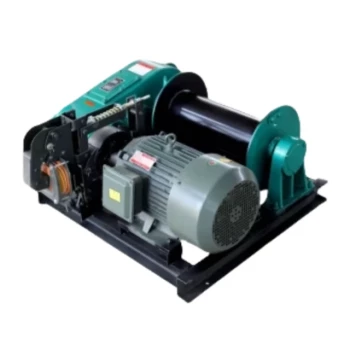
The right winch capacity for your boat depends entirely on whether you need a trailer winch for loading or an anchor winch for mooring. For a trailer winch, capacity is based on the boat's total weight, typically requiring a rating of at least two-thirds to three-quarters of that weight. For an anchor winch, capacity is based on the combined weight of your anchor and rode (chain/rope), requiring a pulling power of at least three times that weight.
The core principle is simple: A trailer winch overcomes rolling friction on an incline, while an anchor winch lifts the dead weight of your ground tackle. Confusing the two calculations is the most common and costly mistake boat owners make.
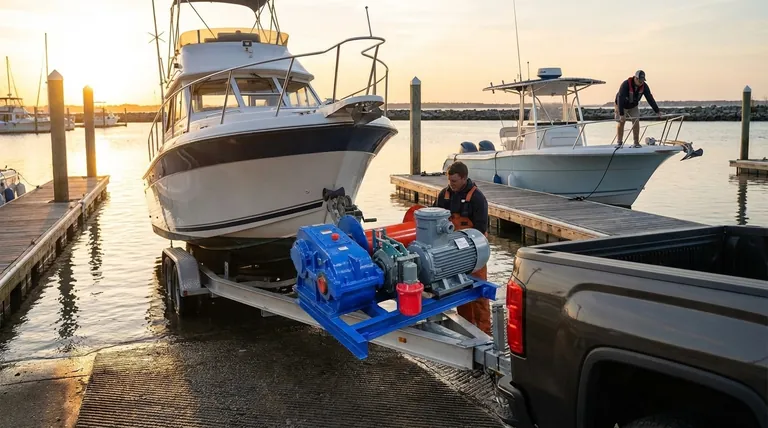
Sizing a Trailer Winch
A trailer winch is designed for one specific job: pulling your boat from the water onto its trailer. The force required is significantly less than the boat's total weight due to the ramp's angle and the buoyancy provided by the water.
The Core Calculation
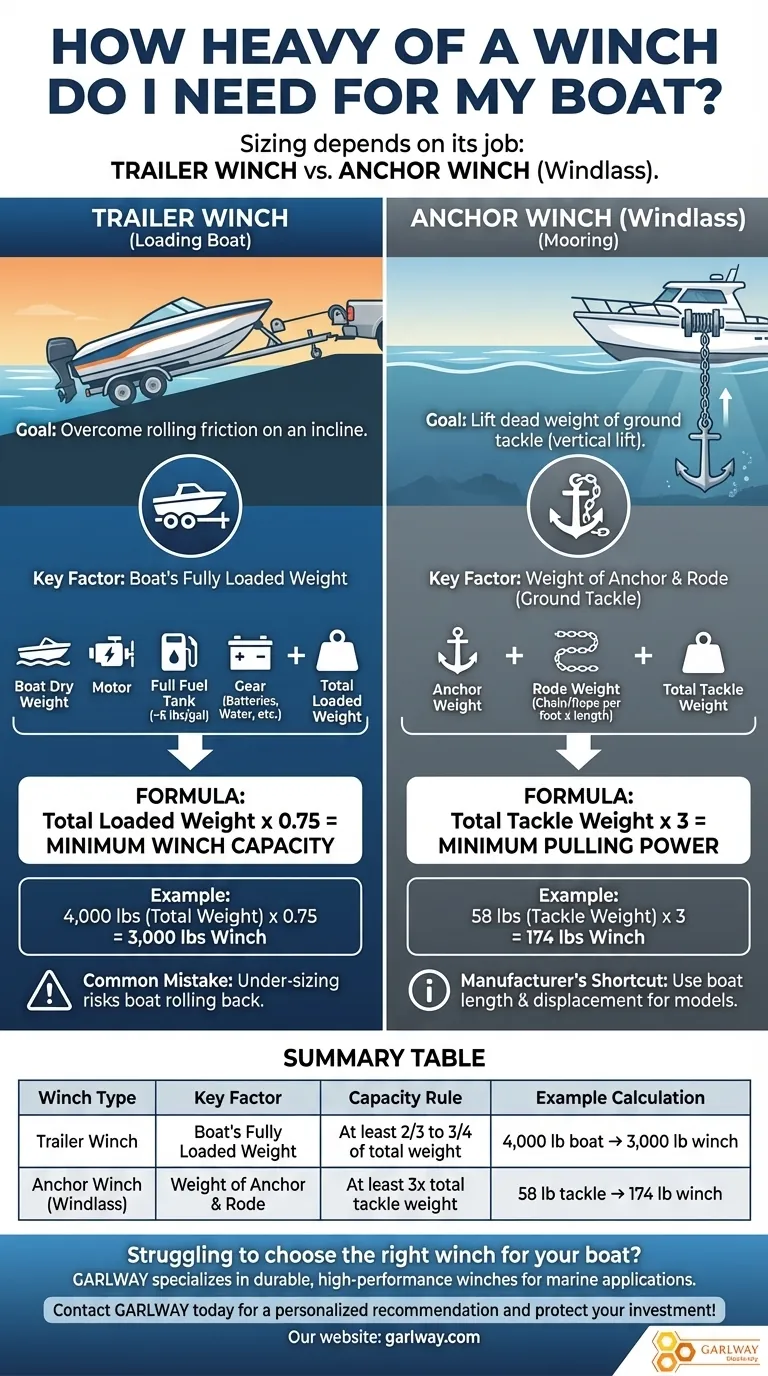
The general rule is to select a winch with a capacity rating that is at least 2/3 to 3/4 of your boat's fully loaded weight. Some will use a more conservative multiplier of 1.5, but this is typically for calculating the pull needed for a rolling load on flat ground, not a boat on a ramp.
What is "Fully Loaded Weight"?
This is the most critical number to determine. It is the combined weight of everything the winch will pull.
Be sure to add up the boat's dry weight, the motor's weight, the weight of a full fuel tank (gasoline is ~6 lbs/gallon), and a realistic estimate for all your gear (batteries, water, safety equipment, etc.).
A Practical Formula
- Calculate Total Weight: Boat + Motor + Fuel + Gear = Total Loaded Weight.
- Determine Winch Capacity: Total Loaded Weight x 0.75 = Minimum Winch Capacity.
For example, a boat package weighing 4,000 lbs would require a winch with a minimum capacity of 3,000 lbs (4,000 x 0.75).
Sizing an Anchor Winch (Windlass)
An anchor winch, or windlass, performs a completely different task. It does a vertical lift of your anchor and rode, known as ground tackle, directly out of the water. Its capacity has nothing to do with the boat's weight.
The Ground Tackle Formula
The standard industry rule for an anchor winch is that it must be able to pull a minimum of three times the total weight of your ground tackle. This 3x multiplier provides a critical safety margin to handle the anchor breaking free from the seabed and to account for wind, waves, and friction in the system.
Step-by-Step Calculation
- Find Anchor Weight: Note the weight of your anchor (e.g., 25 lbs).
- Calculate Rode Weight: Determine the weight of your chain and/or rope. For chain, find its weight-per-foot and multiply by the length you have (e.g., 30 feet of 1/4" chain at 1.1 lbs/ft = 33 lbs).
- Find Total Tackle Weight: Anchor Weight + Rode Weight = Total Tackle Weight (e.g., 25 lbs + 33 lbs = 58 lbs).
- Determine Winch Capacity: Total Tackle Weight x 3 = Minimum Pulling Power (e.g., 58 lbs x 3 = 174 lbs).
The Manufacturer's Shortcut
Most windlass manufacturers simplify this process by recommending models based on boat length and displacement. This is often the easiest starting point, as they have already factored in typical ground tackle requirements for a vessel of that size.
Understanding the Trade-offs
Choosing the right capacity isn't just about meeting a minimum number. It's about ensuring safety and performance without unnecessary cost or complexity.
The Risk of Under-Sizing
An under-sized winch is a serious safety hazard. A trailer winch that is too small can lead to catastrophic failure, allowing the boat to roll back down the ramp. An under-powered anchor winch may fail to retrieve your anchor in poor conditions, leaving you stranded.
The Downside of Over-Sizing
While less dangerous, an oversized winch is still problematic. It costs more, draws more power from your electrical system, and, in the case of a windlass, adds unnecessary weight to the bow of your boat, which can affect performance.
Beyond Pulling Power
Remember that rated capacity is only one factor. Also consider the winch's line speed, power source (manual or electric), and the durability of its materials, especially for saltwater use. Proper mounting and alignment with the bow roller are also critical for function.
Making the Right Choice for Your Goal
Ultimately, the correct winch depends entirely on its intended job. By identifying the task first, you can apply the right formula.
- If your primary focus is a TRAILER winch: Calculate your boat's fully loaded weight and choose a winch with a capacity of at least three-quarters of that value.
- If your primary focus is an ANCHOR winch (windlass): Calculate the total weight of your anchor and rode, then select a windlass with a maximum pull rating of at least three times that weight.
- If you are ever in doubt: Always choose the next size up. The added margin of safety is well worth the minor additional cost.
Selecting the correct winch ensures safety, protects your investment, and makes your time on the water easier.
Summary Table:
| Winch Type | Key Factor | Capacity Rule | Example Calculation |
|---|---|---|---|
| Trailer Winch | Boat's Fully Loaded Weight | At least 2/3 to 3/4 of total weight | 4,000 lb boat → 3,000 lb winch |
| Anchor Winch (Windlass) | Weight of Anchor & Rode | At least 3x total tackle weight | 58 lb tackle → 174 lb winch |
Struggling to choose the right winch for your boat? GARLWAY specializes in durable, high-performance winches for construction and marine applications, including trailer and anchor winches for boaters and contractors worldwide. Our experts can help you select the perfect model based on your specific needs, ensuring safety and reliability. Contact GARLWAY today for a personalized recommendation and protect your investment on the water!
Visual Guide
Related Products
- Electric 120V Boat Winch by Badlands
- 12000 lb Electric Boat Trailer Winch with Windlass Anchor Warn
- Heavy Duty Electric Boat Winch Windlass Anchor
- 12000 lb Heavy Duty Electric Boat Winch
- Quick Windlass Portable Winch for Truck and Boat Best Boat Winch
People Also Ask
- How do electric boat winches work? Unlock Effortless Launching & Retrieval
- How much current does an electric boat winch draw? Plan Your Electrical System for Peak Performance
- Can I run a winch straight from a battery? Essential Power Setup for Safe Operation
- What are the types of electric winches available? Choose the Right Winch for Your Job
- What are the uses of electric winches in mining and tunneling? Enhance Safety and Efficiency Underground