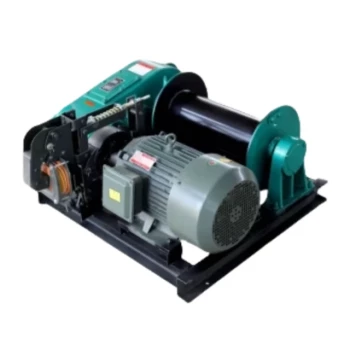
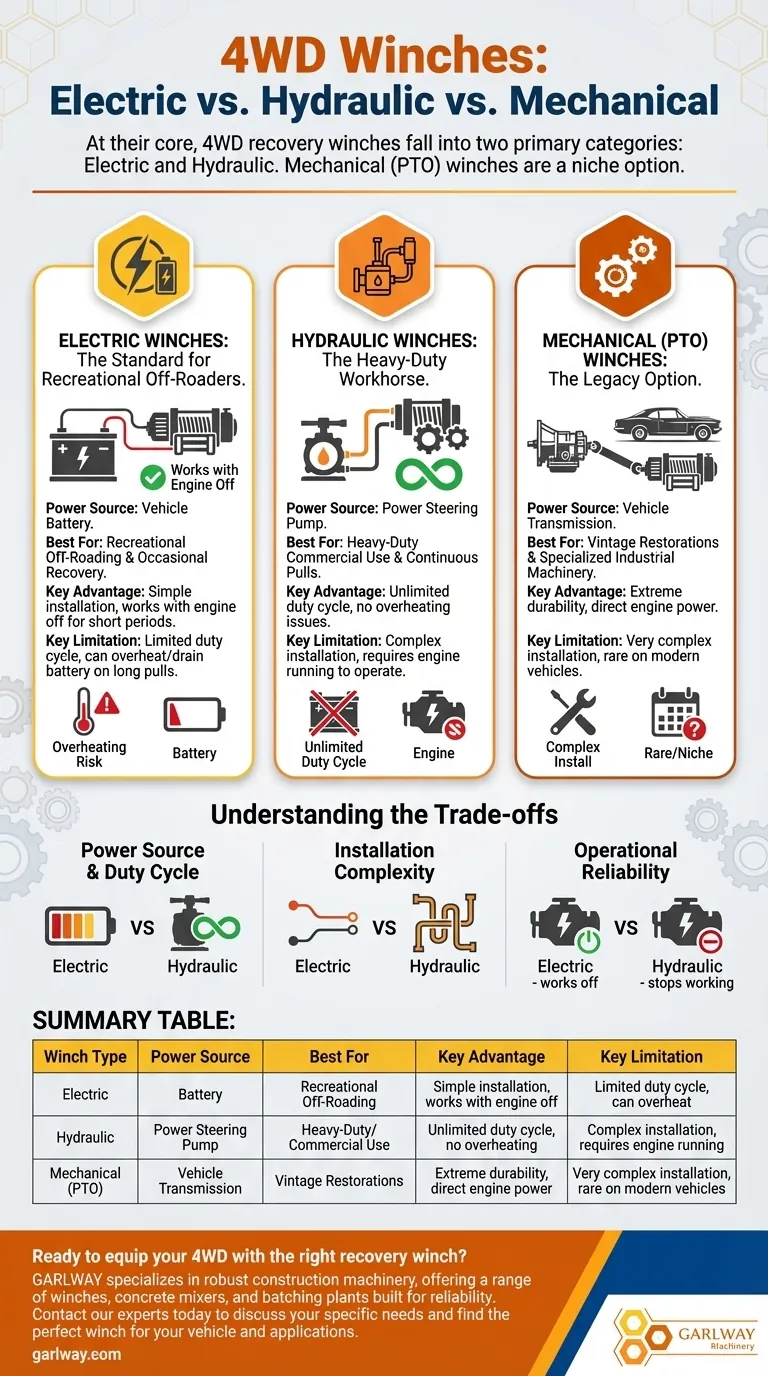
At their core, 4WD recovery winches fall into two primary categories: electric and hydraulic. Electric winches are the most common choice for recreational off-roading due to their ease of installation and operation, while hydraulic winches are favored for heavy-duty commercial or industrial applications that demand continuous, sustained pulling power. A third, much less common type is the mechanical, or Power Take-Off (PTO), winch.
The decision between an electric and a hydraulic winch is not about which is superior, but which power source best aligns with your vehicle's systems and your intended use. It is a trade-off between installation simplicity and the ability to perform long, heavy pulls without overheating.
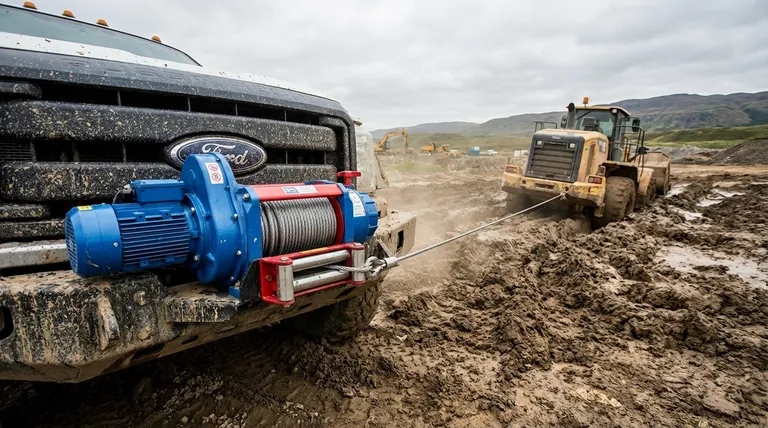
The Core Winch Types Explained
A vehicle winch is a powerful tool that transforms your 4WD into a true recovery machine, enabling you to conquer mud, steep inclines, and other obstacles. Understanding how each type is powered is the key to selecting the right one.
Electric Winches: The Standard for Most Off-Roaders
Electric winches connect directly to your vehicle's battery and electrical system. They are self-contained units that are relatively straightforward to mount and wire.
This makes them the default choice for the vast majority of recreational 4WD enthusiasts and professionals. They are versatile, widely available, and come in a vast range of pulling capacities.
The primary advantage is that an electric winch can operate even if the vehicle's engine is stalled, drawing power directly from the battery for short periods.
Hydraulic Winches: The Heavy-Duty Workhorse
Hydraulic winches tap into the vehicle's power steering pump for their power. They are not powered by electricity but by hydraulic fluid pressure.
This design makes them ideal for continuous, heavy-duty use, as they do not generate significant heat and can pull for as long as the engine is running.
You will typically find hydraulic winches on commercial tow trucks, industrial equipment, and extreme off-road vehicles where reliability under constant load is non-negotiable.
Mechanical (PTO) Winches: The Legacy Option
Mechanical winches are driven directly by the vehicle's transmission via a Power Take-Off (PTO) unit. This is the oldest type of vehicle-mounted winch.
Their power is directly proportional to the engine's RPM, and they are exceptionally durable. However, they are complex to install and are rarely found on modern consumer 4WD vehicles.
They are now considered a niche option, typically reserved for vintage vehicle restorations or highly specialized industrial machinery that is equipped with a PTO.
Understanding the Trade-offs
Choosing a winch involves balancing its power source against your operational needs. Each system has distinct limitations and advantages that you must consider.
Power Source & Duty Cycle
An electric winch is limited by the vehicle's battery and alternator. Long, heavy pulls generate significant heat and can drain a battery quickly, requiring rest periods to cool down and allow the battery to recharge. This is known as its duty cycle.
A hydraulic winch, however, can run continuously without overheating as long as the engine is running and supplying pressure from the power steering pump. Its duty cycle is effectively unlimited.
Installation Complexity
Electric winches are far simpler to install. The process typically involves mounting the winch and running heavy-gauge wires to the vehicle's battery.
Hydraulic winches require a much more involved installation, as you must tap into your vehicle's power steering lines. This often requires professional expertise to ensure it's done safely and correctly.
Operational Reliability
The key difference lies in what happens when the engine dies. An electric winch can still operate for a short time off the battery's reserve power, which could be critical.
Conversely, a hydraulic winch will immediately stop working if the engine stalls. However, it will never drain your battery, which is a common failure point for electric winch users who pull too long without the engine running.
Making the Right Choice for Your Goal
Your selection should be guided by a realistic assessment of how you will use the winch.
- If your primary focus is recreational off-roading and occasional recovery: An electric winch offers the best balance of performance, affordability, and ease of installation.
- If your primary focus is commercial recovery, industrial work, or extreme terrain where long pulls are common: A hydraulic winch is the superior choice for its unmatched reliability and continuous power.
- If your primary focus is a period-correct restoration of a vintage 4WD: A mechanical (PTO) winch may be the only authentic option, provided your vehicle has the necessary transmission output.
Ultimately, choosing the right winch is about matching the tool's core design to your specific recovery needs.
Summary Table:
| Winch Type | Power Source | Best For | Key Advantage | Key Limitation |
|---|---|---|---|---|
| Electric | Vehicle Battery | Recreational Off-Roading | Simple installation, works with engine off | Limited duty cycle, can overheat/drain battery |
| Hydraulic | Power Steering Pump | Heavy-Duty/Commercial Use | Unlimited duty cycle, no overheating | Complex installation, requires engine running |
| Mechanical (PTO) | Vehicle Transmission | Vintage Restorations | Extreme durability, direct engine power | Very complex installation, rare on modern vehicles |
Ready to equip your 4WD with the right recovery winch?
GARLWAY specializes in robust construction machinery, offering a range of winches, concrete mixers, and batching plants built for reliability. Whether you're a contractor needing a heavy-duty hydraulic winch or a construction company requiring dependable equipment, our solutions are engineered for performance.
Contact our experts today to discuss your specific needs and find the perfect winch for your vehicle and applications.
Visual Guide
Related Products
- Heavy Duty Electric Boat Winch Windlass Anchor
- Warn Winch Windlass Boat Trailer Winch
- Electric and Hydraulic Winch for Heavy Duty Applications
- Portable Small Trailer Winch
- Quick Windlass Portable Winch for Truck and Boat Best Boat Winch
People Also Ask
- How do electric boat winches work? Unlock Effortless Launching & Retrieval
- How much current does an electric boat winch draw? Plan Your Electrical System for Peak Performance
- Can an electric winch be used as a hoist? Understand the Critical Safety Differences
- What is the major advantage of an electric-powered winch? Unmatched Self-Recovery When Your Engine Fails
- What makes electric winches suitable for off-road use? Key Features for Reliable Vehicle Recovery