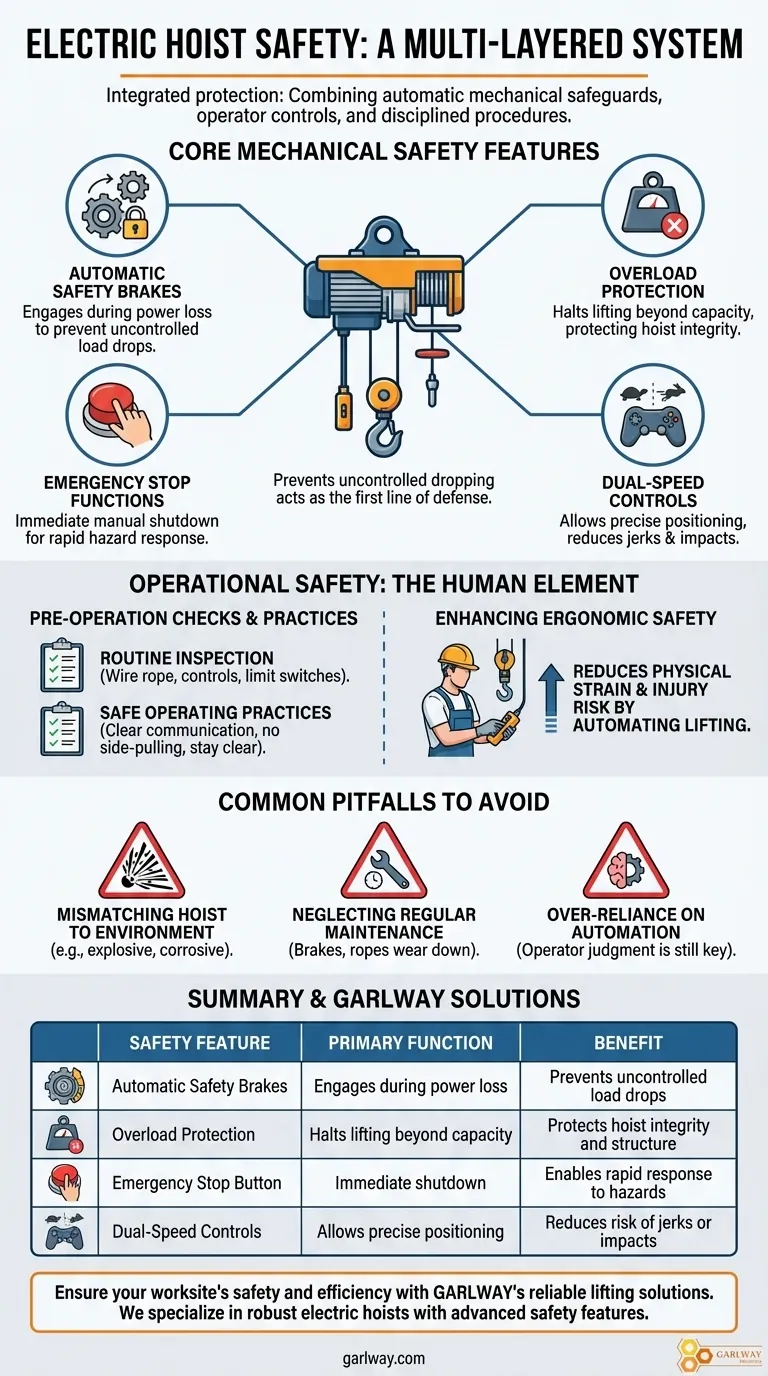
At their core, electric hoists are engineered with a multi-layered system of safety features. The most common of these are automatic safety brakes that engage during power loss, overload protection sensors to prevent lifting beyond capacity, prominent emergency stop buttons for immediate shutdown, and dual-speed controls that allow for precise, careful positioning of heavy loads.
The safety of an electric hoist doesn't come from a single component, but from an integrated system. It combines automatic mechanical safeguards like brakes and overload limiters with crucial operator-controlled functions and disciplined operational procedures.
Core Mechanical Safety Features
The primary safety objective of an electric hoist is to prevent the uncontrolled dropping of a load. This is achieved through several key built-in mechanisms that act as the first line of defense.
Automatic Safety Brakes
The safety brake is arguably the most critical component. It is designed to automatically engage in the event of a power failure or mechanical issue.
This function ensures that a suspended load remains securely in place, preventing catastrophic drops that could endanger personnel and damage valuable materials.
Overload Protection
Every hoist has a maximum rated capacity. An overload protection system, often using a load limiter, prevents the hoist from lifting a weight that exceeds this limit.
This feature is crucial for protecting the structural integrity of the hoist, the wire rope or chain, and the mounting structure itself, preventing failures caused by excessive stress.
Emergency Stop Functions
A clearly marked and easily accessible emergency stop button allows the operator to halt all hoist functions immediately.
This provides a manual override that is vital in situations where a load becomes unstable, an obstruction is encountered, or any other unforeseen hazard arises.
Dual-Speed Configurations
While not always seen as a direct safety feature, dual-speed or variable-speed control is essential for safe operation. It allows for slow, precise movements when positioning a load.
This reduces the risk of sudden jerks or impacts, which is especially important when handling fragile equipment or maneuvering loads in tight spaces.
Operational Safety: The Human Element
Built-in features are only half of the equation. True operational safety depends on how the equipment is used, maintained, and integrated into the workflow.
The Importance of Pre-Operation Checks
Before any shift, operators should conduct a routine inspection. This includes checking the wire rope for fraying, ensuring controls are responsive, and verifying that safety mechanisms like limit switches are functioning correctly.
Enhancing Ergonomic Safety
By automating the lifting process, electric hoists significantly reduce the physical strain on workers. This dramatically lowers the risk of musculoskeletal disorders and other injuries associated with manual lifting, making the workplace inherently safer.
Adherence to Safe Operating Practices
Operator training is non-negotiable. Safe practices include ensuring clear communication, never standing directly under a suspended load, and avoiding "side-pulling," which places undue stress on the hoist components.
Common Pitfalls to Avoid
Even the most advanced hoist can be rendered unsafe if its limitations are not respected. Understanding these trade-offs is key to maintaining a safe environment.
Mismatching the Hoist to the Environment
A standard hoist is not suitable for a hazardous or explosive environment. Specialized models are designed for high temperatures, cleanrooms, or corrosive atmospheres, and using the wrong one creates significant risk.
Neglecting Regular Maintenance and Inspections
Safety features wear down over time. Brakes, clutches, and wire ropes require regular, professional inspection and maintenance to ensure they will function as designed in an emergency.
Over-Reliance on Automation
While features like overload protection are effective, they should not replace sound judgment. Operators must always be aware of the load's weight and the hoist's capacity before initiating a lift.
Making the Right Choice for Your Goal
Selecting a hoist is about matching its features to the specific demands of your tasks and the safety culture of your workplace.
- If your primary focus is maximum operational safety: Prioritize models with comprehensive features like overload protection, dual brakes, and variable speed control, and invest heavily in operator training.
- If your primary focus is handling delicate or precise loads: Look for hoists with true variable-speed or dual-speed configurations to ensure smooth, controlled movements and prevent damage.
- If your primary focus is worker well-being and ergonomics: Recognize that any properly rated electric hoist is a significant upgrade over manual lifting, fundamentally reducing the daily risk of physical injury.
Ultimately, a safe lifting operation is achieved when advanced equipment is paired with a well-trained and disciplined team.
Summary Table:
| Safety Feature | Primary Function | Benefit |
|---|---|---|
| Automatic Safety Brakes | Engages during power loss | Prevents uncontrolled load drops |
| Overload Protection | Halts lifting beyond capacity | Protects hoist integrity and structure |
| Emergency Stop Button | Immediate shutdown of all functions | Enables rapid response to hazards |
| Dual-Speed Controls | Allows precise load positioning | Reduces risk of jerks or impacts |
Ensure your worksite's safety and efficiency with GARLWAY's reliable lifting solutions. We specialize in construction machinery, offering robust electric hoists, winches, concrete mixers, and batching plants designed for construction companies and contractors worldwide. Our equipment integrates advanced safety features to protect your team and assets. Contact us today to discuss your project needs and discover how GARLWAY can enhance your operational safety and productivity.
Visual Guide
Related Products
- Electric Hoist Winch Boat Anchor Windlass for Marine Applications
- Electric and Hydraulic Winch for Heavy Duty Applications
- Hydraulic Winding Engine Harbor Freight Winch
- Heavy Duty Electric Boat Winch Windlass Anchor
- 12000 lb Electric Boat Trailer Winch with Windlass Anchor Warn
People Also Ask
- How does an electric anchor winch work? Power, Safety, and Reliable Operation Explained
- What are the advantages of installing an electric anchor winch on a boat? Boost Safety & Ease for Boaters
- What are the operational differences between electric hoists and winches? A Guide to Safe Lifting vs. Pulling
- What are the main benefits of a boat anchor winch? Boost Safety & Efficiency for Your Vessel
- How does a boat anchor winch work? A Guide to Reliable Anchor Handling