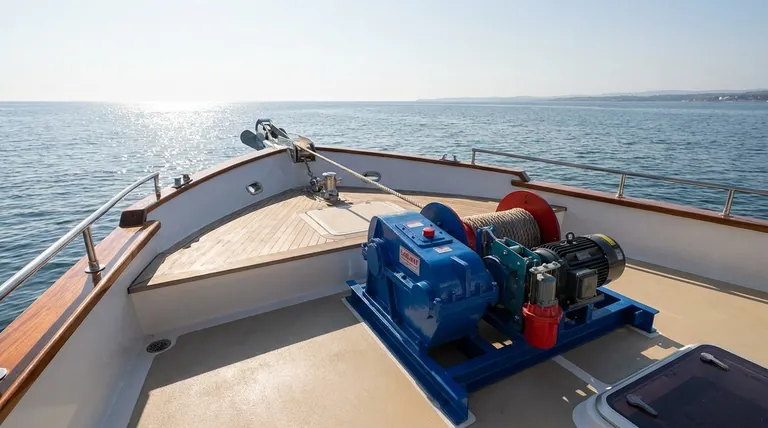
Mounting an anchor winch further back on your boat is a deliberate choice that significantly enhances the system's reliability and ease of use. This rearward placement directly improves how the anchor line spools onto the drum, preventing the line from bunching in the middle and ensuring the winch housing doesn't obstruct the driver's forward view.
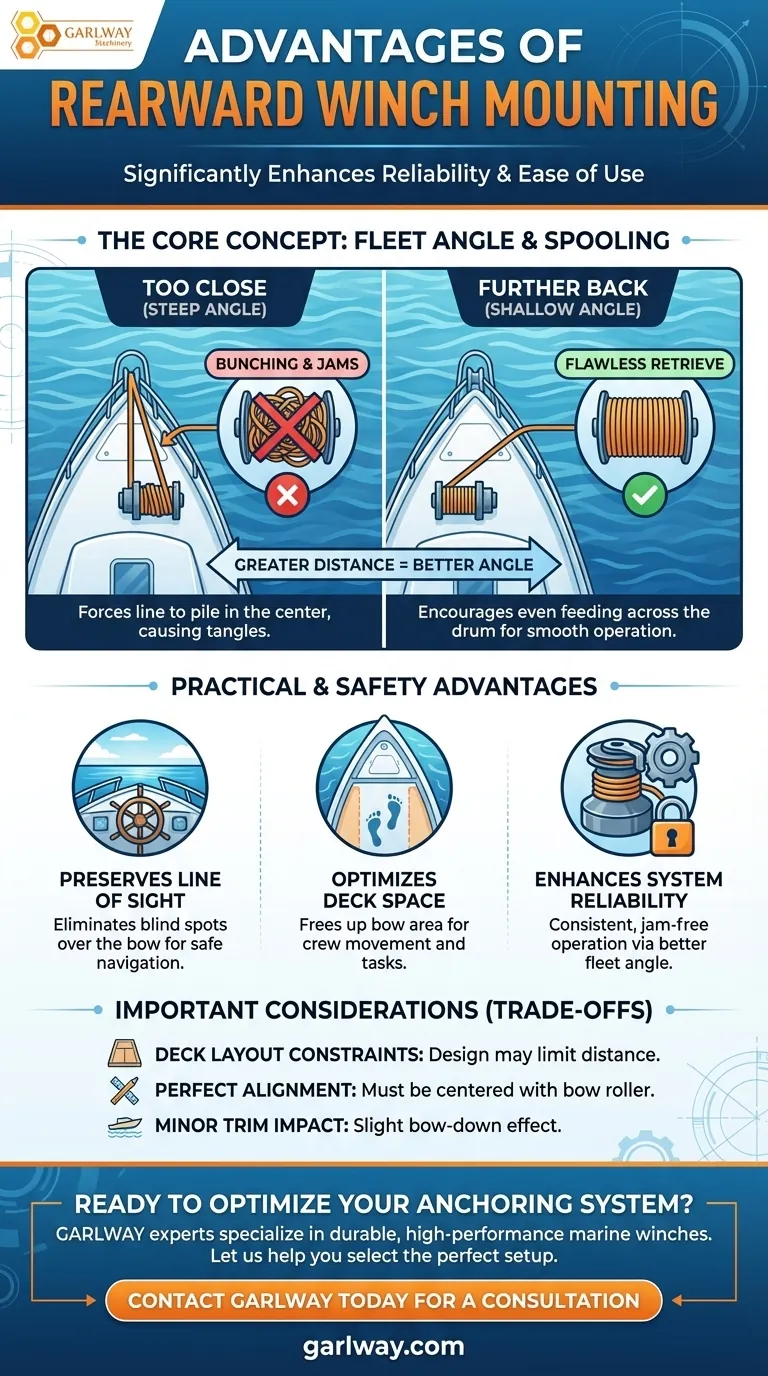
The core principle is simple: increasing the distance between the bow roller and the winch creates a better "fleet angle." This forces the anchor line to lay evenly across the drum, which is the single most important factor for smooth, jam-free operation.
The Mechanics of a Flawless Retrieve
The primary reason for specific winch placement comes down to managing the anchor line, or "rode," as it comes aboard.
Understanding the "Fleet Angle"
The fleet angle is the angle at which the rode travels from the bow roller to the edge of the winch drum.
A steep angle, caused by placing the winch too close to the roller, forces the line to pile up in the center of the drum. This leads to bunching, tangles, and potential jams.
A shallow angle, achieved by moving the winch further back, encourages the line to feed evenly across the entire width of the drum as it retrieves.
Why Greater Distance is Better
Think of trying to neatly wrap a string around a spool. If you guide the string from very close, you have to move your hand side-to-side aggressively. If you guide it from further away, small movements are all you need to lay the string perfectly.
Mounting the winch further back uses this same principle, allowing the system to essentially guide itself for a level, uniform wrap every time.
Practical and Safety Advantages
Beyond the mechanics of line spooling, winch placement has real-world implications for how you use your boat.
Preserving Your Line of Sight
An improperly placed winch can create a significant blind spot directly over the bow.
Setting the winch further astern keeps this critical line of sight clear, which is essential for safe navigation, especially when approaching docks, moorings, or other boats.
Optimizing Usable Deck Space
The bow is often a high-traffic area. Placing the winch further back frees up the forward-most deck space.
This makes it easier and safer for you or your crew to move around the bow area for other tasks without a major piece of hardware getting in the way.
Understanding the Trade-offs
While moving the winch back is overwhelmingly beneficial, there are practical constraints to consider.
The Constraint of Deck Layout
Your boat's design is the ultimate deciding factor. Hatches, cleats, and the physical shape of the deck may limit how far back you can realistically mount the winch.
The goal is to find the optimal position within the available space.
The Need for Perfect Alignment
Regardless of distance, the winch drum must be perfectly centered with the bow roller.
Even a slight misalignment will counteract the benefits of a good fleet angle, causing the rode to favor one side of the drum and leading to poor spooling.
A Minor Impact on Boat Trim
An anchor winch can weigh 80 pounds or more. Mounting it further back slightly changes the boat's leverage and balance.
This can create a very minor bow-down effect. For most boats, this is negligible, but it is a factor to be aware of.
Making the Right Choice for Your Boat
To determine the best position, balance the ideal mechanical setup with the realities of your vessel.
- If your primary focus is maximum reliability: Mount the winch as far back from the bow roller as your deck space cleanly allows to achieve the best possible fleet angle.
- If your primary focus is preserving a specific deck layout: You may need to compromise on the distance, but never compromise on keeping the winch perfectly aligned with the bow roller.
- If you are installing on a smaller boat: Pay close attention to the winch's weight and its minor effect on trim, placing it far enough back for good spooling without unnecessarily weighing down the bow.
Ultimately, proper winch placement is a foundational step toward a safer and more dependable anchoring system.
Summary Table:
| Advantage | Key Benefit |
|---|---|
| Improved Line Spooling | Prevents bunching and jams for flawless retrieval |
| Clear Forward Visibility | Eliminates blind spots over the bow for safer navigation |
| Optimized Deck Space | Frees up the bow area for easier crew movement |
| Enhanced System Reliability | Creates a better fleet angle for smooth, consistent operation |
Ready to optimize your boat's anchoring system? The experts at GARLWAY specialize in durable, high-performance marine winches designed for reliability. Whether you're a commercial operator or a serious recreational boater, we can help you select and install the perfect winch for your vessel's specific layout. Contact GARLWAY today for a consultation and ensure your next anchor retrieval is smooth and safe!
Visual Guide
Related Products
- Electric Hoist Winch Boat Anchor Windlass for Marine Applications
- 12000 lb Electric Boat Trailer Winch with Windlass Anchor Warn
- Best 18000 Pound Drum Anchor Trailer Winch
- Heavy Duty Electric Boat Winch Windlass Anchor
- Warn Winch Windlass Boat Trailer Winch
People Also Ask
- How does an electric anchor winch work? Power, Safety, and Reliable Operation Explained
- What are the advantages of installing an electric anchor winch on a boat? Boost Safety & Ease for Boaters
- What are the operational differences between electric hoists and winches? A Guide to Safe Lifting vs. Pulling
- What are the main benefits of a boat anchor winch? Boost Safety & Efficiency for Your Vessel
- How does a boat anchor winch work? A Guide to Reliable Anchor Handling