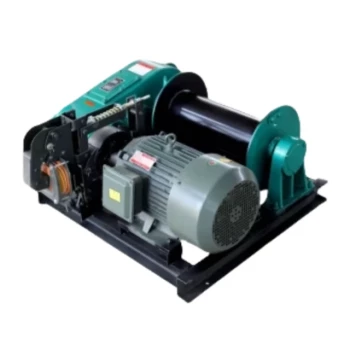
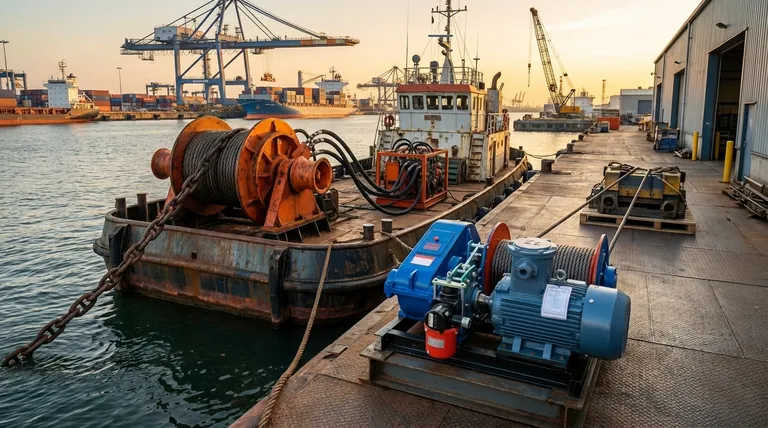
In industrial and maritime settings, the two primary types of winches are defined by their power source: electric winches and hydraulic winches. While other designs exist for specific tasks, nearly every heavy-duty application relies on one of these two fundamental technologies to provide the necessary pulling force.
The core distinction comes down to a trade-off between convenience and raw power. Electric winches offer versatile, self-contained operation ideal for intermittent use, while hydraulic winches deliver superior, continuous power required for the most demanding and sustained tasks.
The Electric Winch: Versatility and Accessibility
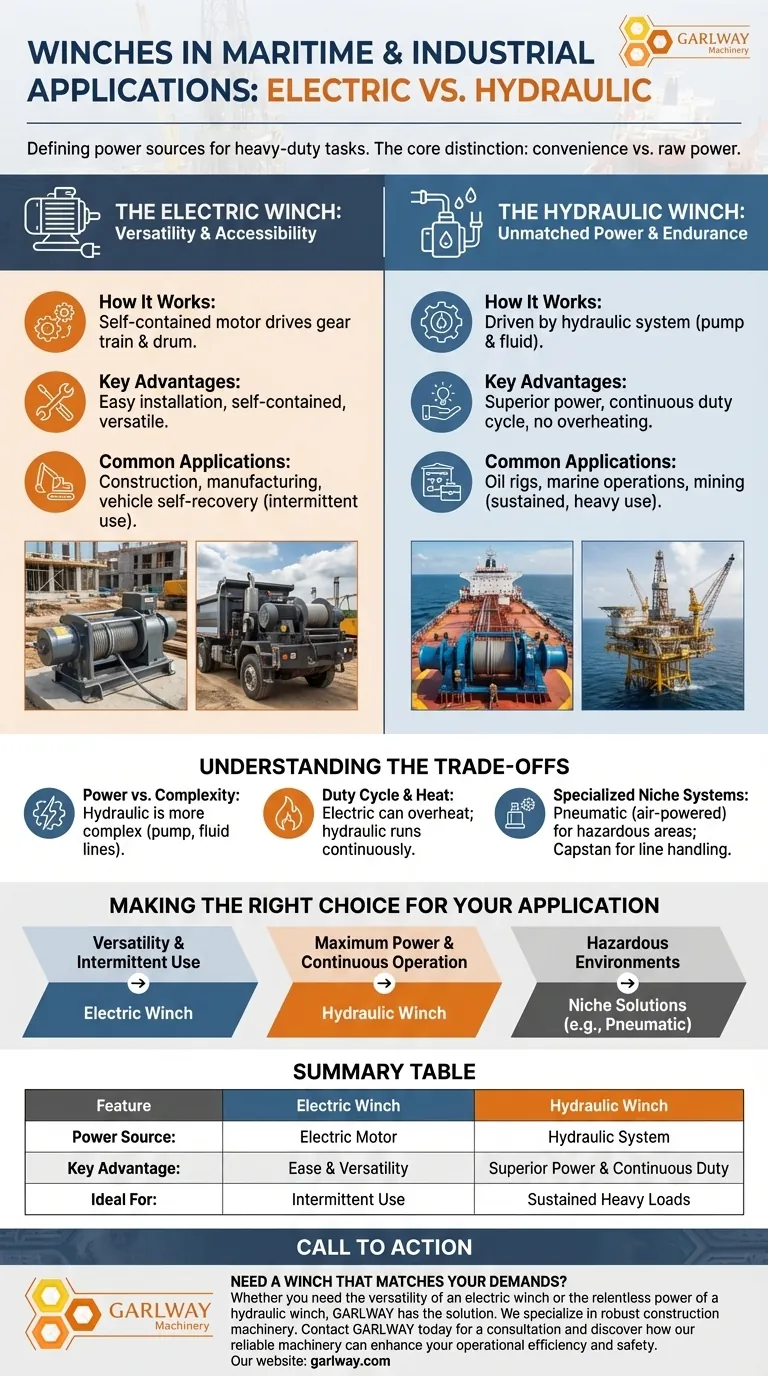
An electric winch uses an electric motor, powered either by a vehicle's electrical system or an independent power source, to turn the winch drum and pull a load. This design makes them highly versatile and relatively easy to install.
How It Works
The system is self-contained. An electric motor drives a gear train, which provides the torque needed to rotate the winch drum and wind the cable.
Key Advantages
The primary advantage of an electric winch is its ease of installation and use. It doesn't require the complex plumbing of an external pump or fluid reservoir, making it suitable for a wide range of applications.
Common Applications
Electric winches are a common choice for construction sites, manufacturing floors, and vehicle self-recovery. Their ability to be mounted on floors, walls, or vehicles makes them a flexible solution for lifting and pulling moderate-to-heavy loads in non-continuous scenarios.
The Hydraulic Winch: Unmatched Power and Endurance
A hydraulic winch is driven by a hydraulic motor powered by a separate hydraulic pump. This system is designed for maximum power and the ability to run for long periods without overheating.
How It Works
The winch is a component within a larger hydraulic system. A pump, typically driven by an engine, circulates hydraulic fluid under pressure to the winch's motor, which then drives the gear mechanism to turn the drum.
Key Advantages
Hydraulic winches can pull significantly heavier loads than electric winches of a similar size. Their defining feature is their duty cycle—they can operate continuously under heavy load without the risk of overheating that electric motors face.
Common Applications
This endurance makes hydraulic winches indispensable in heavy industrial settings like oil rigs, large-scale marine operations, and mining. They are the standard for any task requiring sustained, immense pulling force.
Understanding the Trade-offs
Choosing between electric and hydraulic is not about which is "better," but which is appropriate for the task. The decision hinges on power requirements and operational demands.
Power vs. Complexity
Hydraulic systems deliver superior power, but they are also more complex. They require a hydraulic pump, fluid lines, and a reservoir, adding installation complexity and maintenance points that a self-contained electric winch does not have.
Duty Cycle and Heat
The most critical trade-off is the duty cycle. An electric motor generates significant heat and can burn out if run continuously under heavy load. A hydraulic system dissipates heat through its fluid, allowing it to work all day.
Specialized Niche Systems
While electric and hydraulic are the main categories, other types serve specific roles. Pneumatic (air-powered) winches are used in environments where an electric spark would be hazardous. Capstan winches are used on ships for handling lines but operate on a different principle without storing the line on the drum.
Making the Right Choice for Your Application
Your final decision must be aligned with the operational demands of the work being performed.
- If your primary focus is versatility and intermittent use: An electric winch is the most practical and cost-effective choice for tasks like vehicle recovery or occasional lifting on a construction site.
- If your primary focus is maximum power and continuous operation: A hydraulic winch is the only reliable option for heavy industrial or maritime jobs that require sustained, heavy pulling.
- If your primary focus is a hazardous or specialized environment: You may need to look beyond the main two types to niche solutions like pneumatic winches for explosive atmospheres.
Ultimately, understanding the core differences in power source and duty cycle empowers you to select the right tool for the job.
Summary Table:
| Feature | Electric Winch | Hydraulic Winch |
|---|---|---|
| Power Source | Electric Motor | Hydraulic System |
| Key Advantage | Ease of Installation & Versatility | Superior Power & Continuous Duty Cycle |
| Ideal For | Intermittent Use (e.g., Construction, Vehicle Recovery) | Sustained Heavy Loads (e.g., Marine, Mining, Oil Rigs) |
Need a Winch That Matches Your Demands?
Whether you require the versatility of an electric winch for intermittent tasks or the relentless power of a hydraulic winch for continuous heavy-duty operations, GARLWAY has the solution. We specialize in providing robust construction machinery, including winches, concrete mixers, and batching plants, tailored for construction companies and contractors worldwide.
Let us help you select the perfect winch for your specific application. Our experts will ensure you get the right combination of power, durability, and performance.
Contact GARLWAY today for a consultation and discover how our reliable machinery can enhance your operational efficiency and safety.
Visual Guide
Related Products
- Warn Winch Windlass Boat Trailer Winch
- Electric and Hydraulic Winch for Heavy Duty Applications
- Small Electric Winch 120V and 240V for Compact Applications
- Quick Windlass Portable Winch for Truck and Boat Best Boat Winch
- Hydraulic Winding Engine Harbor Freight Winch
People Also Ask
- What are the main components of a boat trailer winch? A Guide to Safe & Efficient Boat Loading
- What factors should be considered when choosing a boat trailer winch? Ensure Safe and Effortless Boat Loading
- What is the purpose of boat trailer winches? Safely and Efficiently Load Your Boat
- What are the two main types of boat trailer winches? Manual vs. Electric Explained
- How often should a boat trailer winch be replaced? Your Guide to Safety and Longevity