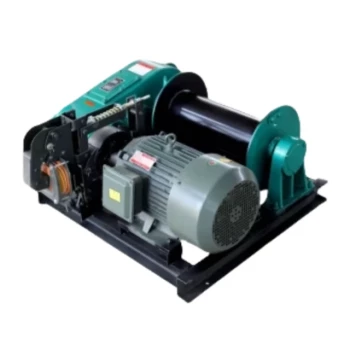
The primary advantages of a hydraulic winch are its immense power, exceptional durability, and its ability to run for long durations without overheating. Because it draws power from a running hydraulic system instead of a battery, it can handle the heaviest loads and most demanding duty cycles in harsh industrial, recovery, and commercial applications.
The decision to use a hydraulic winch is not just about its superior strength; it's a strategic choice for applications requiring sustained, reliable power in unforgiving environments where electric systems would falter.

The Core Principle: Leveraging Hydraulic Power
Hydraulic winches operate on a fundamentally different principle than their electric counterparts. This difference is the source of their most significant advantages.
How It Works
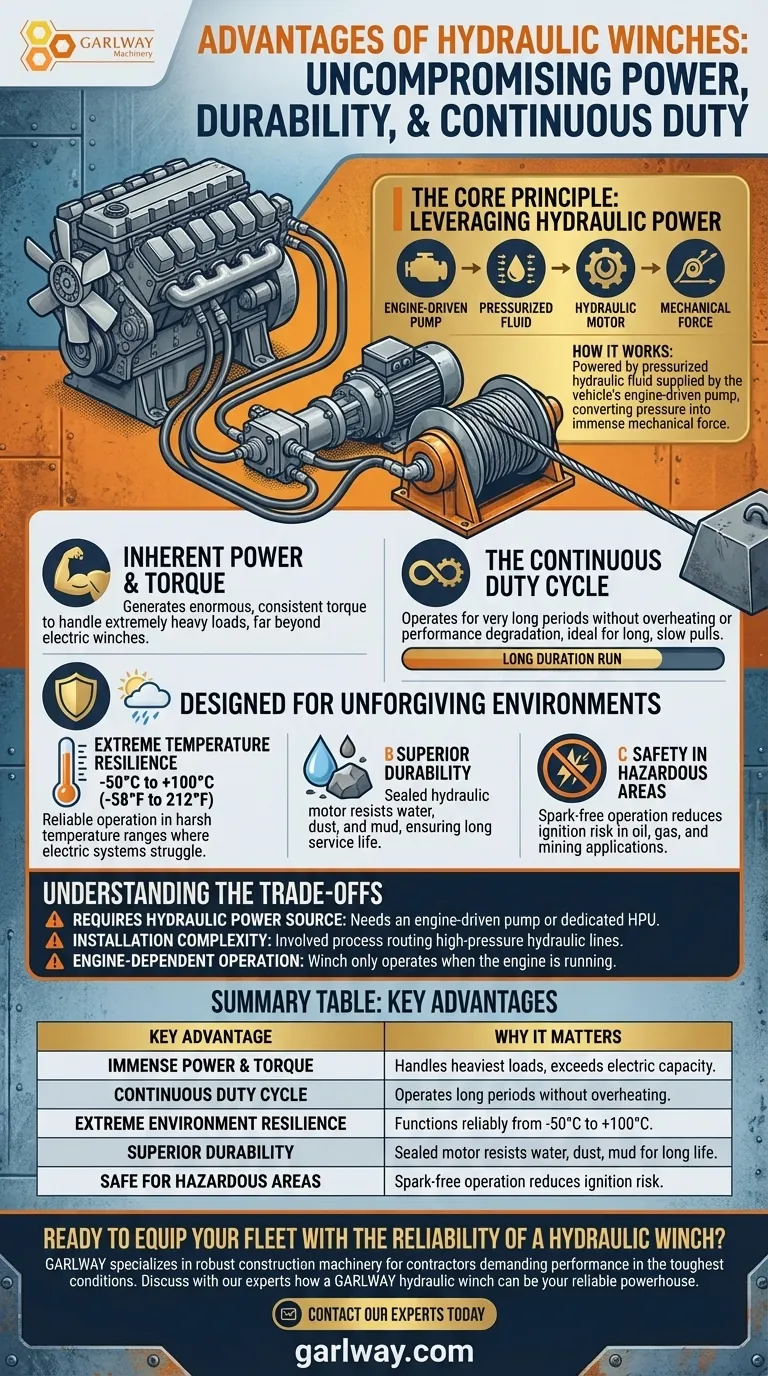
A hydraulic winch is powered by pressurized hydraulic fluid. This fluid is typically supplied by a vehicle's power steering pump or a dedicated hydraulic pump driven by the engine. The winch motor converts this fluid pressure into mechanical force, turning the winch drum and pulling the cable.
Inherent Power and Torque
Because the winch is powered by an engine-driven pump, it can generate enormous and consistent torque. This allows hydraulic winches to handle extremely heavy loads, often far beyond the capacity of comparably sized electric winches.
The Continuous Duty Cycle
This is arguably the most critical advantage. An electric winch draws massive amperage from a battery and will overheat with prolonged use. A hydraulic winch, powered by a continuously running engine, can operate for very long periods without overheating or performance degradation, making it ideal for long, slow, heavy pulls.
Designed for Unforgiving Environments
The construction and power source of hydraulic winches make them uniquely suited for work where failure is not an option.
Extreme Temperature Resilience
Hydraulic systems are famously robust in a wide range of temperatures. Many hydraulic winches are rated to operate reliably in conditions from -50°C to +100°C (-58°F to 212°F), a range where electric motors and batteries can struggle.
Superior Durability
These winches are built for industrial use. Their components are typically more robust, and the hydraulic motor is a sealed unit, making it highly resistant to water, dust, and mud. This inherent toughness ensures a long service life with proper maintenance.
Safety in Hazardous Areas
In environments where electrical sparks could be catastrophic (like oil and gas or mining), a hydraulic system provides a much safer alternative. Since it operates without high-amperage electrical currents, it significantly reduces the risk of ignition.
Understanding the Trade-offs
No tool is perfect for every job. The strengths of a hydraulic winch come with specific requirements and limitations.
Requires a Hydraulic Power Source
The most significant prerequisite is the need for a hydraulic pump. If your vehicle or equipment doesn't already have one, you will need to install a complete hydraulic power unit, which adds complexity and cost.
Installation Complexity
Installing a hydraulic winch is more involved than wiring an electric one. It requires routing high-pressure hydraulic lines from the pump to the winch, which demands a higher level of mechanical expertise.
Engine-Dependent Operation
The winch only operates when the vehicle's engine is running to power the hydraulic pump. You cannot operate the winch with the engine off, which can be a limitation in some recovery scenarios.
Making the Right Choice for Your Goal
To select the correct winch, you must match its core strengths to your primary operational needs.
- If your primary focus is reliability for continuous, heavy-duty work: The hydraulic winch is the definitive choice due to its non-electric, engine-driven power source that prevents overheating.
- If your primary focus is handling the absolute heaviest loads: A hydraulic winch offers superior power and torque capacity for industrial lifting and the recovery of large vehicles.
- If your primary focus is working in hazardous or extreme environments: The sealed nature and spark-free operation of a hydraulic system provide unmatched safety and dependability.
Ultimately, a hydraulic winch is an investment in uncompromising performance for the most demanding professional tasks.
Summary Table:
| Key Advantage | Why It Matters |
|---|---|
| Immense Power & Torque | Handles the heaviest loads, far exceeding electric winch capacity. |
| Continuous Duty Cycle | Operates for long periods without overheating or performance loss. |
| Extreme Environment Resilience | Functions reliably in harsh conditions (-50°C to +100°C). |
| Superior Durability | Sealed motor resists water, dust, and mud for a long service life. |
| Safe for Hazardous Areas | Spark-free operation reduces ignition risk in oil, gas, and mining. |
Ready to equip your fleet with the reliability of a hydraulic winch?
At GARLWAY, we specialize in providing robust construction machinery for companies and contractors who demand performance in the toughest conditions. Our hydraulic winches are engineered to deliver the power and durability your projects require.
Contact our experts today to discuss how a GARLWAY hydraulic winch can be the reliable powerhouse for your heavy lifting and recovery operations.
Visual Guide
Related Products
- Hydraulic Winding Engine Harbor Freight Winch
- Electric and Hydraulic Winch for Heavy Duty Applications
- Small Electric Winch 120V and 240V for Compact Applications
- Electric 120V Boat Winch by Badlands
- 12000 lb Electric Boat Trailer Winch with Windlass Anchor Warn
People Also Ask
- What role does hydraulic fluid play in hydraulic winches? It's the Lifeblood of Your Heavy-Duty Pulling Power
- What vehicles commonly use hydraulic winches? For Industrial Trucks Needing Unmatched Power
- What are the features of hydraulic winches? Unmatched Power and Continuous Duty for Heavy Loads
- What preventive measures can be taken to avoid oil leakage in hydraulic winches? Ensure Long-Term Reliability
- What does 'power out' mean in a hydraulic winch? Achieve Absolute Control When Lowering Heavy Loads