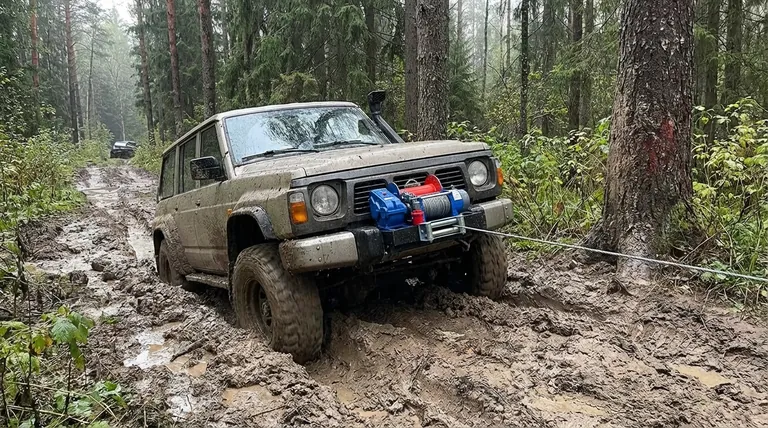
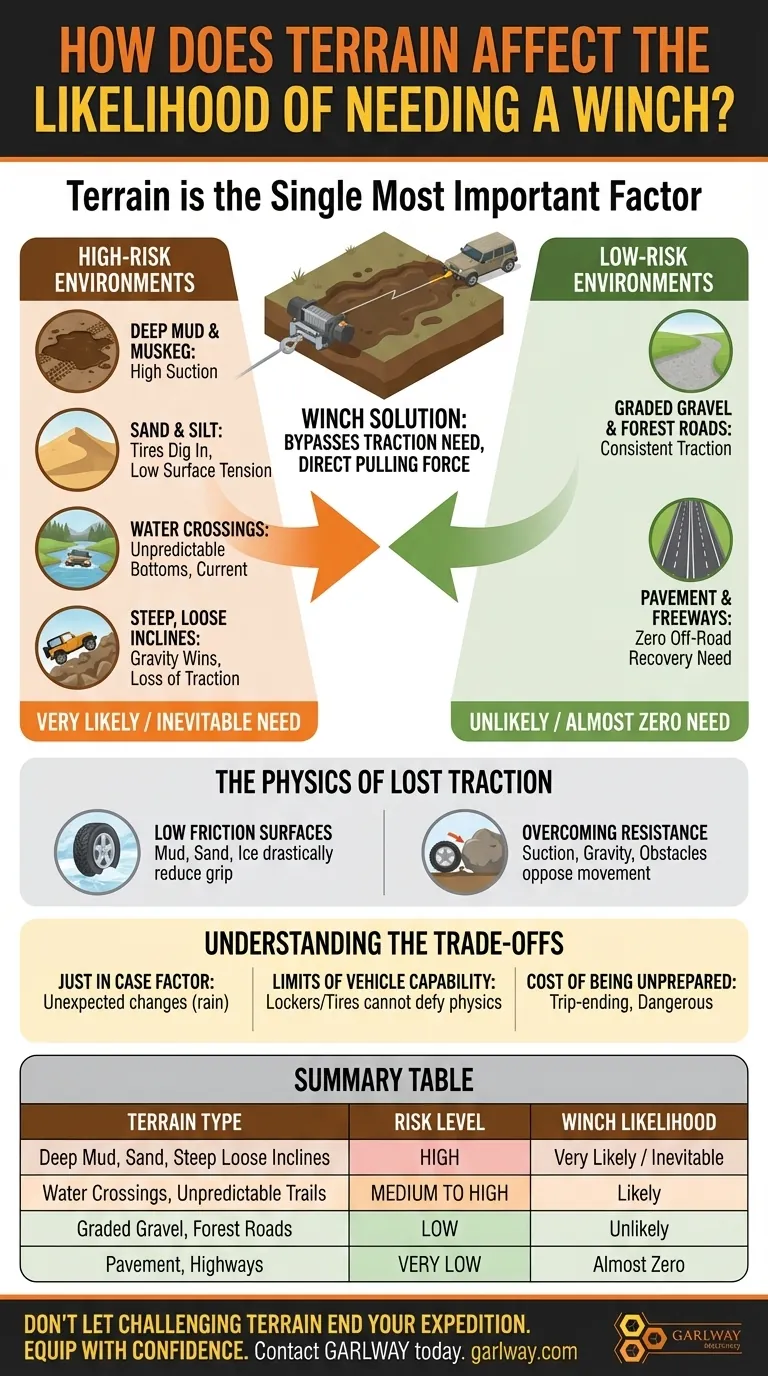
Terrain is the single most important factor in determining the likelihood you will need a winch. Challenging environments with deep mud, sand, significant water crossings, or steep, loose inclines dramatically increase the probability of your vehicle becoming immobilized. Conversely, driving on predictable surfaces like graded gravel roads or pavement presents almost no scenarios where a winch would be required for self-recovery.
The need for a winch is fundamentally a question of traction. When the terrain prevents your tires from gripping effectively enough to move the vehicle's weight, the probability of needing a winch shifts from a possibility to an inevitability.
The Physics of Lost Traction
To understand why certain terrains demand a winch, you must first understand why a vehicle gets stuck. It happens when the engine's power cannot be transferred to the ground effectively.
The Problem: Low Friction Surfaces
Every vehicle moves by using friction between the tires and the ground. Terrains like mud, sand, ice, or deep water drastically reduce this friction. The tires spin, but the vehicle goes nowhere because there is nothing solid for them to push against.
The Obstacle: Overcoming Resistance
Sometimes the issue isn't just a lack of grip, but an opposing force. This can be the suction of deep mud, the force of gravity on a steep hill, or a physical barrier like a rock ledge or fallen tree that the vehicle cannot climb over using tire traction alone.
A winch bypasses the need for traction at the wheels. It creates a direct, mechanical pulling force from a fixed anchor point, allowing you to pull the vehicle forward regardless of how little grip the tires have.
High-Risk vs. Low-Risk Terrains
An honest assessment of where you drive is the best way to evaluate your need for a winch.
High-Risk Environments
- Deep Mud and Muskeg: As found in regions like the Ozarks, mud clogs tire treads and creates powerful suction. This terrain is a primary reason vehicle recovery tools are necessary.
- Sand and Silt: Sand offers very little surface tension to support a vehicle's weight. Tires quickly dig in, and the vehicle's own mass becomes the anchor holding it in place.
- Water Crossings: Riverbeds are unpredictable. A soft, muddy bottom, unseen boulders, or the force of the current can easily halt a vehicle mid-crossing.
- Steep, Loose Inclines: Trying to climb a hill covered in loose rock, dirt, or wet grass often results in a total loss of traction where gravity wins.
Low-Risk Environments
- Graded Gravel & Forest Roads: These roads are typically compacted and designed for water runoff. While conditions can vary, they generally provide consistent and reliable traction.
- Pavement and Freeways: For the purposes of off-road recovery, the need for a winch on paved surfaces is virtually zero.
Understanding the Trade-offs
Deciding on a winch isn't just about the terrain you seek out; it's also about managing risk for the terrain you might encounter unexpectedly.
The "Just in Case" Factor
A perfectly manageable trail can become a high-risk mud pit after a single, unexpected downpour. A winch serves as a powerful insurance policy against changing conditions that are beyond your control.
The Limits of Vehicle Capability
Advanced features like locking differentials and aggressive mud-terrain tires can certainly delay the moment you get stuck. However, in truly challenging terrain, they cannot defy physics. No amount of tire spin can overcome deep suction or a lack of solid ground.
The Cost of Being Unprepared
Not having a winch can turn a minor inconvenience into a dangerous, trip-ending event. It may force you to abandon the vehicle or rely on another vehicle for a potentially high-risk kinetic recovery, which isn't always possible or safe.
How to Assess Your Personal Need
Your driving habits and goals are the ultimate guide.
- If your primary focus is on paved roads and well-maintained gravel: A winch is an unnecessary expense and weight for your vehicle.
- If your primary focus is on exploring moderate trails with occasional mud or obstacles: A winch is a valuable safety tool that turns a potential weekend-ending problem into a 20-minute delay.
- If your primary focus is on remote exploration in areas known for deep mud, sand, or challenging terrain: A winch is not a luxury; it is a fundamental piece of recovery equipment.
Ultimately, an honest assessment of the terrain you intend to conquer is the clearest indicator of your need for a winch.
Summary Table:
| Terrain Type | Risk Level | Likelihood of Needing a Winch |
|---|---|---|
| Deep Mud, Sand, Steep Loose Inclines | High | Very Likely / Inevitable |
| Water Crossings, Unpredictable Trails | Medium to High | Likely |
| Graded Gravel, Forest Roads | Low | Unlikely |
| Pavement, Highways | Very Low | Almost Zero |
Don't let challenging terrain end your expedition.
GARLWAY specializes in durable, high-performance winches and construction machinery designed for the toughest conditions. Whether you're a contractor on a remote site or an explorer tackling deep mud and sand, our equipment provides the reliable pulling power you need for safe self-recovery.
Equip your vehicle with confidence. Contact GARLWAY today to find the perfect winch for your terrain and needs!
Visual Guide
Related Products
- Warn Winch Windlass Boat Trailer Winch
- Electric and Hydraulic Winch for Heavy Duty Applications
- Small Electric Winch 120V and 240V for Compact Applications
- 12000 lb Electric Boat Trailer Winch with Windlass Anchor Warn
- Quick Windlass Portable Winch for Truck and Boat Best Boat Winch
People Also Ask
- What are the main components of a boat trailer winch? A Guide to Safe & Efficient Boat Loading
- What factors should be considered when choosing a boat trailer winch? Ensure Safe and Effortless Boat Loading
- What is the purpose of boat trailer winches? Safely and Efficiently Load Your Boat
- What are the two main types of boat trailer winches? Manual vs. Electric Explained
- How often should a boat trailer winch be replaced? Your Guide to Safety and Longevity