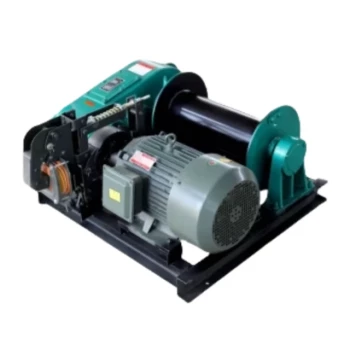
In short, hydraulic winches are the standard in any application that demands immense, sustained pulling power. You will most commonly see them on heavy commercial vehicles like tow trucks (wreckers), on marine vessels and docks, and at demanding industrial sites for construction, mining, and oil exploration.
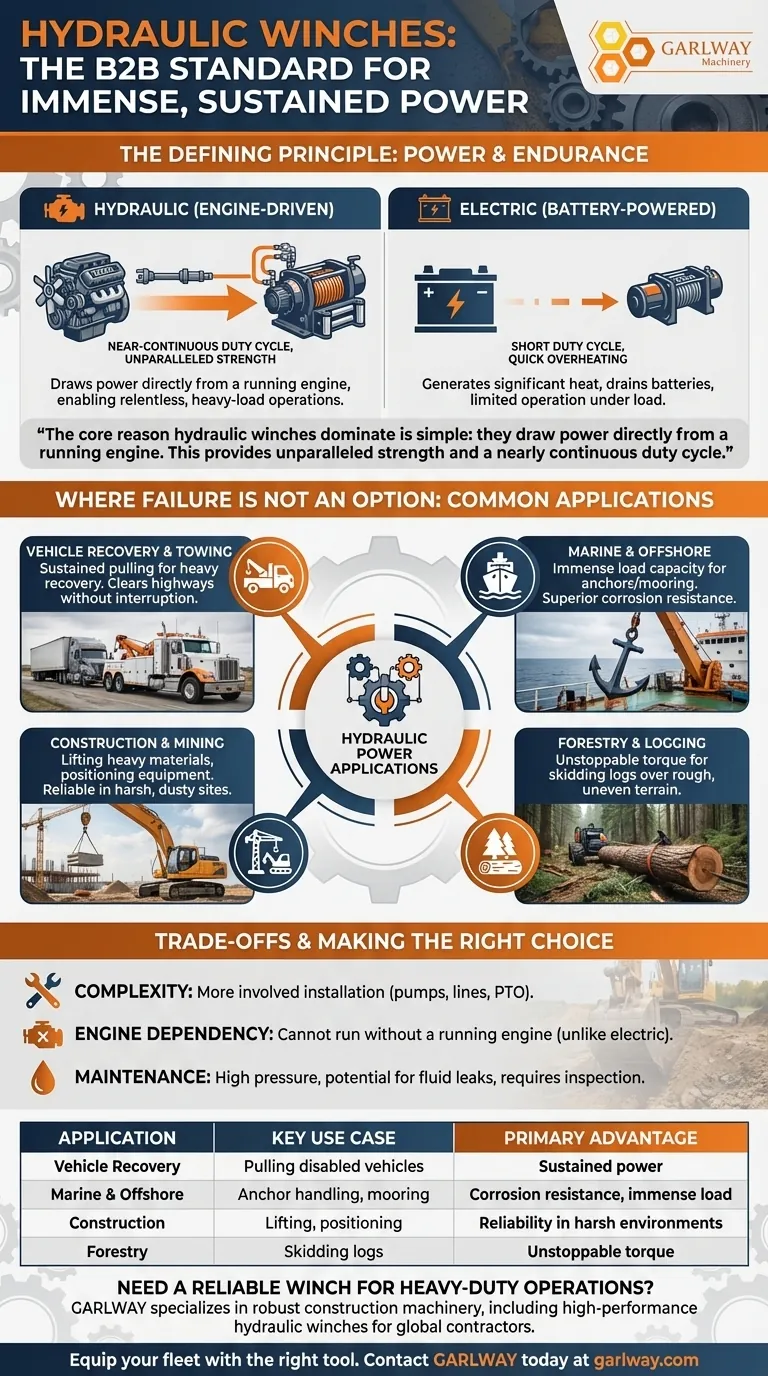
The core reason hydraulic winches dominate these fields is simple: they draw power directly from a running engine. This provides unparalleled strength and a nearly continuous duty cycle that battery-powered electric winches cannot match, making them the only reliable choice for relentless, heavy-load operations.
The Defining Principle: Power and Endurance
To understand where hydraulic winches are used, you must first understand why they are chosen over their electric counterparts. The difference lies in the power source and the operational limits it creates.
Tapping into Engine Power
A hydraulic winch is not a self-contained unit. It is part of a larger system that runs off a pump, typically connected to the vehicle's engine via a Power Take-Off (PTO) or its power steering system.
This design directly links the winch's performance to the immense power of the internal combustion engine.
The Critical Concept of Duty Cycle
Duty cycle refers to how long a winch can operate under load before it needs to cool down. Electric winches generate significant heat and drain batteries quickly, giving them a very short duty cycle.
A hydraulic winch, cooled by circulating fluid, can run for as long as the vehicle's engine is running. This near-continuous duty cycle is its single greatest advantage.
Why This Matters for Heavy-Duty Work
In a commercial scenario, time is critical. A tow truck operator cannot wait ten minutes for a winch to cool down while clearing a highway. A ship needs to raise its anchor without interruption. This requirement for sustained operation makes hydraulic systems the default choice.
A Tour of Common Hydraulic Winch Applications
The principle of engine-driven power and a high duty cycle dictates where hydraulic winches are deployed. They are found where failure is not an option and the loads are extreme.
Vehicle Recovery and Towing
This is the most visible application. Wreckers and heavy recovery vehicles use hydraulic winches to pull cars from ditches or load disabled vehicles onto flatbeds. These tasks require consistent, controllable power, often for several minutes at a time.
Marine and Offshore Operations
Ships, docks, and offshore oil platforms rely heavily on hydraulic winches. Their massive load capacity is essential for lifting anchors, managing mooring lines, and moving heavy equipment. The sealed nature of a hydraulic system also offers superior resistance to corrosive saltwater environments.
Construction and Mining
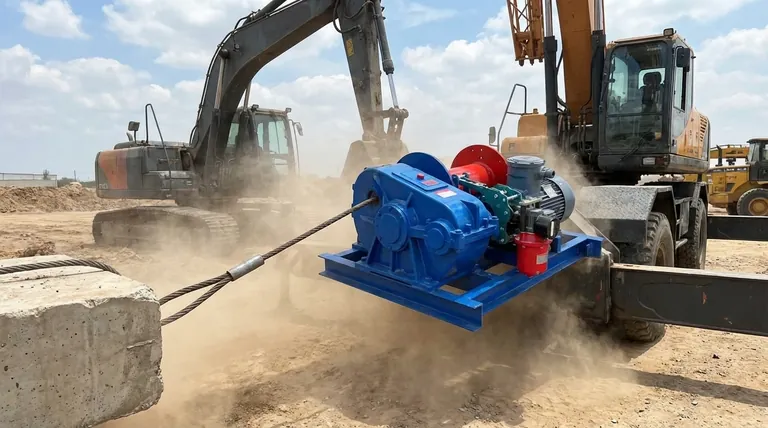
On construction and mining sites, hydraulic winches are used for lifting heavy materials, positioning equipment, and other demanding tasks. They thrive in these harsh, dusty environments where an electric motor's sensitive components might fail.
Forestry and Logging
The forestry industry uses hydraulic winches for skidding logs and other pulling tasks. The raw, unstoppable torque provided by a hydraulic system is perfect for dragging immense weight over rough, uneven terrain.
Understanding the Trade-offs
Despite their power, hydraulic winches are not universally superior. Their design comes with specific requirements and limitations that make them unsuitable for certain applications.
The Complexity of Installation
Installing a hydraulic winch is far more involved than wiring an electric one. It requires tapping into the vehicle's engine, running high-pressure hydraulic lines, and installing pumps and fluid reservoirs. This makes it a specialized and more expensive process.
The Engine Dependency
A hydraulic winch is completely useless if the vehicle's engine cannot run. In a recovery scenario where the primary vehicle is stalled or disabled, the winch cannot be operated. An electric winch, by contrast, can run on battery power alone.
Maintenance and Leak Potential
Hydraulic systems operate under high pressure and involve multiple connection points. While generally reliable, they introduce the potential for fluid leaks, which require diligent inspection and maintenance to prevent.
Making the Right Choice for Your Goal
The decision between a hydraulic or electric winch is a direct reflection of the work you need to accomplish.
- If your primary focus is heavy commercial or industrial use: A hydraulic winch is the industry standard due to its unmatched power, control, and nearly unlimited duty cycle.
- If your primary focus is occasional off-road recovery for a personal vehicle: An electric winch is often more practical due to its simpler installation, lower cost, and ability to operate without a running engine.
- If your primary focus is reliability in harsh, corrosive environments: The robust and sealed nature of a hydraulic system gives it a significant advantage for marine or mining applications.
Ultimately, the choice is dictated not by a simple preference, but by the relentless demands of the task at hand.
Summary Table:
| Application | Key Use Case | Primary Advantage |
|---|---|---|
| Vehicle Recovery & Towing | Pulling/loading disabled vehicles | Sustained power for continuous operation |
| Marine & Offshore | Anchor handling, mooring lines | Superior corrosion resistance & immense load capacity |
| Construction & Mining | Lifting materials, positioning equipment | Reliability in harsh, dusty environments |
| Forestry & Logging | Skidding logs over rough terrain | Unstoppable torque for extreme pulling tasks |
Need a Reliable Winch for Your Heavy-Duty Operations?
GARLWAY specializes in providing robust construction machinery, including high-performance hydraulic winches, concrete mixers, and batching plants. Our solutions are engineered for construction companies and contractors globally who demand power, durability, and continuous operation in the toughest environments.
Let us help you equip your fleet with the right tool for the job.
Contact GARLWAY today to discuss your specific needs and discover how our machinery can enhance your operational efficiency and reliability.
Visual Guide
Related Products
- Hydraulic Winding Engine Harbor Freight Winch
- Electric and Hydraulic Winch for Heavy Duty Applications
- Small Electric Winch 120V and 240V for Compact Applications
- Electric 120V Boat Winch by Badlands
- Electric Hoist Winch Boat Anchor Windlass for Marine Applications
People Also Ask
- What role does hydraulic fluid play in hydraulic winches? It's the Lifeblood of Your Heavy-Duty Pulling Power
- What vehicles commonly use hydraulic winches? For Industrial Trucks Needing Unmatched Power
- What are the features of hydraulic winches? Unmatched Power and Continuous Duty for Heavy Loads
- What preventive measures can be taken to avoid oil leakage in hydraulic winches? Ensure Long-Term Reliability
- What does 'power out' mean in a hydraulic winch? Achieve Absolute Control When Lowering Heavy Loads