
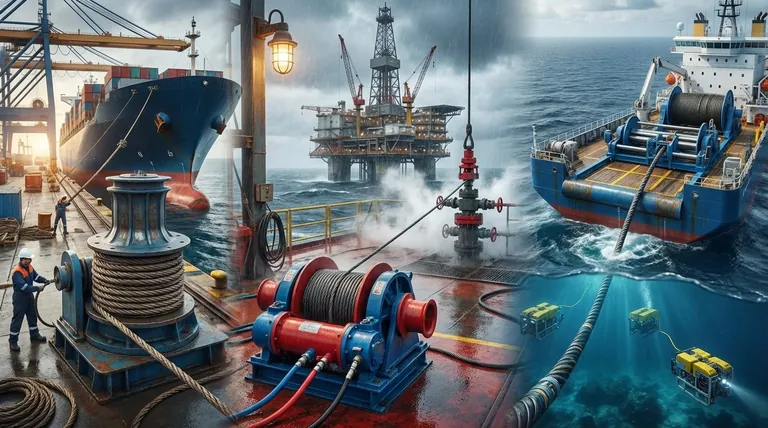
Beyond the standard electric and hydraulic models, a world of specialized winches exists to solve unique and demanding operational challenges. Less common types include capstan winches for continuous pulling, pneumatic (air) winches for hazardous environments, and linear winches for tasks demanding absolute precision.
The key takeaway is that specialized winches are not merely different; they are purpose-built solutions for problems where common winch designs—based on storing cable on a drum—are either inefficient, unsafe, or mechanically incapable.
A Baseline: What Makes a Winch "Common"?
To understand the specialized, we must first define the standard. Most winching tasks are handled by two ubiquitous designs.
Electric Winches: The Versatile Standard
Electric winches are the most prevalent type due to their excellent power-to-size ratio and ease of integration. They are the default choice for vehicle recovery, off-road applications, and many general industrial tasks.
Hydraulic Winches: The Heavy-Duty Workhorse
Powered by a hydraulic system, these winches deliver immense, sustained pulling power. Their durability makes them ideal for heavy-duty industrial applications like tow trucks, mining, and large construction projects.
Specialized Winches for Unique Challenges
When the operational environment or task requirements go beyond the capabilities of standard designs, specialized winches are required.
Capstan Winches: For Endless Pulling
A capstan winch does not store the rope on its drum. Instead, the line is wrapped around the capstan head a few times, and the friction allows it to pull continuously.
The operator manages the slack on the tail end, meaning the pulling length is limited only by the length of the rope, not the size of the drum. This makes them essential for mooring ships and managing anchor lines on docks.
Pneumatic (Air) Winches: For Hazardous Environments
Pneumatic winches run on compressed air rather than electricity. This design is inherently spark-free, making it the only safe option for use in explosive or flammable atmospheres.
You will find them in underground mining, on offshore oil rigs, and in chemical plants where an electrical motor would pose a catastrophic risk. They also function exceptionally well in wet conditions or even fully submerged.
Linear Winches: For Absolute Precision
Linear winches pull cable or wire in a perfectly straight line using a series of clamps or grips, rather than winding it around a drum. This method offers incredibly precise control over tension and movement.
This precision is non-negotiable for delicate operations like laying subsea fiber-optic cables, marine salvage, and scientific deployments where exact positioning is critical.
Understanding the Trade-offs
These specialized winches are not common because their advantages come with significant trade-offs that make them unsuitable for general-purpose use.
Increased Complexity and Cost
Specialized designs are mechanically more complex and expensive to manufacture and maintain than a standard electric winch. A linear winch, with its intricate hydraulic gripping system, is a prime example of this complexity.
Demanding Infrastructure
A pneumatic winch is useless without a powerful, industrial-scale air compressor and associated plumbing. Likewise, a large capstan or linear winch requires significant structural and power infrastructure to support its operation.
Lack of Versatility
These winches are masters of a single, specific task. A linear winch is perfectly designed for laying cable but would be an exceptionally poor choice for recovering a vehicle from a ditch. Their specialized nature is both their greatest strength and their biggest limitation.
Making the Right Choice for Your Goal
Selecting a winch is about matching the tool to the fundamental need of the operation.
- If your primary focus is general versatility and vehicle recovery: An electric winch is almost always the correct and most efficient choice.
- If your primary focus is continuous, heavy industrial pulling: A hydraulic winch provides the necessary power, durability, and duty cycle.
- If your primary focus is safety in an explosive or submerged environment: A pneumatic winch is the only responsible and reliable option.
- If your primary focus is absolute precision or managing exceptionally long lines: A linear or capstan winch is purpose-built for the task.
Ultimately, understanding the core principles behind each winch design empowers you to select the right tool for the specific problem you need to solve.
Summary Table:
| Winch Type | Key Feature | Primary Application |
|---|---|---|
| Capstan Winch | Continuous pulling (no drum storage) | Mooring ships, dock anchor lines |
| Pneumatic (Air) Winch | Spark-free, explosion-proof | Mining, oil rigs, chemical plants |
| Linear Winch | Precise, straight-line tension control | Subsea cable laying, marine salvage |
Struggling with a unique pulling, lifting, or positioning challenge? Standard winches might not be the answer. GARLWAY specializes in engineering robust and reliable winches, including specialized models for extreme conditions. Whether you're a contractor on a complex construction site or an industrial company operating in hazardous environments, our expertise can provide the perfect solution.
Let's solve your specific challenge together. Contact our experts today for a customized consultation!
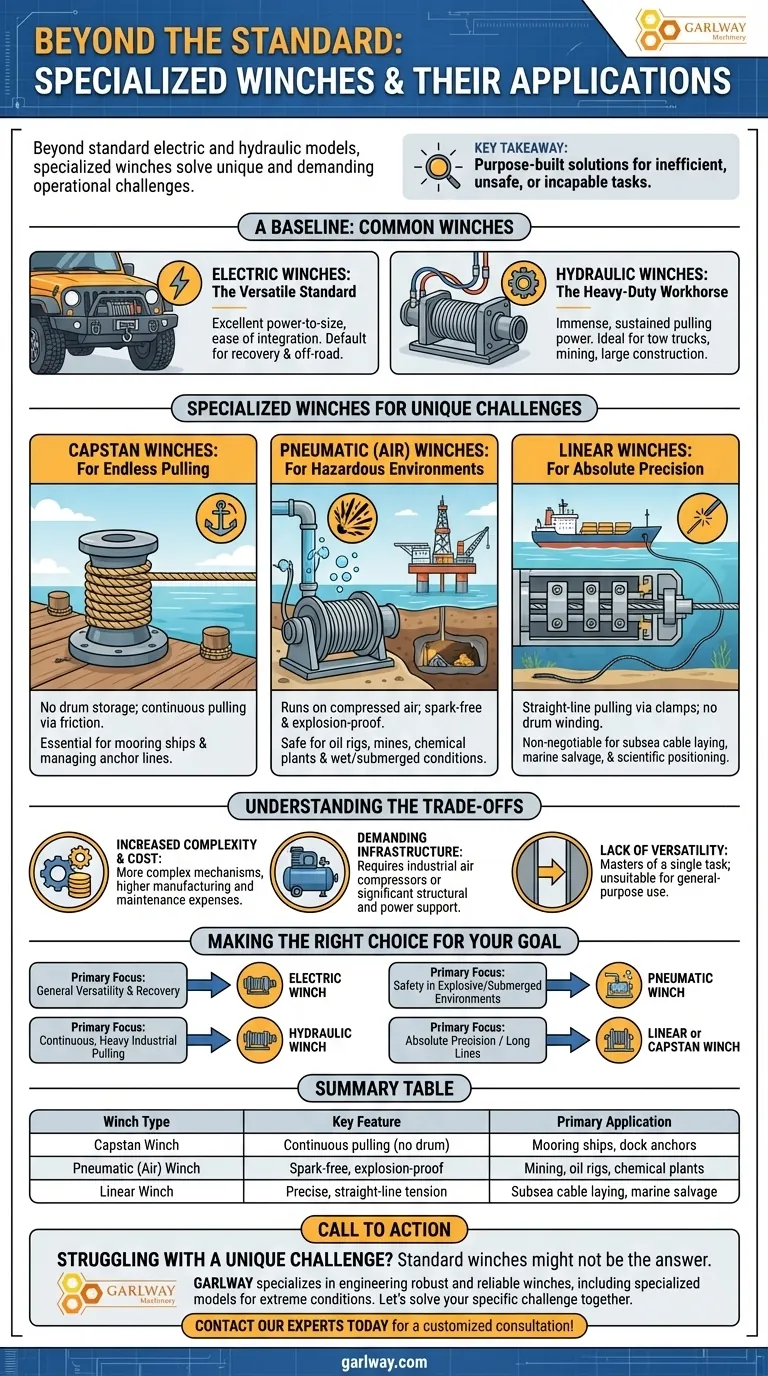
Visual Guide
Related Products
- Small Electric Winch 120V and 240V for Compact Applications
- Warn Winch Windlass Boat Trailer Winch
- Electric and Hydraulic Winch for Heavy Duty Applications
- Quick Windlass Portable Winch for Truck and Boat Best Boat Winch
- Hydraulic Winding Engine Harbor Freight Winch
People Also Ask
- What makes electric winches suitable for off-road use? Key Features for Reliable Vehicle Recovery
- What are the common applications of electric winches? Power Your Lifting & Pulling Tasks
- What are the common uses of an electric winch? A Guide to Safe and Efficient Heavy Lifting
- What are the uses of electric winches in mining and tunneling? Enhance Safety and Efficiency Underground
- How do electric winches contribute to energy savings? Maximize Efficiency and Lower Costs





