The short answer is that cleaning concrete equipment after every batch is essential for maintaining the quality and consistency of future mixes, ensuring accurate measurements, and preventing costly damage to your machinery. Because concrete sets rapidly, any residue left behind immediately begins to compromise your next operation.
The core issue is that leftover concrete is not an inert substance. It actively works against you by altering mix designs, introducing contaminants, and causing abrasive wear on your equipment, turning a simple preventative step into a critical foundation for project success.
The Impact of Hardened Concrete on Future Batches
Failing to clean equipment is not a minor oversight; it has a direct and negative impact on the chemical and physical properties of every subsequent batch of concrete you produce.
Compromising Mix Ratios
The design of a concrete mix is a precise science. The specific water-to-cement ratio and the volume of aggregates are calculated to achieve a target strength and workability.
Hardened residue from a previous batch throws these calculations off. It can add unaccounted-for aggregate or cement paste to the next mix, altering the ratios and leading to unpredictable and substandard results.
Introducing Cross-Contamination
This is especially critical when working with specialized concrete. Residue from a batch containing colorants, accelerators, or other admixtures can easily leach into the next standard batch.
This cross-contamination can lead to aesthetic failures, like discoloration, or performance issues, such as unintended changes in setting time.
Creating Weak Points
Chunks of hardened concrete can break off during mixing and become incorporated into the new batch. These "clinkers" do not bond properly with the fresh matrix.
They create voids and weak points within the final cured product, which can significantly compromise the structural integrity and durability of the pour.
Protecting Your Equipment and Operations
Beyond concrete quality, a consistent cleaning protocol is a fundamental part of equipment maintenance that protects your investment and ensures operational reliability.
Preventing Buildup and Reducing Capacity
With each uncleaned batch, a new layer of concrete hardens inside the mixer drum. Over time, this buildup significantly reduces the internal volume of the mixer.
This means your batches become smaller than intended, leading to inaccuracies in project yield and requiring more batches to complete the job.
Causing Abrasive Damage
Hardened concrete is extremely abrasive. As the mixer turns, this buildup grinds against the drum walls and mixing fins.
This constant abrasion causes premature wear and tear, leading to expensive repairs, component replacement, and significant equipment downtime.
Ensuring Consistent Mixing Action
The fins and paddles inside a mixer are engineered to ensure the components are blended thoroughly and uniformly.
When these parts are caked with hardened concrete, their shape and effectiveness are altered. This results in poor mixing action, non-homogenous concrete, and a low-quality final product.
Understanding the Pitfalls
While the need for cleaning is clear, it's important to approach it with the right mindset to avoid common mistakes.
Time Spent vs. The Cost of Failure
It can be tempting to skip a thorough cleaning to save time on a busy job site. This is a false economy.
The few minutes spent cleaning the equipment are a tiny investment compared to the immense cost of a failed concrete pour, which can involve material waste, demolition, rework labor, and significant project delays.
The Risk of an Incomplete Rinse
A quick, superficial rinse with a hose is not sufficient. This often removes the larger aggregate but can leave a film of cement paste.
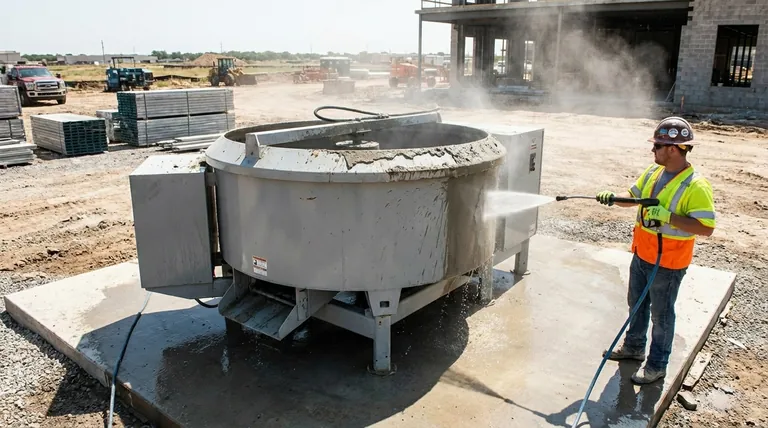
This paste hardens into a rough layer that makes future cleaning even more difficult and still contributes to the problems of buildup and abrasion. A proper cleaning requires high pressure and scrubbing to remove all residue.
Making the Right Choice for Your Goal
Implementing a strict cleaning protocol is a non-negotiable part of professional concrete production. The focus of that protocol can be aligned with your top priorities.
- If your primary focus is structural integrity: Meticulous cleaning is the only way to guarantee accurate mix ratios and prevent the inclusion of weak points that could compromise the final strength.
- If your primary focus is operational efficiency: Consistent cleaning prevents the gradual loss of mixer capacity and protects your machinery from abrasive damage, minimizing downtime and costly repairs.
- If your primary focus is architectural quality: Thorough cleaning is essential to prevent cross-contamination from colored or chemically-modified batches, ensuring aesthetic consistency.
Ultimately, treating equipment cleaning as an integral part of the production cycle is fundamental to delivering a predictable, high-quality product every time.
Summary Table:
| Key Benefit | Impact of Neglecting Cleaning |
|---|---|
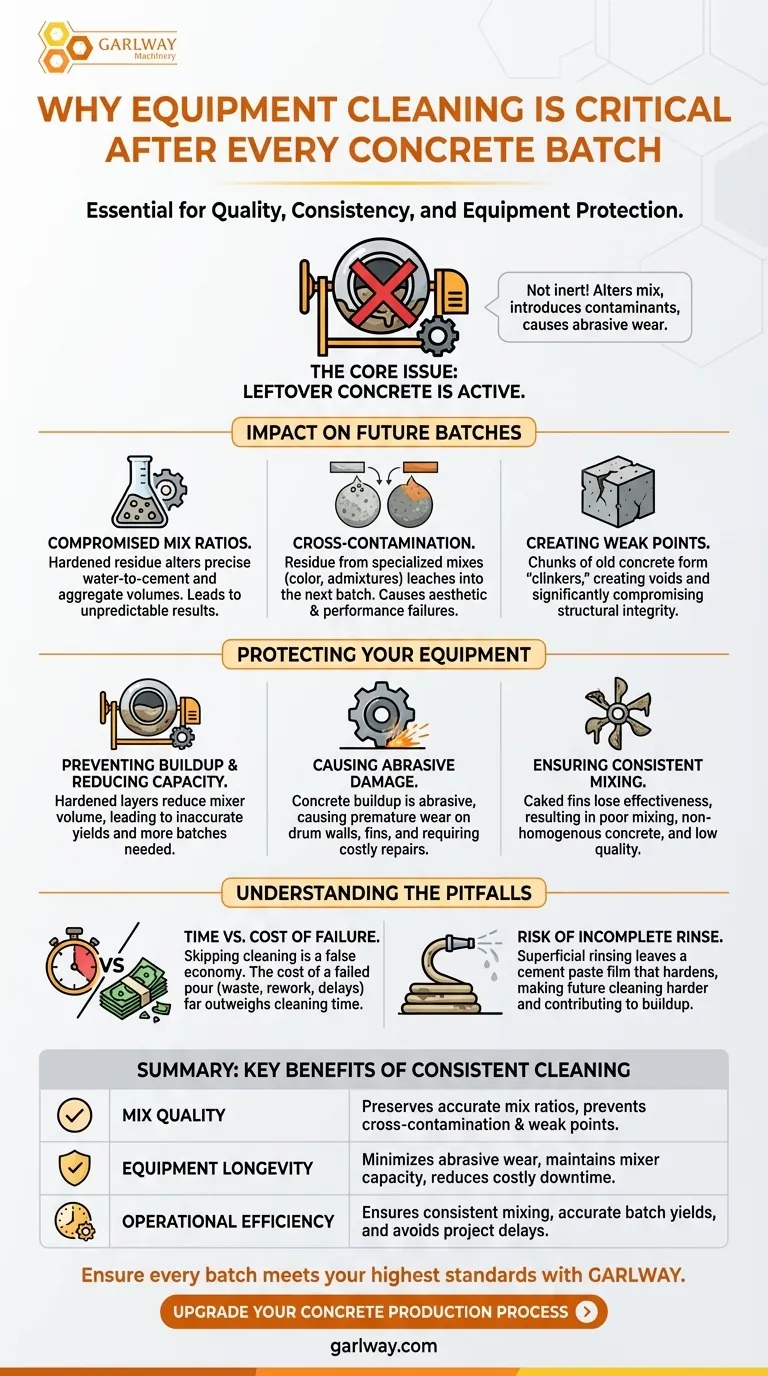
| Mix Quality | Alters water-to-cement ratio, causes cross-contamination, and creates weak points in the concrete. |
| Equipment Longevity | Leads to abrasive wear, reduced mixer capacity, and costly repairs or downtime. |
| Operational Efficiency | Results in inconsistent mixing, inaccurate batch yields, and project delays. |
Ensure every batch meets your highest standards.
At GARLWAY, we understand that reliable equipment is the foundation of a successful construction project. Our durable concrete mixers and batching plants are designed for easy cleaning and long-term performance, helping contractors and construction companies worldwide maintain quality and efficiency.
Ready to upgrade your concrete production process? Contact our experts today to find the perfect solution for your needs!
Visual Guide
Related Products
- Portable Concrete Mixer Machine Equipment for Mixing Concrete
- Construction Products Concrete Plant Machine Mixing Concrete Mixer
- Portable Electric Concrete Mixer Machine for Cement Mixing
- JZC400 Mobile Small Concrete Mixer Cement Mixer Machine
- Hydraulic Concrete Mixer Machine Cement Mixing Equipment for Mixture Concrete
People Also Ask
- Why is it necessary to use a portable concrete mixer? Gain Total Control & Efficiency
- How much concrete can you pour with a portable mixer? Find the Perfect Fit for Your Project
- What types of projects are portable concrete mixers suitable for? Ideal for DIY & Small-Scale Construction
- How much does a portable concrete mixer hold? A Guide to Choosing the Right Capacity
- What types of portable concrete mixers exist? Find the Perfect Mixer for Your Project