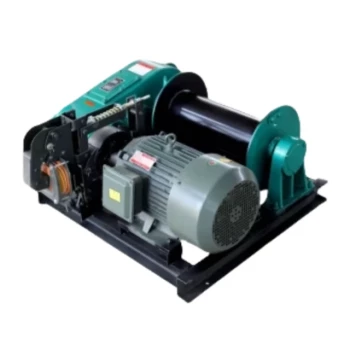
In short, winches are used in recovery operations ranging from pulling an off-road vehicle from mud to righting a capsized ocean liner. They are fundamental tools for tow trucks, fire departments, military operations, and industrial salvage crews, providing the controlled pulling force necessary to move immense or immobilized objects.
The core function of a winch in any recovery is to apply significant, controlled mechanical force. While the scenarios vary dramatically in scale, the underlying principle of retrieving something that is stuck, disabled, or in the wrong position remains the same.
Everyday Vehicle and Emergency Recovery
This is the most common context for winch-based recovery, focused on restoring mobility to standard vehicles or clearing immediate hazards.
Off-Road Self-Recovery
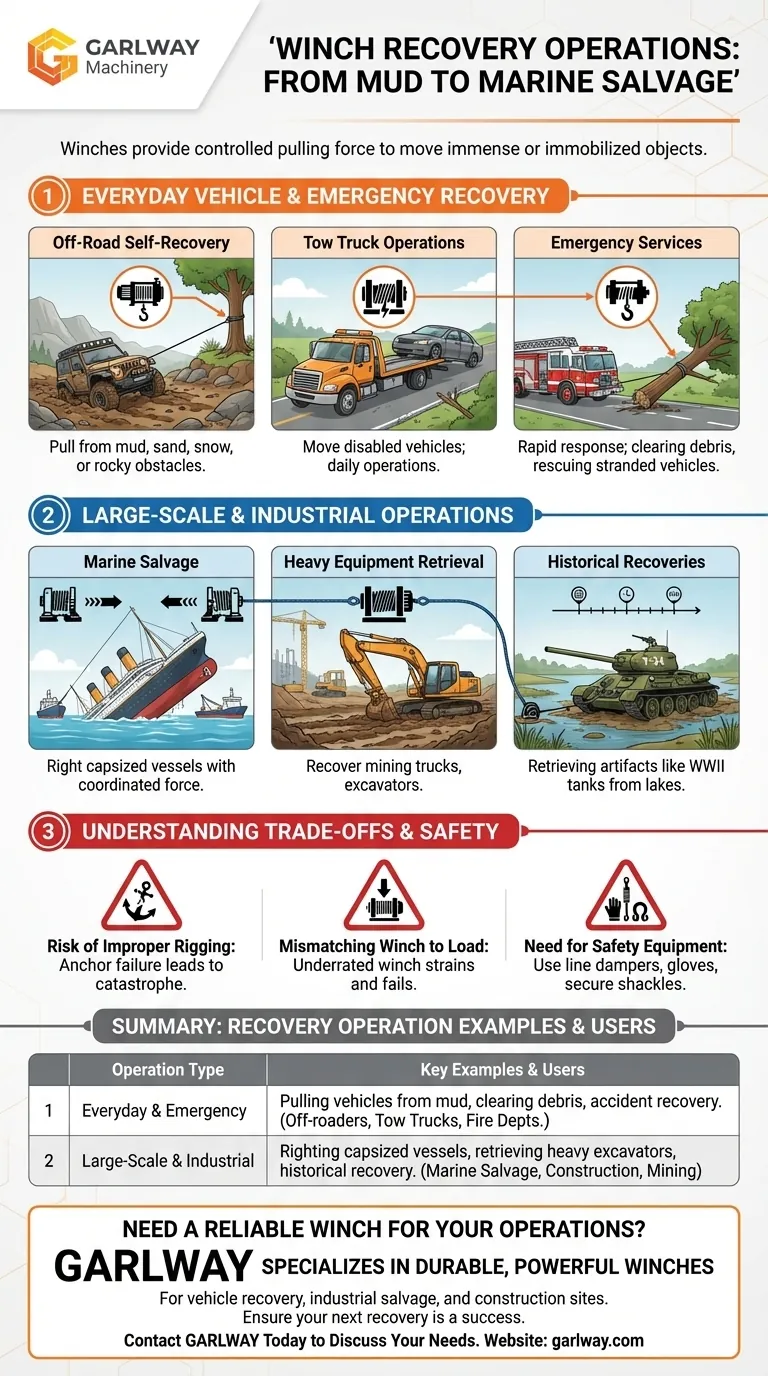
An essential tool for any serious off-roader, a winch provides self-sufficiency. It allows a driver to pull their own vehicle, or another's, out of challenging terrain such as deep mud, sand, snow, or rocky obstacles.
Tow Truck Operations
Tow trucks are universally equipped with winches, typically powerful hydraulic models. These are used daily to pull disabled or damaged vehicles onto a flatbed or to move them from a ditch or accident scene.
Emergency Services
Fire trucks and other emergency vehicles often use winches for rapid response tasks. This can include clearing debris like fallen trees from a roadway or rescuing stranded vehicles from precarious situations.
Large-Scale and Industrial Operations
At the high end of the spectrum, specialized winches are indispensable for massive industrial, marine, and historical recovery efforts that require immense power and precision.
Marine Salvage
One of the most dramatic examples of winch power is in marine salvage. Massive winch systems are used in complex operations to right capsized vessels, including enormous ocean liners, by applying tremendous, coordinated pulling force.
Heavy Equipment Retrieval
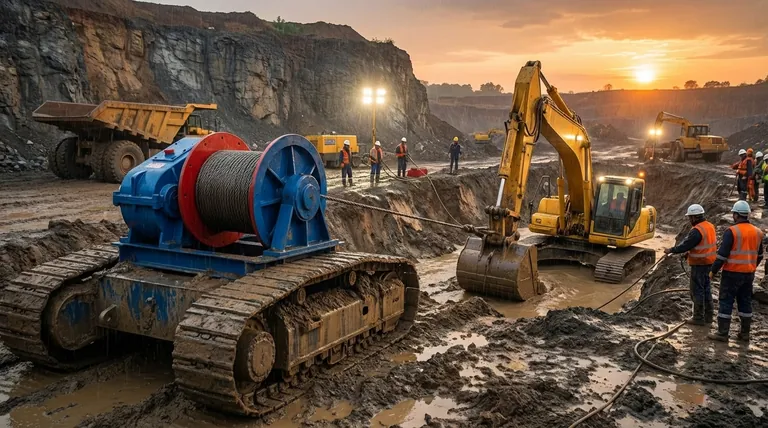
On construction sites or in industrial zones, large equipment can become stuck or disabled. Winches are used to recover everything from heavy excavators to mining trucks from difficult or unsafe locations.
Historical Recoveries
Winches have even been used to recover priceless historical artifacts. A notable example is the recovery of a WWII-era T-34 tank from a boggy German lake 50 years after the war, pulled to shore using a powerful hydraulic winch.
Understanding the Trade-offs
While powerful, a winch is not a magic solution. Its effectiveness is entirely dependent on proper use and a clear understanding of mechanical forces.
The Risk of Improper Rigging
The single greatest point of failure in a winch recovery is the anchor point or rigging. Choosing an anchor that cannot withstand the load, or using damaged straps, can lead to catastrophic failure and severe injury.
Mismatching Winch to Load
Using a winch that is underrated for the vehicle or object being recovered is a common mistake. This not only strains the winch motor and cable but may fail to complete the recovery, leaving you in a worse situation.
The Need for Safety Equipment
Professional recovery operations never rely on the winch alone. Essential safety gear includes winch line dampers to absorb energy if the line snaps, heavy-duty gloves, and secure shackles. Ignoring these tools turns a recovery into a significant risk.
Making the Right Choice for Your Goal
The type of recovery dictates the equipment and approach required.
- If your primary focus is personal off-road safety: A properly rated electric winch mounted to your vehicle provides critical self-reliance.
- If your primary focus is commercial towing: A robust, high-speed hydraulic winch is essential for efficient and safe daily operations.
- If your primary focus is industrial salvage: The operation requires a custom-engineered system of multiple, high-capacity winches with meticulous planning.
Ultimately, a winch is a foundational tool of leverage, enabling a small force to move a massive object safely and effectively.
Summary Table:
| Recovery Operation Type | Primary Users | Key Examples |
|---|---|---|
| Everyday & Emergency | Off-roaders, Tow Trucks, Fire Departments | Pulling vehicles from mud/snow, clearing road debris, accident recovery |
| Large-Scale & Industrial | Marine Salvage Crews, Construction & Mining | Righting capsized vessels, retrieving heavy excavators, historical artifact recovery |
Need a reliable winch for your recovery operations? GARLWAY specializes in construction machinery, offering durable and powerful winches, concrete mixers, and concrete batching plants for construction companies and contractors globally. Our equipment is engineered for the demanding conditions of vehicle recovery, industrial salvage, and construction site operations. Contact GARLWAY today to discuss your specific needs and ensure your next recovery is a success.
Visual Guide
Related Products
- Warn Winch Windlass Boat Trailer Winch
- Electric and Hydraulic Winch for Heavy Duty Applications
- Small Electric Winch 120V and 240V for Compact Applications
- 12000 lb Electric Boat Trailer Winch with Windlass Anchor Warn
- Quick Windlass Portable Winch for Truck and Boat Best Boat Winch
People Also Ask
- What are the main components of a boat trailer winch? A Guide to Safe & Efficient Boat Loading
- What factors should be considered when choosing a boat trailer winch? Ensure Safe and Effortless Boat Loading
- What is the purpose of boat trailer winches? Safely and Efficiently Load Your Boat
- What are the two main types of boat trailer winches? Manual vs. Electric Explained
- How often should a boat trailer winch be replaced? Your Guide to Safety and Longevity