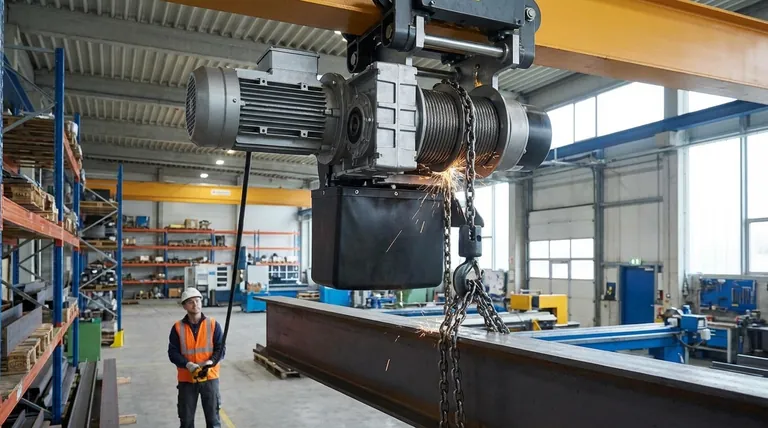
At its core, a hoist operates by converting a power source—whether manual, electric, or pneumatic—into vertical force through a system of gears, drums, or wheels. For lifting, this system engages to pull a chain or wire rope. For lowering, the process is either reversed under power or controlled by a braking mechanism that uses the load's own gravity for descent.
The essential function of any hoist is the controlled multiplication of force. It masterfully transforms a small, manageable input into the immense power required for vertical lifting, while ensuring the descent is always safe and predictable.
The Core Principle: Converting Power to Vertical Force
A hoist is fundamentally a device for gaining mechanical advantage, designed exclusively for vertical lifting and lowering. It takes an input force and multiplies it to overcome the weight of a heavy object.
The Lever Principle Applied
Every hoist operates on a principle similar to a lever. It uses mechanisms like gears or the winding of a drum to transform a low-force, high-travel input into a high-force, low-travel output.
The Lifting Medium: Chain vs. Wire Rope
While some hoists use wire rope wound onto a drum, many modern hoists utilize a chain that passes over a grooved lift-wheel. The chain is a robust and durable medium well-suited for the pure vertical tension of a lift.
Dissecting Lifting and Lowering Mechanisms
Hoists achieve lifting and lowering through several distinct methods, each suited to different applications.
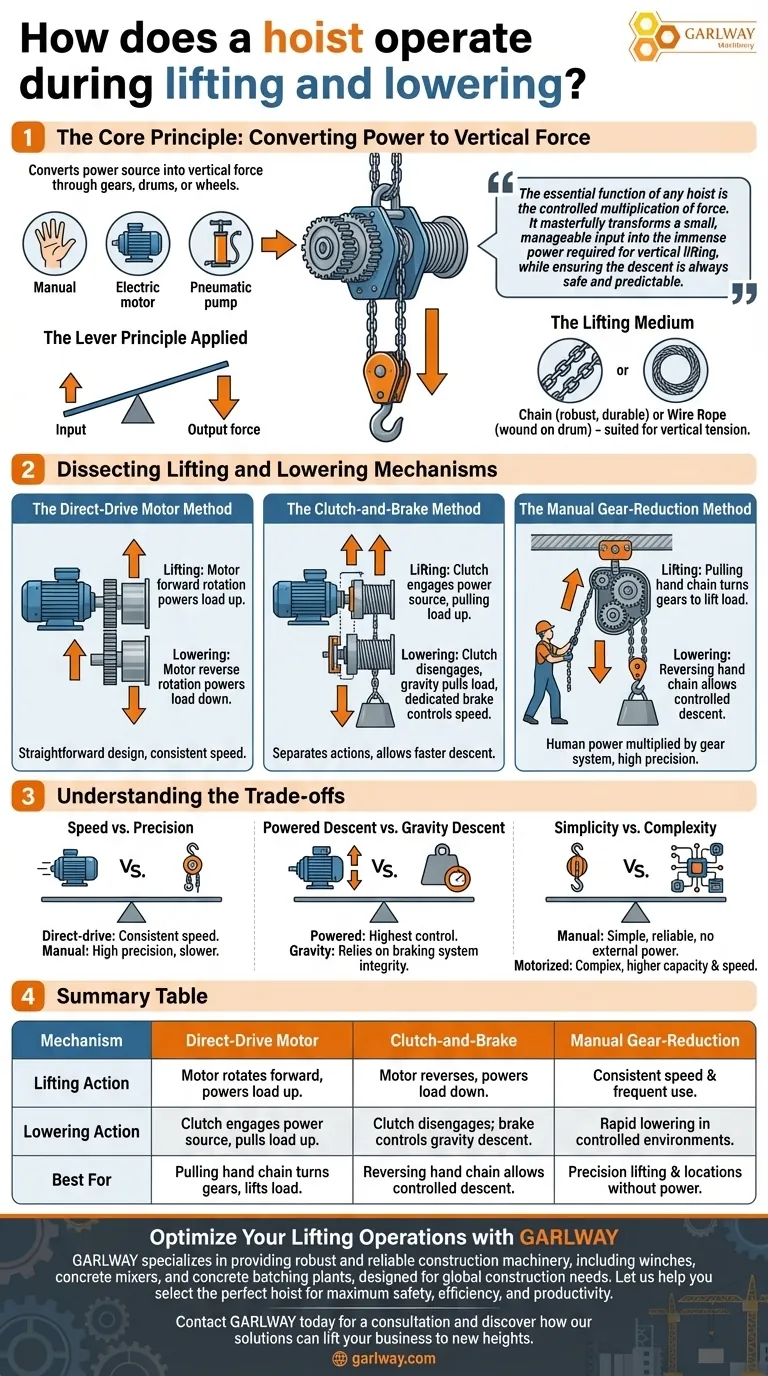
The Direct-Drive Motor Method
This is the most straightforward design. An electric motor's rotation directly controls the movement.
The motor's forward rotation engages the gearing to lift the load. To lower it, the motor simply rotates in reverse, powering the load down at the same controlled speed.
The Clutch-and-Brake Method
This design separates the lifting and lowering actions for specific performance characteristics, often allowing for faster descent.
During lifting, a clutch engages the power source with the drum or lift-wheel, actively pulling the load upward.
For lowering, the clutch disengages, disconnecting the power source. The load's own gravity causes the drum to reverse, and a dedicated brake controls the speed of this descent.
The Manual Gear-Reduction Method
Manual chain hoists rely on human power, multiplied through an ingenious gear system.
An operator pulls a light hand chain, which turns a series of internal reduction gears. This action concentrates the operator's effort, applying a powerful, slow-moving force to the load chain that lifts the object.
Understanding the Trade-offs
The choice of hoist mechanism involves critical trade-offs between speed, control, and complexity.
Speed vs. Precision
Direct-drive motor hoists offer consistent, predictable speeds for both lifting and lowering. Manual hoists are significantly slower but provide exceptional precision. Clutch-and-brake systems can enable very fast lowering, but this speed is dependent on the load's weight.
Powered Descent vs. Gravity Descent
Powering a load down with a reversing motor offers the highest degree of control. Relying on a gravity-assisted descent with a brake is effective but places the entire safety burden on the braking mechanism's integrity and responsiveness.
Simplicity vs. Complexity
Manual hoists are mechanically simple and highly reliable, requiring no external power. Motorized systems are more complex and require maintenance, but they remove the limitations of human strength and offer much greater speed and capacity.
Matching the Hoist to the Task
Understanding these operational differences is key to selecting the right tool for your specific goal.
- If your primary focus is consistent speed and frequent use: A direct-drive motor hoist that powers the load both up and down provides the most efficient and predictable performance.
- If your primary focus is precision and use in locations without power: A manual chain hoist offers unmatched control and operational simplicity.
- If your primary focus is rapid lowering in a controlled environment: A hoist with a clutch-and-brake mechanism allows for fast, gravity-assisted descent, but demands rigorous inspection of its braking system.
By grasping these fundamental mechanics, you can ensure your lifting operations are not just possible, but also optimally safe and efficient.
Summary Table:
| Mechanism | Lifting Action | Lowering Action | Best For |
|---|---|---|---|
| Direct-Drive Motor | Motor rotates forward, powering the load up. | Motor reverses, powering the load down. | Consistent speed and frequent use. |
| Clutch-and-Brake | Clutch engages power source to pull the load up. | Clutch disengages; brake controls gravity descent. | Rapid lowering in controlled environments. |
| Manual Gear-Reduction | Pulling hand chain turns gears to lift the load. | Reversing hand chain allows controlled descent. | Precision lifting and locations without power. |
Optimize Your Lifting Operations with GARLWAY
Understanding hoist mechanics is the first step. Implementing the right equipment is what drives real-world success. GARLWAY specializes in providing robust and reliable construction machinery, including winches, concrete mixers, and concrete batching plants, designed for the demanding needs of construction companies and contractors globally.
Let us help you select the perfect hoist for your specific application, ensuring maximum safety, efficiency, and productivity on your job site.
Contact GARLWAY today for a consultation and discover how our solutions can lift your business to new heights.
Visual Guide
Related Products
- Electric Hoist Winch Boat Anchor Windlass for Marine Applications
- Electric and Hydraulic Winch for Heavy Duty Applications
- Hydraulic Winding Engine Harbor Freight Winch
- Portable Cement Mixer with Lift Concrete Machine
- 12000 lb Electric Boat Trailer Winch with Windlass Anchor Warn
People Also Ask
- How does an electric anchor winch work? Power, Safety, and Reliable Operation Explained
- What are the advantages of installing an electric anchor winch on a boat? Boost Safety & Ease for Boaters
- What are the operational differences between electric hoists and winches? A Guide to Safe Lifting vs. Pulling
- What are the main benefits of a boat anchor winch? Boost Safety & Efficiency for Your Vessel
- How does a boat anchor winch work? A Guide to Reliable Anchor Handling