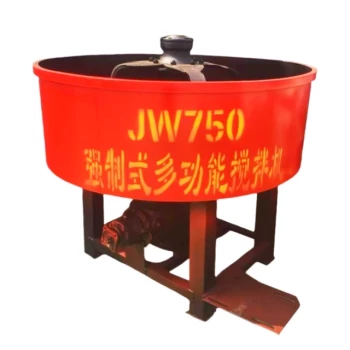
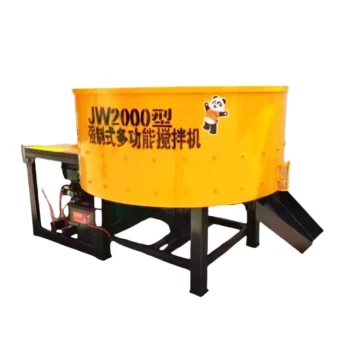
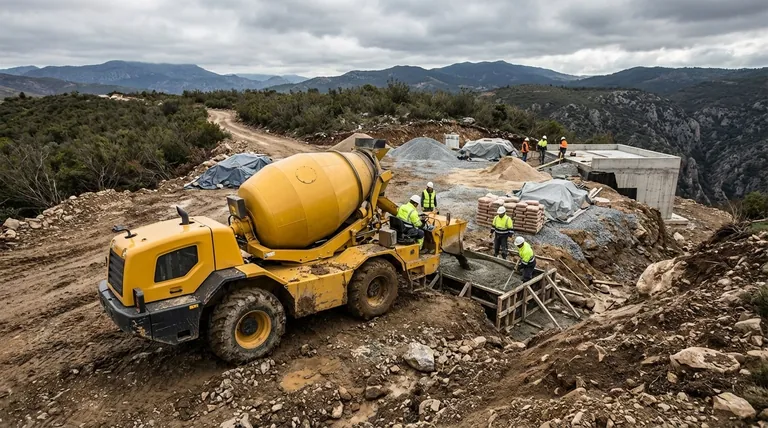
Rough terrain mixers are specialized vehicles designed to produce and deliver fresh concrete directly to job sites that are inaccessible to standard equipment. They are purpose-built to navigate and operate effectively in remote locations, on undeveloped land, and across challenging or harsh ground conditions where traditional transit mixers would fail.
The core function of a rough terrain mixer is to eliminate logistical barriers. It combines the capabilities of an all-terrain vehicle, a mobile batching plant, and a concrete transporter into a single, rugged machine, ensuring concrete can be produced precisely where it is needed, regardless of the environment.
The Core Problem: Concrete in Inaccessible Locations
To understand the value of a rough terrain mixer, one must first appreciate the limitations of conventional concrete delivery methods in specific environments.
The Limitations of Standard Transit Mixers
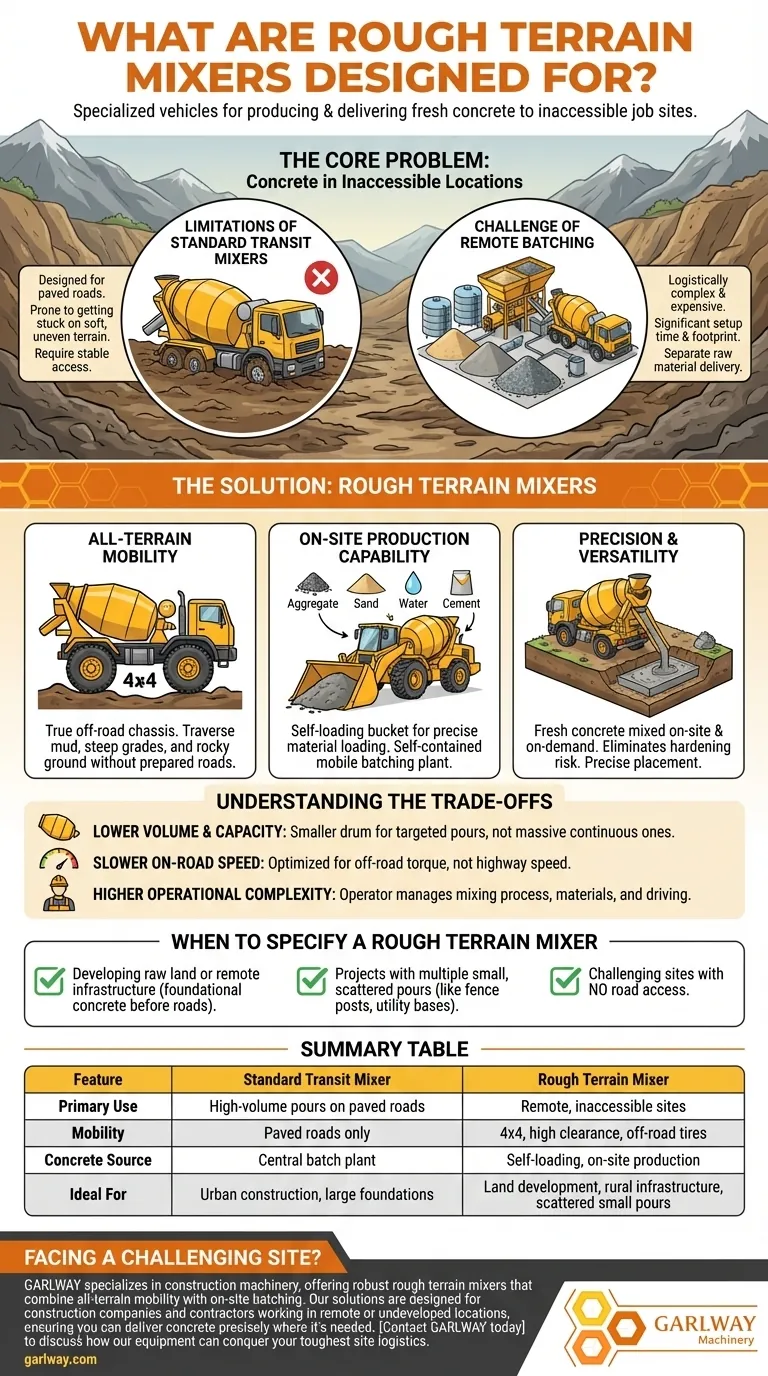
Standard concrete trucks are designed for paved roads. Their weight, tire type, and low ground clearance make them extremely prone to getting stuck on soft ground, mud, or uneven terrain. They require stable, prepared access routes to the pour site, which are often unavailable in the early stages of a project.
The Challenge of Remote Batching
For remote projects, an alternative is setting up a temporary concrete batch plant on-site. However, this is a logistically complex and expensive undertaking, requiring significant setup time, a large footprint, and separate delivery of raw materials (sand, aggregate, cement, and water).
How Rough Terrain Mixers Provide the Solution
Rough terrain mixers are engineered with specific features to overcome these exact challenges, making them an indispensable tool for certain types of projects.
All-Terrain Mobility
These machines are built on a true off-road chassis, typically featuring four-wheel drive (4x4), high ground clearance, and large, aggressive tires. This allows them to traverse mud, steep grades, and rocky, uneven ground without the need for prepared access roads.
On-Site Production Capability
Many rough terrain mixers are self-loading. They are equipped with a front-mounted bucket that allows the operator to load the precise amount of aggregate and sand directly into the mixing drum. Combined with on-board water tanks and cement storage, the machine becomes a self-contained, mobile batching plant.
Precision and Versatility
Because concrete is mixed on-site and on-demand, you get a fresh batch exactly when and where you need it. This eliminates the risk of concrete hardening during a long transit from a distant plant and significantly reduces waste. Many models also feature rotating drums and chutes for precise placement.
Understanding the Trade-offs
While incredibly capable, rough terrain mixers are not a universal solution. Their specialized design comes with important trade-offs.
Lower Volume and Capacity
Compared to a large, road-going transit mixer that can carry 8-10 cubic meters (or more), rough terrain mixers typically have a smaller drum capacity. They are designed for targeted, specific pours rather than massive, continuous ones.
Slower On-Road Speed
These vehicles are optimized for off-road torque and durability, not highway speed. Transporting them over long distances between major project sites can be less efficient than moving standard trucks.
Higher Operational Complexity
The operator of a self-loading mixer is responsible for more than just driving. They must accurately measure materials, manage the water-cement ratio, and control the entire mixing process, which requires a higher level of skill and training.
When to Specify a Rough Terrain Mixer
Your choice of equipment should always be driven by the specific constraints and goals of your project.
- If your primary focus is developing raw land or remote infrastructure: A rough terrain mixer is essential for producing foundational concrete before roads are built.
- If your primary focus is projects with multiple small, scattered pours (like fence posts or utility bases): The mixer's ability to move, produce a small batch, and move again is far more efficient than coordinating multiple deliveries from a central plant.
- If your primary focus is high-volume, easily accessible pours: Conventional transit mixers delivering from a dedicated batch plant remain the most cost-effective and efficient solution.
Ultimately, specifying a rough terrain mixer is about matching the equipment's unique capabilities to the logistical challenges of your specific job site.
Summary Table:
| Feature | Standard Transit Mixer | Rough Terrain Mixer |
|---|---|---|
| Primary Use | High-volume pours on paved roads | Remote, inaccessible sites with no prepared roads |
| Mobility | Paved roads only | 4x4 drive, high clearance, off-road tires |
| Concrete Source | Central batch plant | Self-loading, on-site production |
| Ideal For | Urban construction, large foundations | Land development, rural infrastructure, scattered small pours |
Facing a challenging site with no road access? GARLWAY specializes in construction machinery, offering robust rough terrain mixers that combine all-terrain mobility with on-site batching. Our solutions are designed for construction companies and contractors working in remote or undeveloped locations, ensuring you can deliver concrete precisely where it's needed. Contact GARLWAY today to discuss how our equipment can conquer your toughest site logistics.
Visual Guide
Related Products
- Portable Concrete Mixer Machine Equipment for Mixing Concrete
- JDY350 Electric Hydraulic Mortar Mud Concrete Mixer
- Construction Products Concrete Plant Machine Mixing Concrete Mixer
- Portable Ready Mix Concrete Mixer Equipment
- JDC350 Small Cement Concrete Mortar Mixer
People Also Ask
- Why is it necessary to use a portable concrete mixer? Gain Total Control & Efficiency
- How much concrete can you pour with a portable mixer? Find the Perfect Fit for Your Project
- What types of projects are portable concrete mixers suitable for? Ideal for DIY & Small-Scale Construction
- How much does a portable concrete mixer hold? A Guide to Choosing the Right Capacity
- What types of portable concrete mixers exist? Find the Perfect Mixer for Your Project