
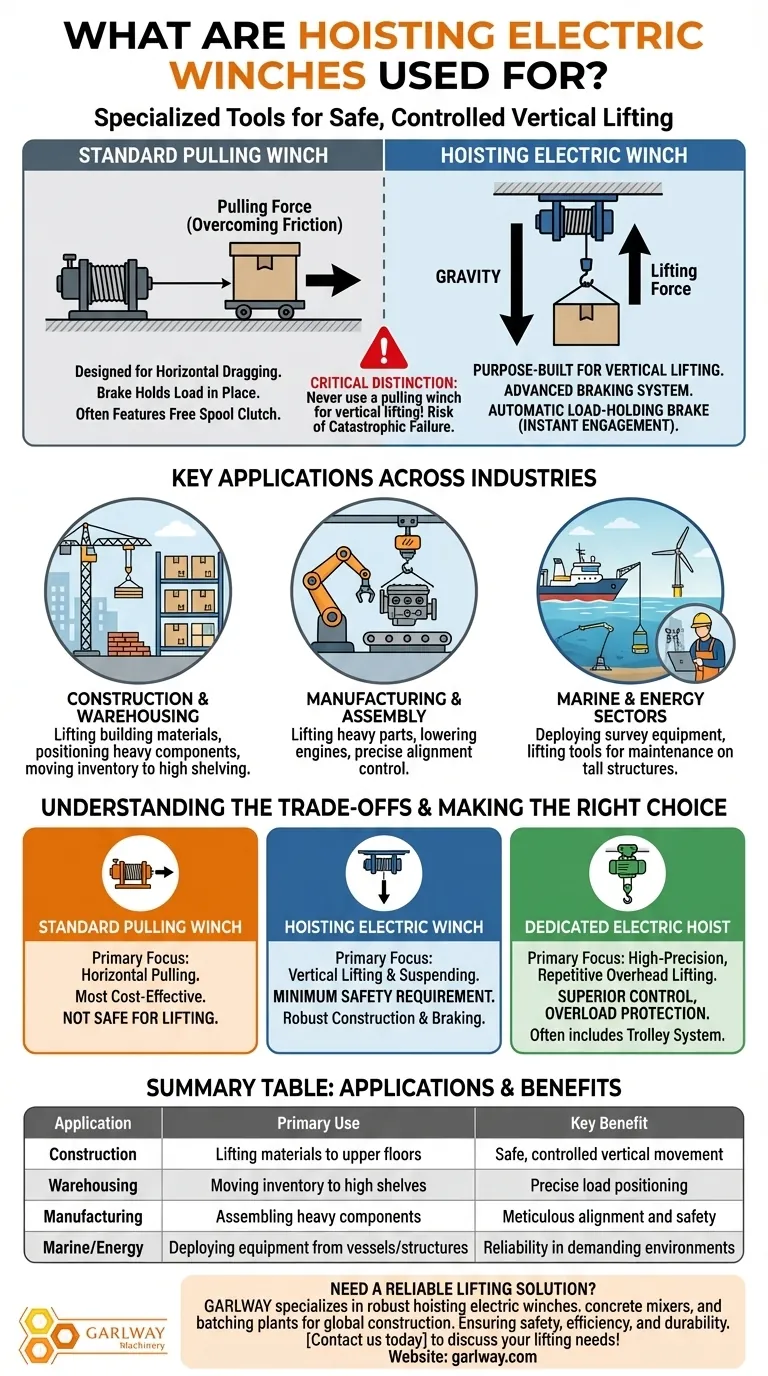
At their core, hoisting electric winches are specialized tools designed for the vertical lifting of materials and equipment. Unlike standard winches built for pulling loads horizontally, hoisting winches are engineered with specific safety and control features, making them essential in environments like construction sites, warehouses, and manufacturing facilities where loads must be safely suspended and positioned.
The critical distinction to understand is that a hoisting winch is purpose-built for lifting against gravity. Its design, particularly its advanced braking system, prioritizes safety and precision for vertical applications, a task for which a standard pulling winch is fundamentally unsuited.
The Core Difference: Lifting vs. Pulling
Many people use the terms "winch" and "hoist" interchangeably, but in engineering and safety, the distinction is vital. The difference is rooted in the direction of force and the design of the braking system.
The Role of a Standard Winch
A standard electric winch is a pulling machine. It is designed to drag a load across a surface, overcoming friction. Its brake is typically designed to simply hold the load in place, not to safely suspend it overhead. Many feature a "free spool" clutch for rapid cable deployment, a feature optimized for pulling, not lifting.
The Specialization of a Hoisting Winch
A hoisting winch is a lifting machine. It is engineered from the ground up to work against the full, direct force of gravity. Every component, from the gears to the cable and drum, is rated for the unique stresses of vertical lifting.
The Critical Braking System
The defining feature of a hoisting winch is its automatic, load-holding brake. This system is designed to engage instantly the moment power is cut or interrupted. This ensures the load does not slip or fall, which is the paramount safety requirement for any overhead lifting operation.
Key Applications Across Industries
The unique capabilities of hoisting electric winches make them indispensable tools in a variety of demanding fields.
Construction and Warehousing
This is the most common application. Hoisting winches are used to lift building materials to upper floors, position heavy components, and move inventory onto high shelving. Their precision control allows for careful placement of sensitive items.
Manufacturing and Assembly
In factories, these winches are crucial for lifting heavy parts onto an assembly line or lowering engines into vehicle chassis. The ability to control speed allows for meticulous and safe alignment.
Marine and Energy Sectors
Hoisting winches are used in marine science to deploy and retrieve sensitive survey equipment from vessels. In the oil, gas, and renewable energy sectors, they are used for maintenance, lifting tools and inspection equipment onto tall structures like turbines or rigs.
Understanding the Trade-offs
Choosing the right equipment requires understanding its specific strengths and limitations compared to other solutions.
Hoisting Winches vs. Dedicated Hoists
While a hoisting winch is built for lifting, a dedicated electric hoist (like a chain hoist or wire rope hoist) may offer even greater precision. Hoists often include features like integrated trolleys for horizontal movement, overload protection, and finer variable speed control for delicate positioning tasks.
Cost and Complexity
Due to their enhanced safety features, superior braking systems, and more robust construction, hoisting-rated winches are significantly more expensive and complex than standard pulling winches of a similar capacity.
The Critical Risk of Misuse
Never use a standard pulling winch for any vertical lifting task. Their braking systems are not designed to reliably suspend a load against gravity. A failure can be catastrophic, leading to property damage, severe injury, or death.
Making the Right Choice for Your Application
Selecting the correct tool is the most important step for ensuring both safety and efficiency for your project.
- If your primary focus is horizontal pulling: A standard electric winch is the correct and most cost-effective tool for the job.
- If your primary focus is vertical lifting and suspending a load: A hoisting electric winch is the minimum safety requirement and is designed specifically for this purpose.
- If your primary focus is high-precision, repetitive overhead lifting: A dedicated electric hoist often provides superior control, overload protection, and integration with trolley systems.
Ultimately, choosing a tool rated specifically for lifting is a non-negotiable decision that protects both your equipment and your personnel.
Summary Table:
| Application | Primary Use | Key Benefit |
|---|---|---|
| Construction | Lifting materials to upper floors | Safe, controlled vertical movement |
| Warehousing | Moving inventory to high shelves | Precise load positioning |
| Manufacturing | Assembling heavy components | Meticulous alignment and safety |
| Marine/Energy | Deploying equipment from vessels/structures | Reliability in demanding environments |
Need a reliable lifting solution for your project? GARLWAY specializes in construction machinery, offering robust hoisting electric winches, concrete mixers, and batching plants designed for construction companies and contractors globally. Our equipment ensures safety, efficiency, and durability. Contact us today to discuss how we can meet your specific lifting needs!
Visual Guide
Related Products
- Electric Hoist Winch Boat Anchor Windlass for Marine Applications
- Electric and Hydraulic Winch for Heavy Duty Applications
- Heavy Duty Electric Boat Winch Windlass Anchor
- 12000 lb Electric Boat Trailer Winch with Windlass Anchor Warn
- Small Electric Winch 120V and 240V for Compact Applications
People Also Ask
- How does an electric anchor winch work? Power, Safety, and Reliable Operation Explained
- What are the advantages of installing an electric anchor winch on a boat? Boost Safety & Ease for Boaters
- What are the operational differences between electric hoists and winches? A Guide to Safe Lifting vs. Pulling
- What are the main benefits of a boat anchor winch? Boost Safety & Efficiency for Your Vessel
- How does a boat anchor winch work? A Guide to Reliable Anchor Handling





