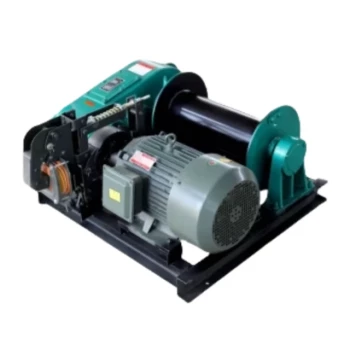
At its core, an electric winch integrates a complete electrical powertrain onto the foundation of a manual winch. This adds a motor to do the work, a solenoid to handle the high-current switching, a control system for operation, and a clutch for disengaging the drum. These components work together to replace manual effort with electrical power.
While a manual winch is a simple mechanical system of gears and a drum, an electric winch adds a dedicated powertrain. This introduces complexity but delivers significant gains in power, speed, and convenience for heavy or frequent pulling tasks.
The Foundation: A Manual Winch's Simplicity
A manual winch is a testament to mechanical advantage. Understanding its basic design is key to seeing what makes an electric winch different.
### The Core Mechanism
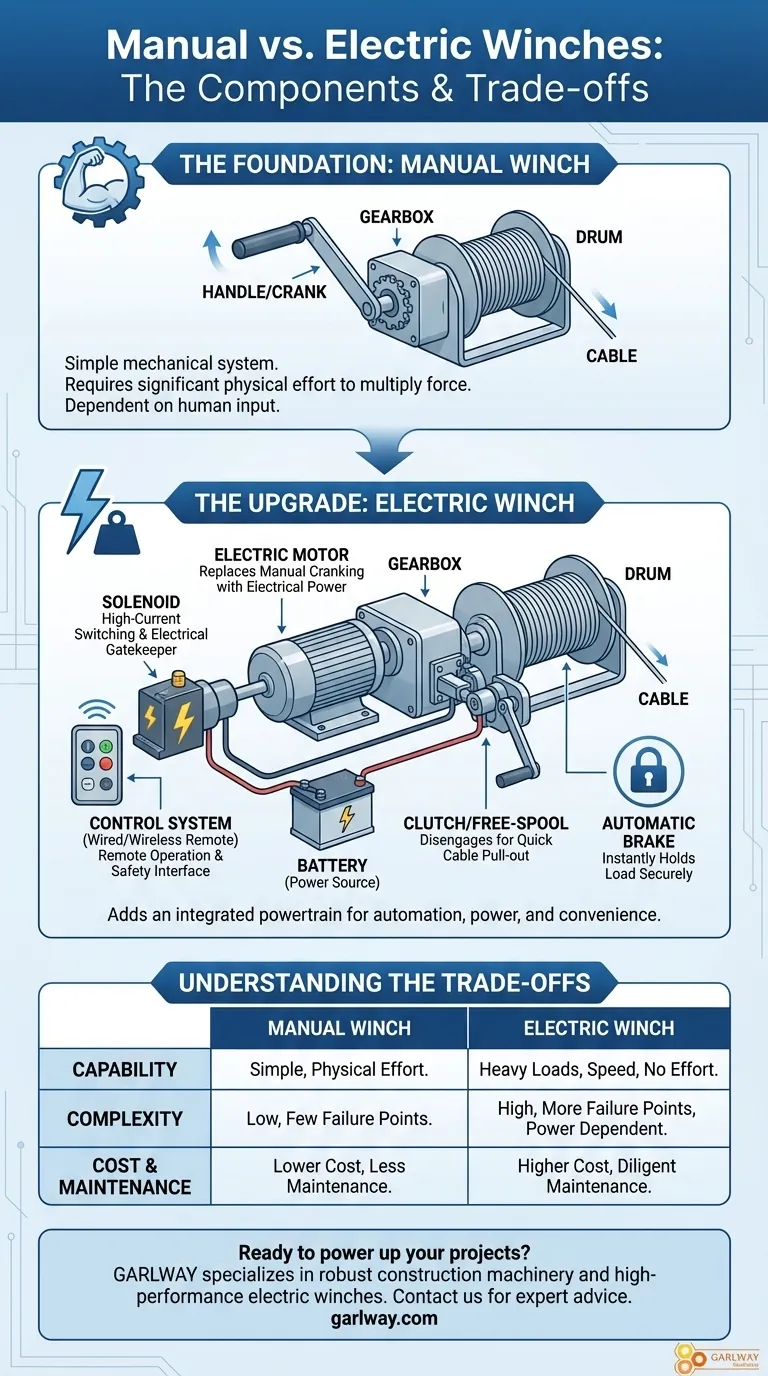
A manual winch consists of a drum to wrap the cable, a gearbox to multiply the force you apply, and a handle or crank for you to provide that force.
### The Operation
You turn the crank, the gears multiply your effort, and the drum slowly and powerfully winds the cable. Its operation is entirely dependent on your physical input.
The Electrified Powertrain: What Electric Winches Add
An electric winch builds upon the manual winch's foundation by adding a system of components designed to automate the pulling process. This system is essentially an integrated powertrain.
### The Electric Motor
This is the heart of the system, directly replacing the need for manual cranking. It connects to a power source, typically a 12-volt vehicle battery, to generate the rotational force needed to turn the drum.
### The Solenoid (Contactor)
An electric motor requires a large amount of electrical current that a simple switch in a remote control cannot handle. The solenoid acts as a heavy-duty, remote-controlled relay or electrical gatekeeper. It takes the low-power signal from your controller and safely connects the high-amperage current from the battery to the motor.
### The Control System
This is your interface with the winch. It can be a wired remote that plugs directly into the winch or a wireless remote that offers greater freedom and safety. This system sends the signal to the solenoid to power the motor in or out.
### The Clutch and Free-Spool
The clutch mechanism allows you to disengage the motor and gearbox from the drum. This enables free-spooling, where you can pull the cable out by hand quickly and easily, which is far faster than trying to power it out with the motor.
### The Automatic Brake
Most electric winches include an automatic braking system. When you stop powering the motor, the brake engages instantly to hold the load securely in place. This is a critical safety feature for lifting or holding a load on an incline.
Understanding the Trade-offs
Adding an electrical powertrain introduces a clear set of advantages and disadvantages compared to the purely mechanical nature of a manual winch.
### Capability and Convenience
The primary benefit of an electric winch is its ability to handle heavier loads with greater speed and no physical effort. Remote operation also allows you to control the pull from a safer distance.
### Complexity and Failure Points
Each added electrical component—motor, solenoid, wiring, controls—is a potential point of failure. Electric winches require a reliable power source and are more susceptible to issues from water, dirt, and wear.
### Cost and Maintenance
The added components and engineering make electric winches significantly more expensive than manual winches. They also require more diligent maintenance to ensure the electrical connections are clean and the motor is in good working order.
Making the Right Choice for Your Task
Your final decision depends entirely on the demands of your work.
- If your primary focus is absolute reliability and use in situations without a power source: A manual winch's simplicity is unmatched.
- If your primary focus is handling frequent, heavy loads with speed and minimal effort: An electric winch is the correct and necessary tool.
- If your primary focus is occasional light-duty pulling on a strict budget: A manual winch provides the best value and is more than sufficient.
Ultimately, choosing the right winch means matching its complexity and capability to the specific challenges you face.
Summary Table:
| Component | Function | Key Benefit |
|---|---|---|
| Electric Motor | Replaces manual cranking with electrical power | Enables handling of heavier loads with minimal effort |
| Solenoid | Acts as a heavy-duty relay for high-current switching | Allows safe remote control of the winch |
| Control System | Interface for operation (wired/wireless remote) | Provides convenience and safety from a distance |
| Clutch | Disengages motor from drum for free-spooling | Allows quick manual cable deployment |
| Automatic Brake | Engages instantly when power stops | Critical safety feature for holding loads securely |
Ready to power up your projects with a reliable electric winch?
At GARLWAY, we specialize in providing robust construction machinery, including high-performance electric winches, concrete mixers, and batching plants, designed for the demanding needs of construction companies and contractors worldwide.
Our winches are engineered for durability, safety, and maximum efficiency, helping you tackle heavy lifting and pulling tasks with ease. Let us help you select the perfect equipment to enhance your site's productivity.
Contact our experts today for a personalized consultation and discover the GARLWAY difference!
Visual Guide
Related Products
- Electric 120V Boat Winch by Badlands
- Electric and Hydraulic Winch for Heavy Duty Applications
- Small Electric Winch 120V and 240V for Compact Applications
- 12000 lb Electric Boat Trailer Winch with Windlass Anchor Warn
- Electric Hoist Winch Boat Anchor Windlass for Marine Applications
People Also Ask
- How do electric boat winches work? Unlock Effortless Launching & Retrieval
- How much current does an electric boat winch draw? Plan Your Electrical System for Peak Performance
- Can I run a winch straight from a battery? Essential Power Setup for Safe Operation
- What are the types of electric winches available? Choose the Right Winch for Your Job
- What are the uses of electric winches in mining and tunneling? Enhance Safety and Efficiency Underground