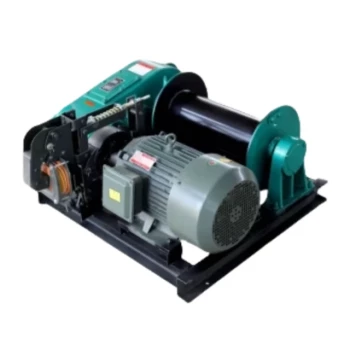
To be truly effective, a winch requires more than just the unit itself. The essential accessories are what transform a winch from a simple pulling device into a safe, versatile, and powerful recovery system. A complete kit should always include heavy-duty gloves, a tree trunk protector, D-shackles, and a snatch block for foundational safety and capability.
The core principle is this: your winch is only as strong and safe as its weakest link. Essential accessories are not optional add-ons; they are integral components of a complete recovery system designed to protect you, your equipment, and the environment.
The Core Components of a Complete Winch Kit
A proper recovery kit is built around a few key items that each serve a distinct and critical purpose. Understanding their function is the first step toward safe and successful winching.
Anchoring and Connection
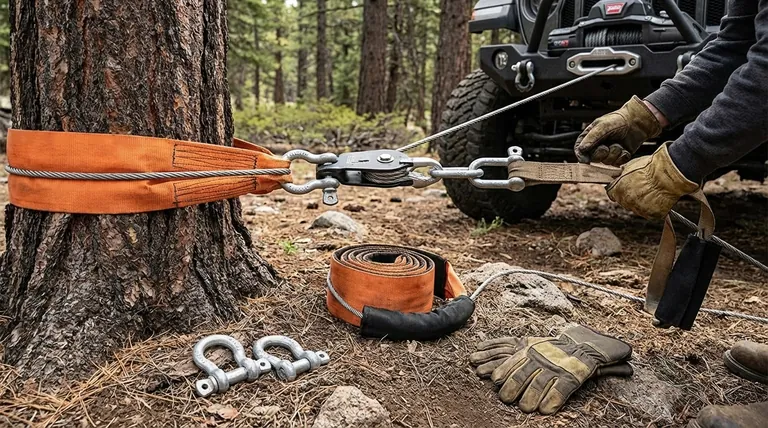
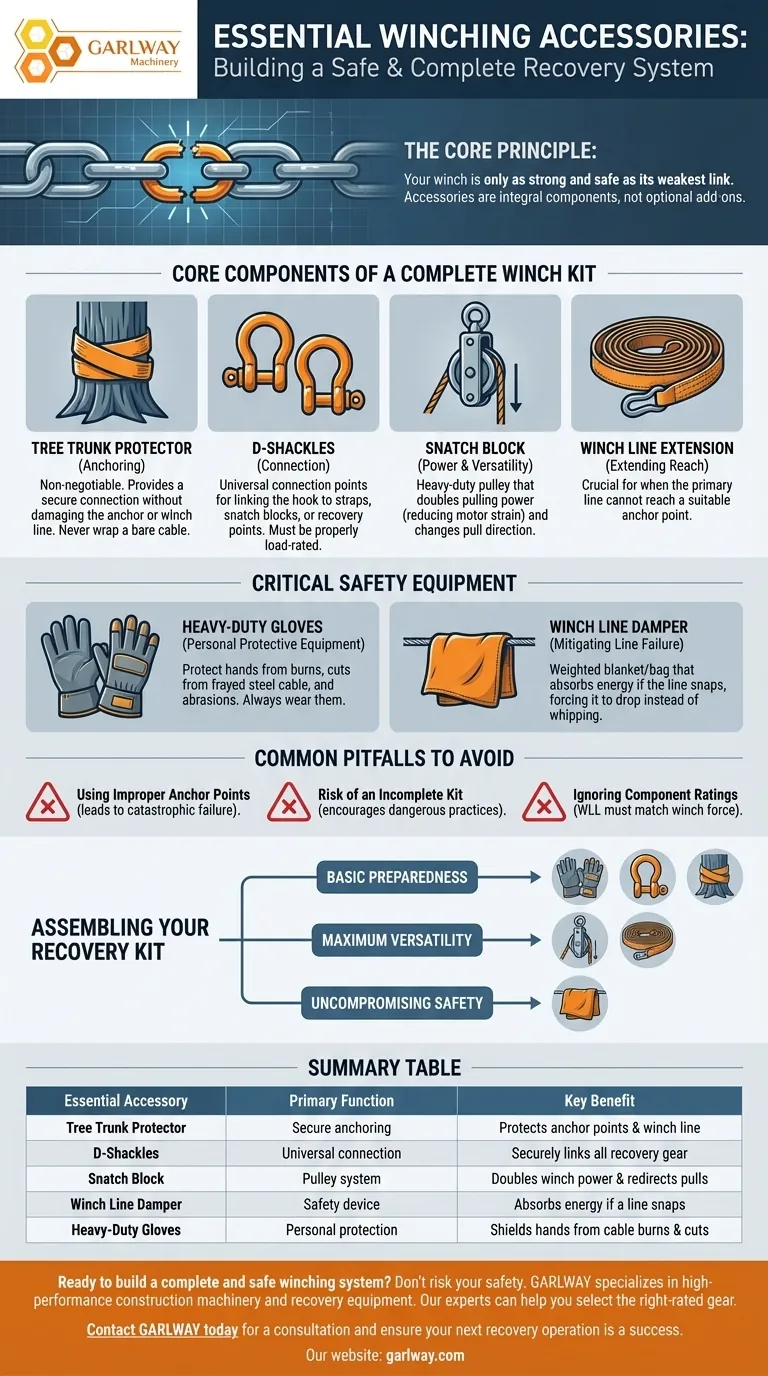
Tree Trunk Protectors are non-negotiable. These wide straps are designed to wrap around a tree or other stable anchor point, providing a secure connection without damaging the anchor or your winch line. Never wrap a bare winch cable around a tree.
D-Shackles (or bow shackles) are the universal connection points in any recovery setup. They are used to securely connect your winch line hook to straps, snatch blocks, or vehicle recovery points. Ensure they are properly load-rated for your winch's capacity.
Enhancing Power and Versatility
A Snatch Block is a heavy-duty pulley that dramatically increases a winch's utility. It can be used to double the pulling power of your winch, which reduces strain on the motor. It also allows you to change the direction of your pull, which is invaluable when a straight-line recovery is not possible.
Extending Your Reach
A Winch Line Extension is a simple but crucial accessory. It is essentially a heavy-duty strap used when your primary winch line cannot reach a suitable anchor point.
Critical Safety Equipment
Using a winch involves immense forces, and safety equipment is not optional. These items mitigate the most common and dangerous risks associated with vehicle recovery.
Personal Protective Equipment
Heavy-duty gloves are the first thing you should put on and the last thing you should take off. They protect your hands from burns, cuts from frayed steel cable, and abrasions when handling synthetic rope.
Mitigating Line Failure
A Winch Line Damper is a weighted blanket or vinyl bag that you drape over the winch line during a pull. If the line snaps, the damper absorbs a significant amount of the energy, forcing the broken line to drop to the ground instead of whipping through the air with lethal force.
Common Pitfalls to Avoid
Simply owning the gear is not enough. Understanding the risks and limitations is what separates a prepared operator from a dangerous one.
Using Improper Anchor Points
Never attach a winch line to a vehicle's bumper, axle, or suspension components unless they are specifically designed as rated recovery points. Using an incorrect point can lead to catastrophic failure and severe vehicle damage. Always use designated, frame-mounted tow hooks or recovery points.
The Risk of an Incomplete Kit
A winch without a tree trunk protector encourages dangerous practices. A winch without a line damper exposes you to unnecessary risk. A recovery operation is a system, and neglecting one part compromises the safety and effectiveness of the whole.
Ignoring Component Ratings
Every piece of recovery gear, from shackles to snatch blocks, has a Working Load Limit (WLL). This rating must be appropriate for the pulling force of your winch. A shackle rated for 5,000 lbs is a dangerous weak link in a system with a 10,000 lb winch.
Assembling Your Recovery Kit
Your ideal kit depends on your specific needs, but some principles are universal.
- If your primary focus is basic preparedness: Your absolute minimum kit must include heavy-duty gloves, a properly rated D-shackle, and a tree trunk protector.
- If your primary focus is maximum versatility: Add a snatch block and a line extension to your basic kit to handle angled pulls and distant anchor points.
- If your primary focus is uncompromising safety: A winch line damper is a small investment that provides critical protection against the single most dangerous type of equipment failure.
With the right set of tested, rated accessories, you are equipped to handle almost any recovery situation safely and effectively.
Summary Table:
| Essential Accessory | Primary Function | Key Benefit |
|---|---|---|
| Tree Trunk Protector | Secure anchoring | Protects anchor points & winch line |
| D-Shackles | Universal connection | Securely links all recovery gear |
| Snatch Block | Pulley system | Doubles winch power & redirects pulls |
| Winch Line Damper | Safety device | Absorbs energy if a line snaps |
| Heavy-Duty Gloves | Personal protection | Shields hands from cable burns & cuts |
Ready to build a complete and safe winching system? Don't risk your safety or equipment with an incomplete kit. GARLWAY specializes in high-performance construction machinery and recovery equipment, offering robust winches and essential accessories trusted by construction companies and contractors globally. Our experts can help you select the right-rated gear for your specific needs.
Contact GARLWAY today for a consultation and ensure your next recovery operation is a success.
Visual Guide
Related Products
- Quick Windlass Portable Winch for Truck and Boat Best Boat Winch
- Heavy Duty Electric Boat Winch Windlass Anchor
- Warn Winch Windlass Boat Trailer Winch
- Electric 120V Boat Winch by Badlands
- Portable Small Trailer Winch
People Also Ask
- What features were incorporated into the upgraded portable winch system? Boost Your Recovery Power & Safety
- What are some uses mentioned for portable winches beyond vehicle recovery? Essential Versatility for Property & Work
- How could the twisting issue with a portable winch be mitigated? Achieve Safe, Centered Pulls with Proper Rigging
- What are the primary uses of a portable winch for a truck? Boost Your Truck's Capability and Self-Reliance
- What is the single rope traction force of the quick winch without a pulley block? 0.5 to 40 Tons Explained