
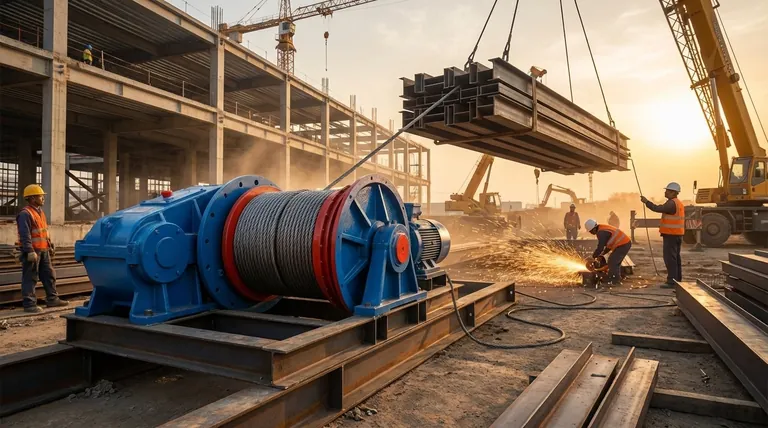
In industrial environments, electric winches serve as indispensable tools for lifting, pulling, and positioning heavy loads across a wide range of sectors. Their primary applications are found in construction for material handling, in manufacturing for assembly line movements, and in the oil and gas industry for positioning heavy equipment. They are fundamentally designed to replace manual effort with mechanized power, increasing both safety and efficiency.
The true value of an electric winch in an industrial setting isn't just its ability to move heavy objects, but its capacity to do so with precision, control, and significantly enhanced operator safety, making complex operations both repeatable and efficient.
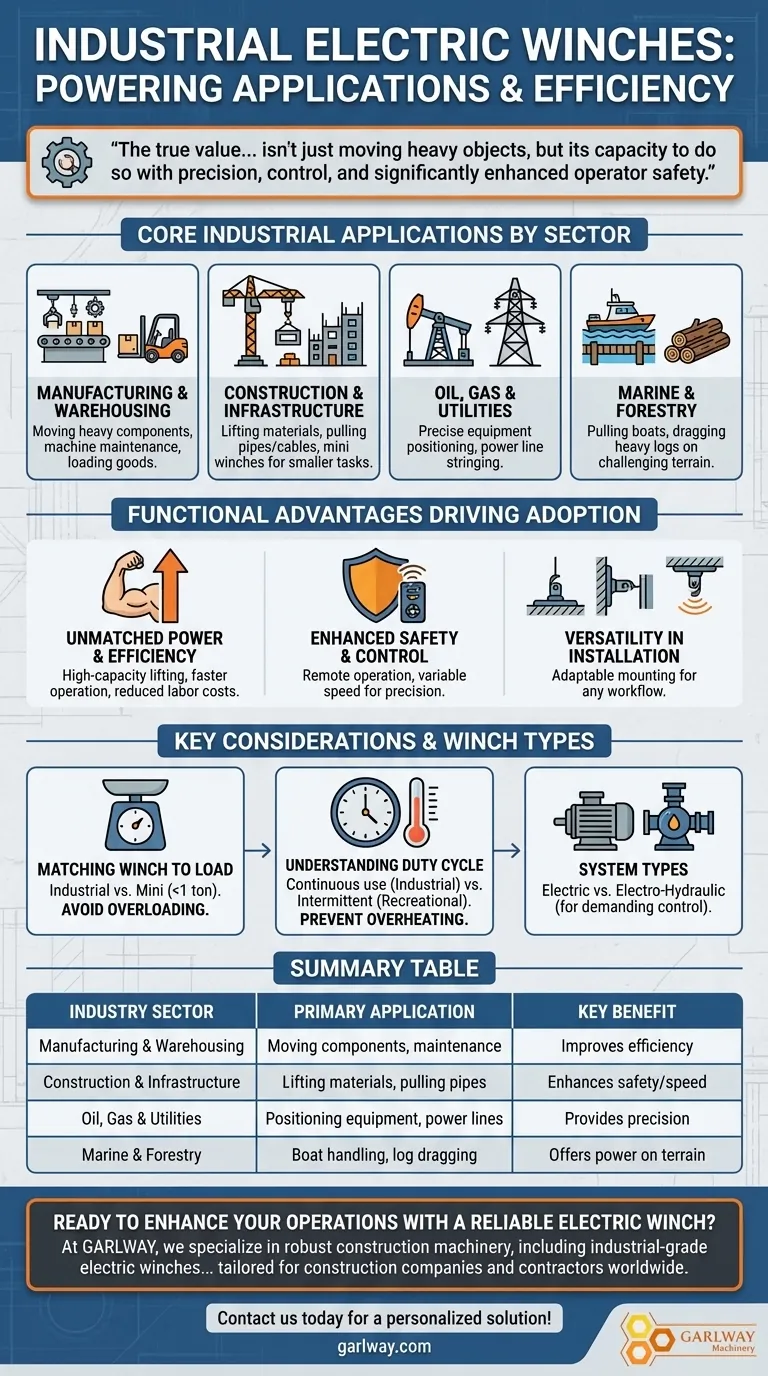
Core Industrial Applications by Sector
Electric winches are adapted to the specific demands of various heavy industries, where their power and control are critical for daily operations.
Manufacturing and Warehousing
In manufacturing plants, electric winches are crucial for moving heavy components along an assembly line. They are also used in machine repair workshops for lifting and positioning heavy machinery for maintenance. In warehousing, they facilitate the loading and unloading of goods that are too heavy for forklifts.
Construction and Infrastructure
On construction sites, these winches are used for lifting building materials to upper floors or pulling heavy pipes and cables through conduits. Mini electric winches are particularly common for pulling materials and equipment weighing less than a ton, streamlining smaller-scale tasks.
Oil, Gas, and Utilities
The energy sector relies heavily on industrial winches for demanding tasks. They are used on oil rigs to precisely position drilling equipment and in the utility industry for stringing power lines or performing maintenance on heavy components of the electrical grid.
Marine and Forestry
In marine applications, electric winches are used for pulling boats ashore and managing heavy cargo on docks. The forestry industry uses them for dragging heavy logs and loading them onto transport vehicles, navigating challenging and uneven terrain.
The Functional Advantages Driving Adoption
The widespread use of electric winches is not accidental. It is driven by a clear set of advantages over manual or other mechanical methods.
Unmatched Power and Efficiency
Electric winches deliver high-capacity pulling and lifting power that is simply not achievable manually. This allows for faster operation compared to hand winches, significantly improving overall project efficiency and reducing labor costs.
Enhanced Safety and Control
Modern industrial winches often feature remote operation, allowing personnel to stand at a safe distance from the load. The inclusion of variable speed controls provides the precision needed to position heavy and sensitive equipment without causing damage.
Versatility in Installation
A key advantage is their adaptability to the physical environment. Electric winches can be mounted on floors, walls, or ceilings, allowing them to be integrated into almost any industrial workflow or facility layout.
Key Considerations and Winch Types
Choosing the right electric winch requires understanding the specific demands of the task and the limitations of the equipment.
Matching the Winch to the Load
The most critical factor is the winch's load capacity. An industrial-grade winch is designed for heavy-duty activities, while a mini electric winch is a cost-effective solution for lighter tasks, typically under one ton. Overloading a winch is a primary cause of equipment failure and safety incidents.
Understanding the Duty Cycle
Industrial winches are often built for continuous use, meaning they can operate for long periods without overheating. This is a major distinction from recreational winches (e.g., for off-road vehicles), which are designed for short, intermittent pulls. Using the wrong type can lead to premature motor burnout.
Electric vs. Electro-Hydraulic Systems
While most common electric winches use an electric motor to power the drum directly, electro-hydraulic winches also exist. These systems use an electric motor to power a hydraulic pump, offering exceptional load control and durability, and are often found in the most demanding utility and marine applications.
Selecting the Right Winch for Your Operation
To make the correct choice, you must align the winch's capabilities with your primary operational goal.
- If your primary focus is heavy, continuous operation: You need an industrial-grade winch with a high duty cycle, thermal protection, and variable speed control.
- If your primary focus is versatility for lighter tasks: A mini electric winch offers a powerful, cost-effective solution for machine repair or material handling under one ton.
- If your primary focus is operator safety and precision: Prioritize models that feature reliable remote operation and advanced control systems to ensure accurate positioning and minimize risk.
Ultimately, selecting the correct electric winch transforms a hazardous, labor-intensive task into a safe, efficient, and repeatable process.
Summary Table:
| Industry Sector | Primary Application | Key Benefit |
|---|---|---|
| Manufacturing & Warehousing | Moving heavy components, machine maintenance | Improves assembly line efficiency |
| Construction & Infrastructure | Lifting materials, pulling pipes/cables | Enhances on-site safety and speed |
| Oil, Gas & Utilities | Positioning drilling equipment, power line work | Provides precision in demanding environments |
| Marine & Forestry | Boat handling, log dragging | Offers power on challenging terrain |
Ready to enhance your industrial operations with a reliable electric winch?
At GARLWAY, we specialize in providing robust construction machinery, including industrial-grade electric winches, concrete mixers, and batching plants, tailored for construction companies and contractors worldwide. Our winches are engineered for unmatched power, safety, and durability, helping you streamline heavy lifting, reduce labor costs, and ensure operator safety.
Contact us today for a personalized solution that meets your specific load capacity and duty cycle requirements!
Visual Guide
Related Products
- Electric 120V Boat Winch by Badlands
- Electric and Hydraulic Winch for Heavy Duty Applications
- Small Electric Winch 120V and 240V for Compact Applications
- 12000 lb Electric Boat Trailer Winch with Windlass Anchor Warn
- Electric Hoist Winch Boat Anchor Windlass for Marine Applications
People Also Ask
- How do electric boat winches work? Unlock Effortless Launching & Retrieval
- How much current does an electric boat winch draw? Plan Your Electrical System for Peak Performance
- Can I run a winch straight from a battery? Essential Power Setup for Safe Operation
- What are the types of electric winches available? Choose the Right Winch for Your Job
- What are the uses of electric winches in mining and tunneling? Enhance Safety and Efficiency Underground





