Ultimately, the primary factor that determines the diameter of a winch drum is the diameter and properties of the wire rope it is designed to hold. While factors like winding speed and overall size are important design considerations, they are all secondary to the fundamental requirement of preserving the rope's strength and integrity.
The core principle is simple: a wire rope must not be bent too tightly. Forcing a thick rope around a small drum creates extreme internal stress, causing fatigue and premature failure. Therefore, the rope's minimum safe bending radius dictates the minimum allowable diameter of the drum.
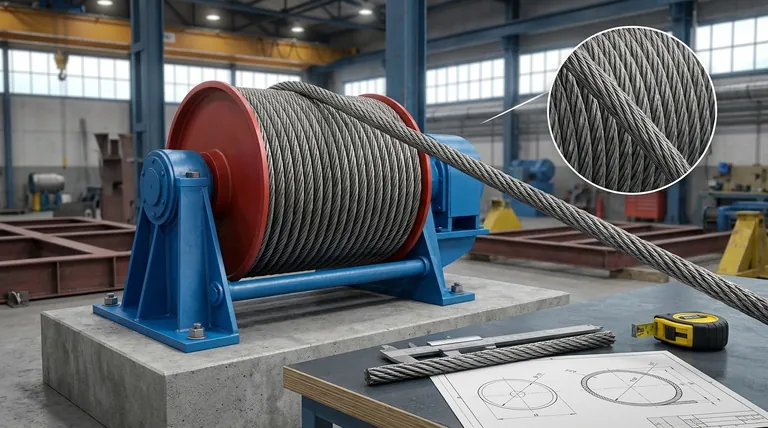
The Core Principle: Rope Integrity Dictates Design
The entire winch system—from the motor to the gears to the frame—is built to support the function of the wire rope. The rope is selected based on the desired load capacity, and the drum must be designed to accommodate it safely.
Why the Rope is the Starting Point
A winch's specified pulling force, such as 10,000 lbs, can only be achieved if the wire rope maintains its rated strength. The design process begins by selecting a rope capable of handling that load with a sufficient safety factor.
The Critical D:d Ratio
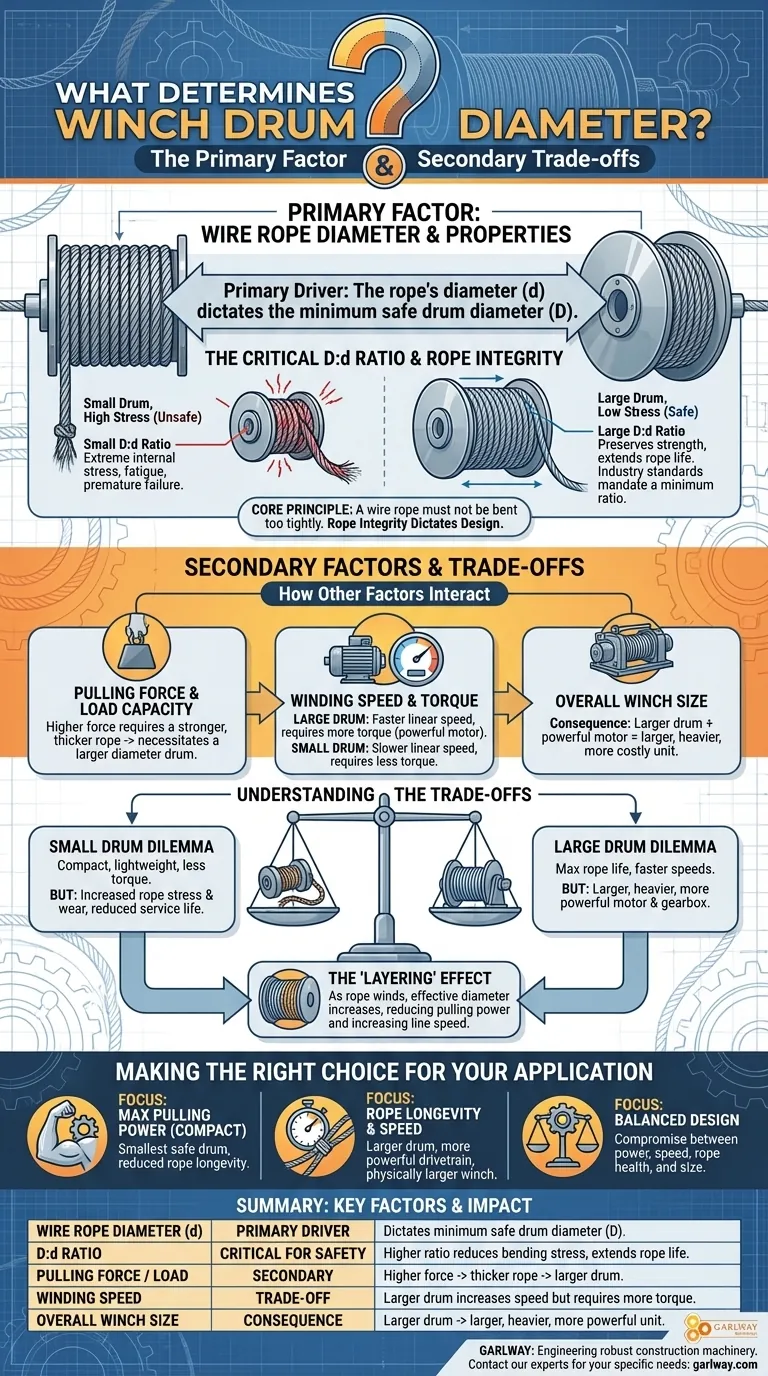
Engineers use a key metric called the D:d ratio, which compares the diameter of the drum (D) to the diameter of the wire rope (d). Industry standards and best practices mandate a minimum ratio to ensure the rope does not bend too sharply.
A small D:d ratio (a small drum for a thick rope) dramatically increases bending stress on the individual wire strands, leading to rapid fatigue, fraying, and a significant reduction in the rope's safe working load.
The Physics of Bending Stress
Imagine bending a thick metal bar versus a thin wire. The thick bar resists far more and experiences greater internal stress. The same principle applies to the wire strands inside a rope as they are forced to conform to the drum's curve during winding.
How Other Factors Interact with Drum Diameter
While the rope is the primary driver, other factors are part of a complex system of trade-offs that influence the final design. They are consequences of, or adjustments to, the core requirement set by the rope.
Pulling Force and Load Capacity
This is directly linked to the rope. A higher pulling force requires a thicker, stronger rope. A thicker rope, to maintain a safe D:d ratio, necessitates a larger diameter drum.
Winding Speed and Torque
The drum diameter acts as a lever arm for the motor.
- A larger diameter drum retrieves more rope per revolution, resulting in a faster linear winding speed. However, it requires more torque (and thus a more powerful motor) to achieve the same pulling force.
- A smaller diameter drum requires less torque for the same pull, but it retrieves rope more slowly.
Overall Winch Size
The physical size of the winch is largely a consequence of the other components. A large-diameter drum, combined with the powerful motor and robust gearing needed to turn it, naturally results in a larger and heavier overall unit.
Understanding the Trade-offs
Choosing a drum diameter is a balancing act between performance, durability, and physical constraints.
The Small Drum Dilemma
A smaller drum allows for a more compact and lightweight winch design that requires less torque from the motor. The primary downside is significantly increased stress and wear on the wire rope, reducing its service life.
The Large Drum Dilemma
A larger drum is ideal for maximizing rope life and achieving faster line speeds. The trade-off is the need for a larger, heavier, and more powerful motor and gearbox, increasing the winch's overall size, weight, and cost.
The "Layering" Effect
As the rope winds onto the drum, each successive layer increases its effective diameter. This is a critical factor, as it reduces the winch's pulling power while increasing its line speed with each added layer. A smaller drum experiences a more dramatic change in pulling force from the first layer to the last.
Making the Right Choice for Your Application
The final drum diameter is an engineered compromise designed to meet specific performance goals.
- If your primary focus is maximum pulling power in a compact unit: The design will likely use the smallest drum possible that meets the minimum safety ratio for the rope, accepting reduced rope longevity as a trade-off.
- If your primary focus is rope longevity and high-speed retrieval: The design will feature a larger drum, requiring a more powerful drivetrain and resulting in a physically larger winch.
- If your primary focus is a balanced, all-purpose design: The drum diameter will be carefully chosen to offer a good compromise between mechanical advantage, line speed, rope health, and the overall size of the unit.
Ultimately, the winch drum's diameter is the foundational element that balances the physics of power, speed, and material durability.
Summary Table:
| Key Factor | Impact on Drum Diameter |
|---|---|
| Wire Rope Diameter (d) | Primary Driver: Dictates the minimum safe drum diameter (D) via the D:d ratio. |
| D:d Ratio (Drum:Rope) | Critical for Safety: A higher ratio reduces bending stress and extends rope life. |
| Pulling Force / Load | Secondary: Higher force requires a stronger, thicker rope, which then requires a larger drum. |
| Winding Speed | Trade-off: A larger drum increases line speed but requires more motor torque. |
| Overall Winch Size | Consequence: A larger drum leads to a larger, heavier, and more powerful overall unit. |
Need a Winch Designed for Your Specific Needs?
Choosing the right winch drum diameter is critical for performance, safety, and cost-efficiency. GARLWAY specializes in engineering robust construction machinery, including winches, concrete mixers, and batching plants. We can help you select or customize a winch that perfectly balances pulling power, line speed, and rope longevity for your project's demands.
Contact our experts today to ensure your equipment is built for durability and peak performance.
Get a Free Consultation & Quote
Visual Guide
Related Products
- Best 18000 Pound Drum Anchor Trailer Winch
- Heavy Duty Electric Boat Winch Windlass Anchor
- Warn Winch Windlass Boat Trailer Winch
- Electric 120V Boat Winch by Badlands
- Electric Hoist Winch Boat Anchor Windlass for Marine Applications
People Also Ask
- In what scenarios is a winch particularly useful for trailers? Load Heavy Items Safely & Efficiently
- How do you install a trailer winch? A Step-by-Step Guide for a Safe & Secure Setup
- What should be considered when mounting a winch on a trailer? Ensure a Safe, Aligned Installation
- What are the considerations for equipping a trailer with a winch for hauling a car? A Guide to Safe and Efficient Vehicle Loading
- What are the main types of trailer winches? Choose the Right Power Source for Your Load