The weight of your anchor and chain is the primary factor dictating the performance and required power of your marine winch. A heavier ground tackle setup directly increases the load on the winch motor and gearbox, demanding a higher pulling capacity to retrieve the anchor efficiently and safely. Failing to match the winch to the weight of your tackle can lead to slow performance, equipment damage, and failure under challenging conditions.
The core issue extends beyond simply lifting the static weight of the anchor and chain. A properly sized winch must have enough reserve power to overcome the significant additional forces from seabed suction, wind, and current, which can multiply the load unexpectedly.
The Direct Impact of Weight on Winch Power
The relationship between the weight of your ground tackle (the anchor and its chain or rope, collectively known as the rode) and your winch is a matter of fundamental physics. A heavier load requires more work to move.
Defining Pulling Capacity
A winch's strength is rated by its maximum pulling capacity. This figure represents the maximum load the winch can pull. The total weight of your anchor and chain is the baseline "dead weight" that this capacity must handle.
Speed vs. Load
For any given winch, retrieval speed is inversely proportional to the load. As the weight of the anchor and chain increases, the speed at which the winch can pull it in will decrease. A severely overloaded winch may slow to a crawl or stop completely.
The Problem of Sustained Load
Lifting even a moderately heavy anchor, such as a 35-pound model with chain, requires significant and sustained force. While this might be manually possible for a short period, a powered winch is designed to handle this continuous strain without fatigue, making it a practical necessity for heavier setups.
Beyond Static Weight: The Hidden Forces at Play
Simply matching your winch's capacity to the weight of your anchor and chain is a common and critical mistake. Real-world anchoring involves dynamic forces that can dramatically increase the load on your equipment.
The Suction of the Seabed
When an anchor is well-set in mud or sand, a powerful suction effect is created. The initial force required to break the anchor free from the seabed can be several times the anchor's actual weight. An undersized winch will struggle or fail at this critical first step.
The Influence of Wind and Current
Wind and current exert constant pressure on your vessel, which translates directly into tension on the anchor rode. When you try to retrieve the anchor, the winch must pull the boat forward against these forces in addition to lifting the ground tackle.
Understanding the Trade-offs and Risks
Choosing the right winch is about more than just convenience; it's about system reliability and the safety of your vessel.
The Risk of an Undersized Winch
An undersized winch is constantly operating at or near its limit. This leads to overheating motors, tripped circuit breakers, and premature wear on gears and internal components. In challenging conditions, it may fail entirely, leaving you in a dangerous situation.
The Impact on the Vessel's Balance
Just as a heavy winch affects a vehicle's suspension, a heavy winch, anchor, and chain combination located at the bow impacts your boat's trim. This added weight can make the boat "bow-heavy," which can negatively affect its handling, fuel efficiency, and performance, particularly in rough seas.
Strain on the Electrical System
A winch motor under heavy strain draws significantly more amperage from your boat's electrical system. This increased power draw can deplete batteries faster and put a strain on alternators and wiring if the system is not designed to handle the load.
Sizing Your Winch Correctly
To ensure reliable performance, you must account for both the static weight of your gear and the dynamic forces of the marine environment.
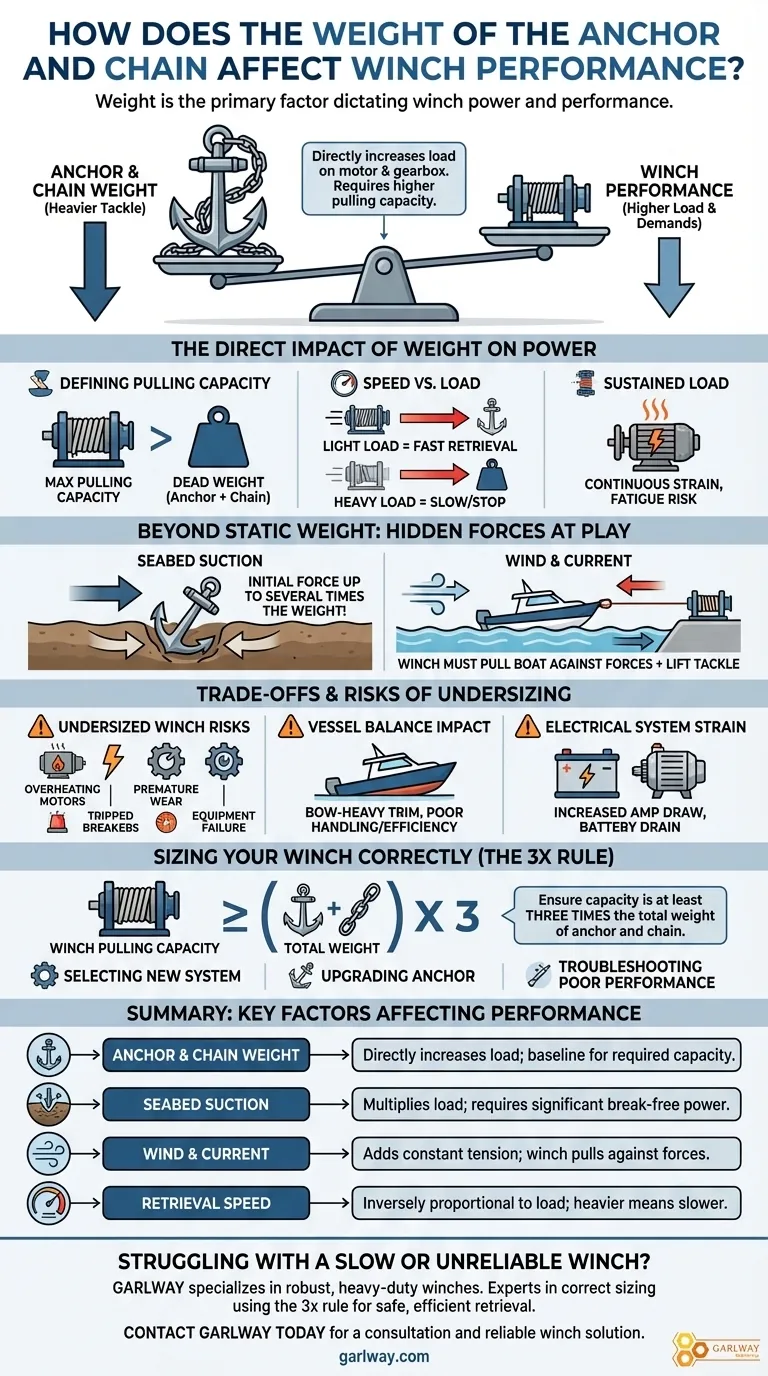
- If your primary focus is selecting a new system: Choose a winch with a maximum pulling capacity that is at least three times the total weight of your anchor and chain.
- If your primary focus is upgrading your anchor: You must re-evaluate if your existing winch can safely handle the new, increased load according to the 3x rule.
- If your primary focus is troubleshooting poor performance: Slow retrieval or frequently tripped breakers are clear signs that your winch is overloaded by the weight of your ground tackle and environmental conditions.
Properly matching your winch to your ground tackle is a fundamental component of safe and reliable anchoring.
Summary Table:
| Factor | Impact on Winch Performance |
|---|---|
| Anchor & Chain Weight | Directly increases the load; baseline for required pulling capacity. |
| Seabed Suction | Can multiply the load, requiring significant extra power to break the anchor free. |
| Wind & Current | Adds constant tension, forcing the winch to pull the boat against these forces. |
| Retrieval Speed | Inversely proportional to load; heavier tackle results in slower retrieval. |
| Risk of Undersizing | Leads to overheating, premature wear, and potential failure in critical conditions. |
Struggling with a slow or unreliable anchor winch? The problem is likely a mismatch between your winch and the weight of your ground tackle. GARLWAY specializes in robust construction and marine machinery, offering powerful winches designed for heavy-duty performance. Our experts can help you select a winch with the correct pulling capacity—typically three times your anchor and chain weight—to ensure safe, efficient retrieval in all conditions. Contact GARLWAY today for a consultation and let us provide a winch solution that guarantees reliability and safety for your vessel. Get in touch with our specialists now!
Visual Guide
Related Products
- Electric Hoist Winch Boat Anchor Windlass for Marine Applications
- Heavy Duty Electric Boat Winch Windlass Anchor
- Warn Winch Windlass Boat Trailer Winch
- Quick Windlass Portable Winch for Truck and Boat Best Boat Winch
- Hydraulic Winding Engine Harbor Freight Winch
People Also Ask
- How does an electric anchor winch work? Power, Safety, and Reliable Operation Explained
- What are the advantages of installing an electric anchor winch on a boat? Boost Safety & Ease for Boaters
- What are the operational differences between electric hoists and winches? A Guide to Safe Lifting vs. Pulling
- What are the main benefits of a boat anchor winch? Boost Safety & Efficiency for Your Vessel
- How does a boat anchor winch work? A Guide to Reliable Anchor Handling