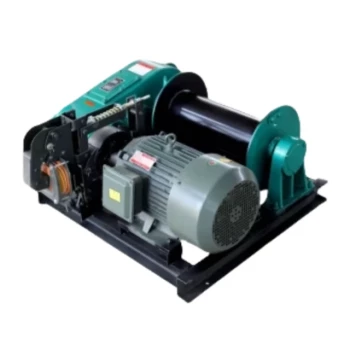
Based on their power source, winches are categorized into several distinct types, with the most common being manual, electric, hydraulic, pneumatic (air-powered), and internal combustion. Each type leverages a different method to generate the force needed to wind the spool, making them suitable for vastly different applications and environments.
The choice of a winch's power source is a fundamental decision that dictates its performance, portability, and operational context. It's a trade-off between raw power, the availability of a power supply like a battery or hydraulic system, and the demands of the specific task.
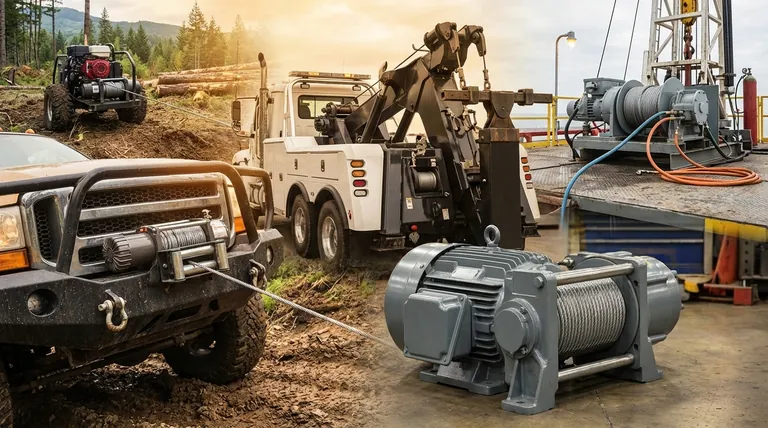
A Closer Look at Each Power Source
To select the right tool, you must first understand the core mechanics and typical use cases for each winch type. They all operate on the same principle of winding a cable or rope, but the way they generate power defines their strengths and weaknesses.
Manual Winches
Manual winches are the simplest form, relying entirely on human effort. The user turns a crank or lever, which uses gear reduction to multiply the force and pull a load.
They are ideal for light-duty tasks where no power source is available. Their simplicity makes them extremely reliable and cost-effective for workshops, boat trailers, and occasional use.
Electric Winches
Electric winches are arguably the most common and versatile type, using an electric motor to drive the winch drum. They are a popular choice where a source of electricity is readily available.
These winches can be further divided by their power input:
- DC (Direct Current): Typically powered by a 12-volt or 24-volt vehicle battery system. 12V models are standard for light trucks and SUVs, while 24V models are used on heavier commercial vehicles for more demanding workloads.
- AC (Alternating Current): These models plug into a standard wall outlet and are used in fixed, industrial applications like factories or workshops where consistent, heavy lifting is required.
Hydraulic Winches
Hydraulic winches are powered by a hydraulic pump, which is typically driven by the engine of a larger piece of equipment like a tow truck, tractor, or industrial machine.
They are known for their immense pulling power and their ability to run continuously without overheating. This makes them the standard for heavy commercial and industrial applications where long, sustained pulls are common.
Pneumatic (Air) Winches
Pneumatic winches, also known as air winches, use compressed air to power an air motor. This makes them intrinsically safe for use in volatile or explosive environments.
You will find them on oil rigs, in mines, and in chemical plants where an electric spark from a motor could be catastrophic. They require a large air compressor to operate.
Internal Combustion Winches
These winches are powered by a small, integrated gasoline or diesel engine, making them completely self-contained.
They are powerful and highly portable, making them perfect for remote logging, construction, or rescue scenarios where no vehicle or external power source is present.
Understanding the Key Trade-offs
Choosing a winch is not just about its power source; it's about understanding the inherent limitations and requirements that come with that source.
Power vs. Portability
Hydraulic and internal combustion winches offer immense power but are either integrated into large machinery or are heavy, standalone units. Conversely, manual and smaller electric winches are highly portable but have significantly lower pulling capacities.
Duty Cycle and Heat Management
This is a critical factor. Electric winches, especially DC models, generate significant heat and have a limited duty cycle, meaning they require a cool-down period after a hard pull. Hydraulic winches can run continuously for long periods, as the hydraulic fluid helps dissipate heat.
Infrastructure Requirements
Your choice is often dictated by the power you have available. Electric winches demand a robust battery and alternator. Hydraulic and pneumatic winches are useless without a pre-existing pump or compressor system. Only manual and internal combustion winches are truly self-sufficient.
Selecting the Right Winch for Your Application
Your final decision should be guided by your primary goal and operating environment.
- If your primary focus is off-road vehicle recovery: A 12V or 24V DC electric winch is the industry standard due to its direct integration with vehicle electrical systems.
- If your primary focus is heavy industrial lifting: An AC electric or hydraulic winch is the best choice for its high power, reliability, and long duty cycle.
- If your primary focus is operation in a hazardous environment: A pneumatic (air) winch is essential for its spark-resistant design and safety profile.
- If your primary focus is portability in remote locations without power: An internal combustion winch provides self-contained power for demanding, independent tasks.
- If your primary focus is light-duty, infrequent use: A manual winch is a simple, cost-effective, and exceptionally reliable solution.
Understanding these fundamental power sources empowers you to look beyond simple capacity ratings and select a winch that is truly engineered for your specific challenge.
Summary Table:
| Power Source | Key Characteristics | Typical Applications |
|---|---|---|
| Manual | Human-powered, cost-effective, reliable | Light-duty tasks, workshops, boat trailers |
| Electric (DC/AC) | Versatile, common, requires battery/outlet | Off-road recovery (12V/24V DC), industrial lifting (AC) |
| Hydraulic | High power, continuous duty, no overheating | Tow trucks, tractors, heavy industrial machinery |
| Pneumatic (Air) | Intrinsically safe, spark-resistant | Hazardous environments (oil rigs, mines, chemical plants) |
| Internal Combustion | Self-contained, powerful, highly portable | Remote logging, construction, rescue operations |
Ready to Find Your Perfect Winch?
Choosing the right power source is critical for performance, safety, and efficiency. GARLWAY specializes in providing robust and reliable construction machinery, including a wide range of winches, concrete mixers, and concrete batching plants tailored for construction companies and contractors globally.
Let our experts help you select the ideal winch for your specific application and operational challenges. We are committed to delivering solutions that enhance your productivity and meet your project demands.
Contact GARLWAY today for a personalized consultation and discover the difference quality equipment makes!
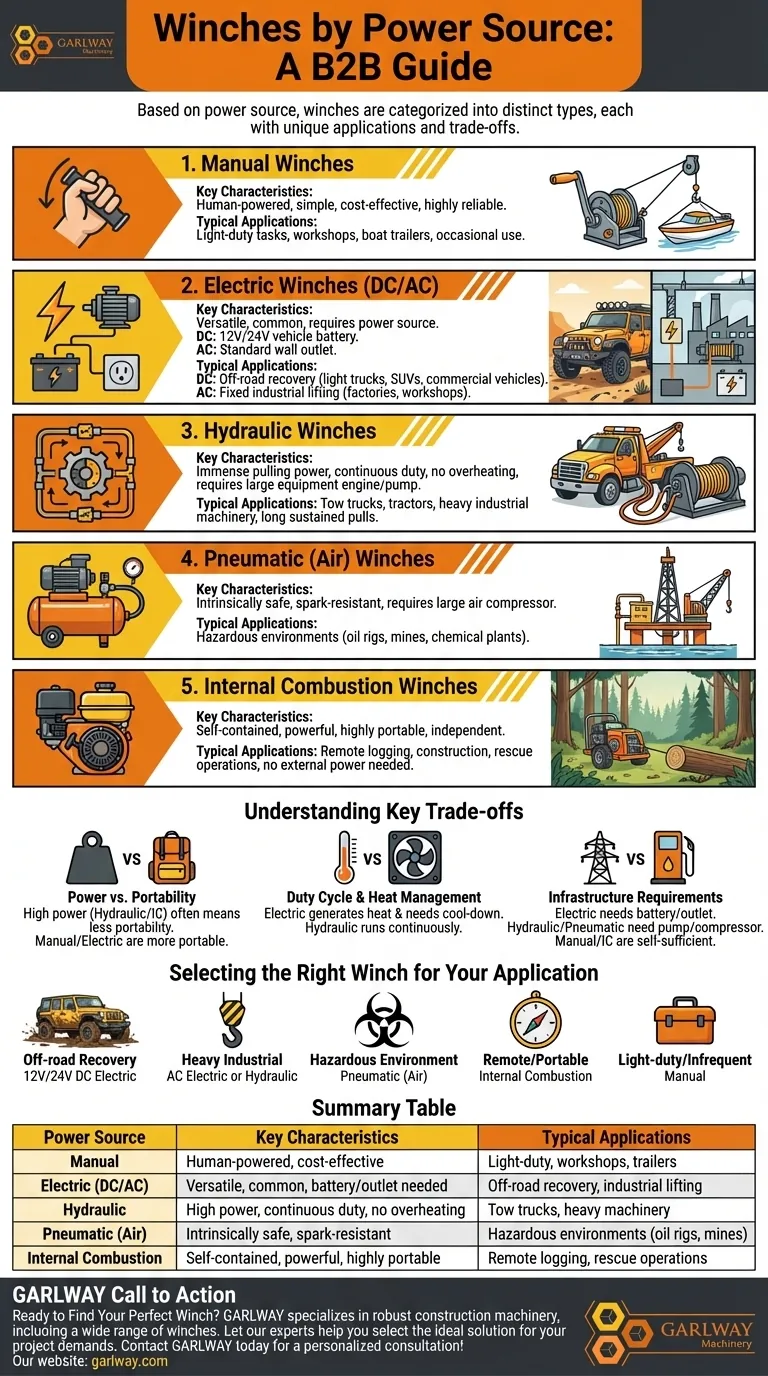
Visual Guide
Related Products
- Warn Winch Windlass Boat Trailer Winch
- Electric and Hydraulic Winch for Heavy Duty Applications
- Small Electric Winch 120V and 240V for Compact Applications
- Quick Windlass Portable Winch for Truck and Boat Best Boat Winch
- Hydraulic Winding Engine Harbor Freight Winch
People Also Ask
- What are the main components of a boat trailer winch? A Guide to Safe & Efficient Boat Loading
- What factors should be considered when choosing a boat trailer winch? Ensure Safe and Effortless Boat Loading
- What is the purpose of boat trailer winches? Safely and Efficiently Load Your Boat
- What are the two main types of boat trailer winches? Manual vs. Electric Explained
- How often should a boat trailer winch be replaced? Your Guide to Safety and Longevity