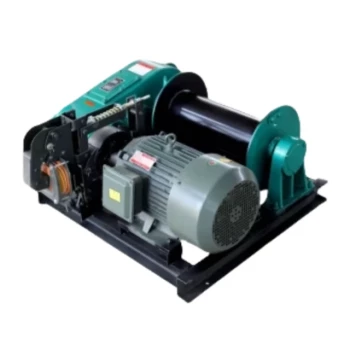
The second type of hoist controls loads using two distinct mechanical actions: a motor-powered lift and a brake-controlled, gravity-assisted descent. For lifting, the motor engages to rotate the drum and raise the load. For lowering, the motor disengages, and a brake system manages the speed at which the load's own weight unwinds the drum.
The critical insight is that this hoist operates asymmetrically. The motor only provides power in one direction—up. The lowering process is not powered by the motor but is instead a controlled release managed entirely by the brake.
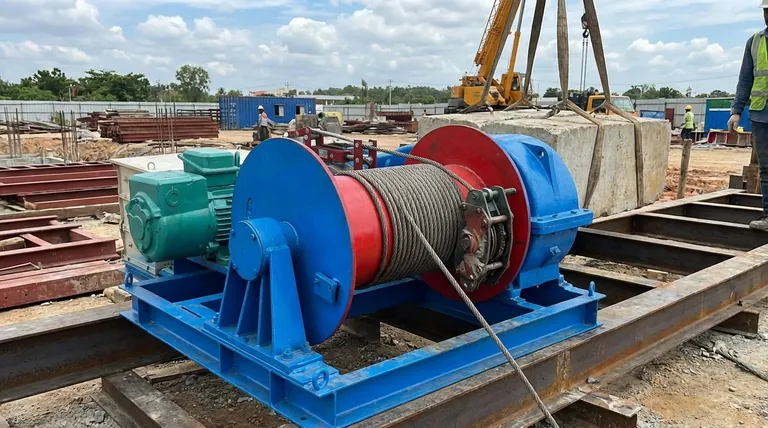
The Core Principle: A Two-Part System
This hoist design separates the task of moving a load into two fundamentally different operations. This mechanical simplicity is its defining characteristic.
Powering the Lift
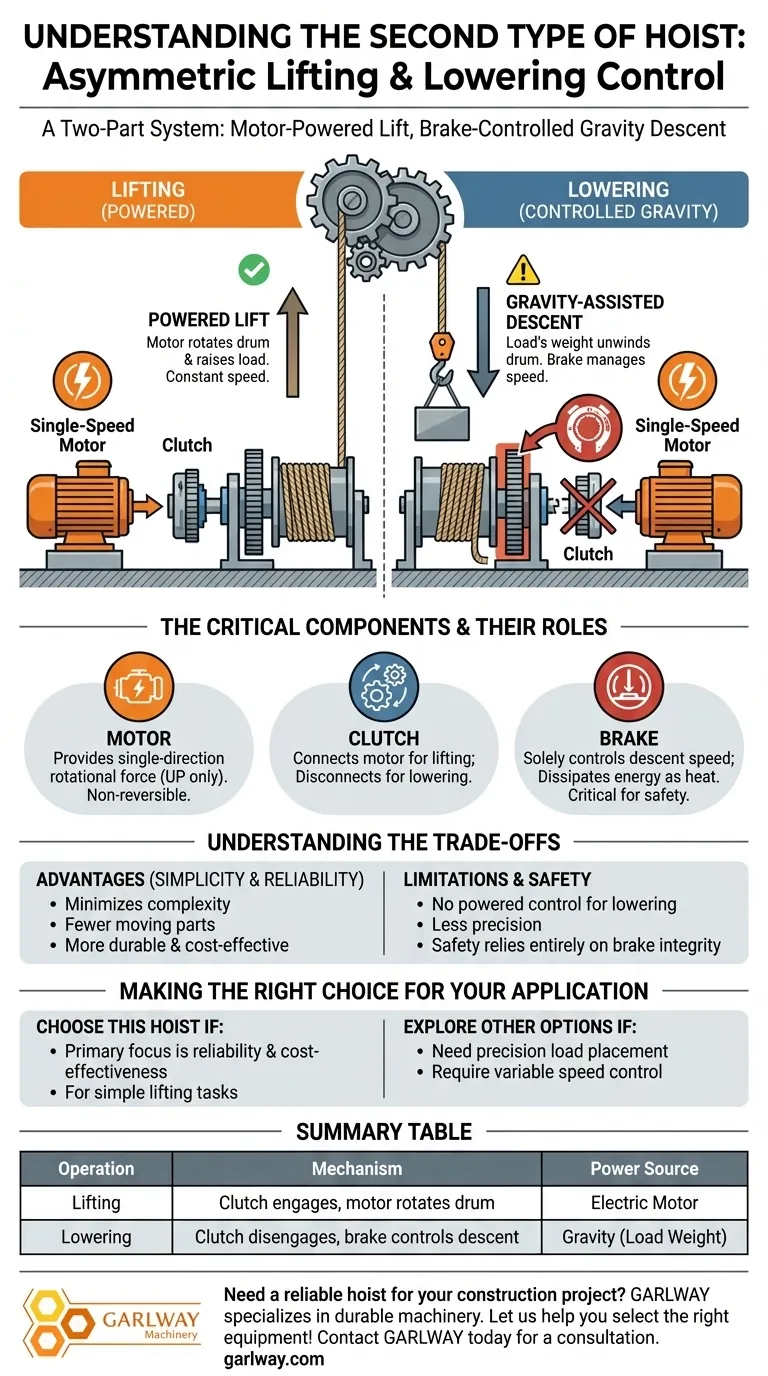
When lifting, the system acts as a direct power-transfer mechanism. The clutch engages, forming a solid link between the single-speed motor and the drum.
The motor's forward rotation turns the drum, which winds the rope or chain and lifts the load at a constant speed.
Controlling the Descent
To lower the load, the process is reversed and the power source is removed. The clutch disengages, disconnecting the motor from the drum.
The load's weight, acting under gravity, is now the force that rotates the drum in the opposite direction. The brake is the sole mechanism controlling the speed of this descent, preventing the load from free-falling.
Deconstructing the Mechanism
Three components work in concert to achieve this controlled movement: the motor, the clutch, and the brake. Each has a specific and limited role.
The Single-Speed Motor
The motor's only job is to provide rotational force in a single direction. This simplifies the electrical and mechanical design, as it does not need to be reversible or offer variable speeds.
The Role of the Clutch
The clutch acts as a mechanical switch. It connects the motor to the system for lifting and completely isolates it for lowering.
The Critical Function of the Brake
The brake is the most important component for safety and control during the lowering operation. It absorbs the potential energy of the falling load, dissipating it as heat and ensuring the descent occurs at a safe, controlled speed.
Understanding the Trade-offs
This design's simplicity creates a clear set of advantages and limitations that make it suitable for specific applications.
Advantage: Simplicity and Reliability
By using a non-reversible, single-speed motor, the design minimizes complexity. Fewer moving parts and simpler electronics often lead to a more robust, durable, and cost-effective machine.
Limitation: Lack of Powered Control for Lowering
Because the motor is disengaged, you cannot "power down" a load. The control over descent is passive, relying entirely on the brake. This can offer less precision than systems that use the motor for both lifting and lowering.
Safety Consideration: Brake Integrity
The entire safety of the lowering operation rests on the brake's performance. Proper maintenance and inspection of the braking system are absolutely critical to prevent catastrophic failure.
Making the Right Choice for Your Application
Understanding this hoist's operational logic is key to determining if it fits your needs.
- If your primary focus is reliability and cost-effectiveness for simple lifting tasks: This design is an excellent choice due to its mechanical simplicity and robust nature.
- If your primary focus is precision load placement or variable speed control: You should explore hoists with reversible or variable-frequency drive (VFD) motors that actively power the load both up and down.
Ultimately, choosing the correct hoist depends on matching its fundamental operating principles to the specific demands of your task.
Summary Table:
| Operation | Mechanism | Power Source |
|---|---|---|
| Lifting | Clutch engages, motor rotates drum | Electric Motor |
| Lowering | Clutch disengages, brake controls descent | Gravity (Load Weight) |
Need a reliable hoist for your construction project? The operational principle of the second-type hoist—simplicity and reliability—is at the core of GARLWAY's design philosophy. We specialize in durable construction machinery, including winches, concrete mixers, and batching plants, trusted by contractors globally. Let us help you select the right equipment for your specific lifting tasks. Contact GARLWAY today for a consultation!
Visual Guide
Related Products
- Electric Hoist Winch Boat Anchor Windlass for Marine Applications
- Electric and Hydraulic Winch for Heavy Duty Applications
- Hydraulic Winding Engine Harbor Freight Winch
People Also Ask
- How does an electric anchor winch work? Power, Safety, and Reliable Operation Explained
- What are the advantages of installing an electric anchor winch on a boat? Boost Safety & Ease for Boaters
- What are the operational differences between electric hoists and winches? A Guide to Safe Lifting vs. Pulling
- What are the main benefits of a boat anchor winch? Boost Safety & Efficiency for Your Vessel
- How does a boat anchor winch work? A Guide to Reliable Anchor Handling