The primary benefit of using a combination rode with different chain sizes is to improve holding power by concentrating weight near the anchor. This technique provides the performance advantages of a heavier chain where it's most needed, while minimizing the total weight carried in the bow of your vessel.
This is an optimization strategy for your ground tackle. It allows you to gain the superior shock absorption and holding power of a heavy chain system without incurring the full weight, cost, and storage penalty of a single, oversized rode.
The Physics of a Tapered Rode
To understand the benefit, we must first look at the core principles of how an anchor system works. The goal is to keep the pull on the anchor as horizontal as possible.
The Critical Role of Catenary
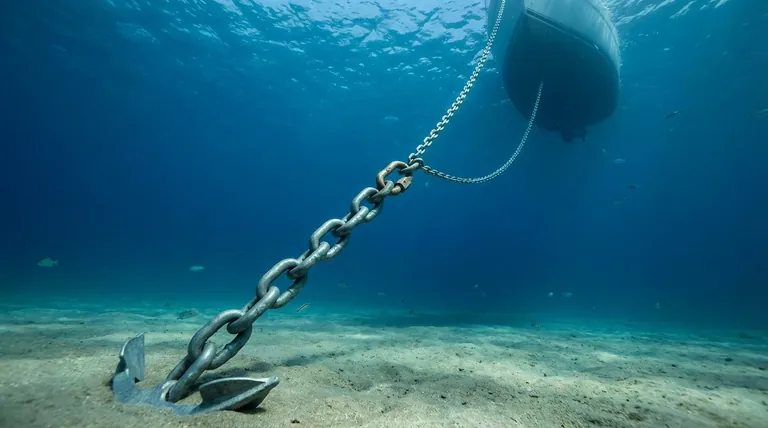
Catenary is the sag in the anchor chain between your boat and the anchor. This curve acts as a natural, highly effective shock absorber.
As wind or waves push the boat, the force is first used to straighten the chain's curve, lifting its weight off the seabed. This action dampens sudden jerks on the anchor.
Maintaining a Horizontal Pull
Anchors are designed to dig in and hold against a horizontal load. If the pull becomes vertical, the anchor's shank will lift, breaking it out of the seabed and drastically reducing its holding power.
A heavier section of chain near the anchor requires significantly more upward force to be lifted. This ensures that even in strong surges, the pull on the anchor itself remains low and parallel to the seafloor.
The Dual-Size Advantage in Practice
A common configuration involves using a heavier, larger-diameter chain for the first 25 to 50 feet from the anchor, connected to a lighter, smaller-diameter chain for the rest of the rode.
Gaining Performance, Shedding Pounds
The heavier section (e.g., 3/8-inch) provides the necessary weight to resist uplift and absorb shock loads effectively.
The lighter section (e.g., 5/16-inch) for the remainder of the rode significantly reduces the total weight in your anchor locker. Less weight in the bow improves a vessel's performance and reduces pitching in a seaway.
Optimizing Cost and Capacity
Lighter-gauge chain is less expensive and takes up less volume. This allows you to carry a longer overall rode for the same weight or cost, increasing your anchoring options in deeper water.
Understanding the Trade-offs and Complexities
While effective, this is not a universally simple solution. It introduces complexities that must be managed correctly to ensure safety and reliability.
The Connection Point is a Critical Link
The connection between the two chain sizes is a potential point of failure. It must be made with a certified connecting link (like a C-link) that is rated to the full strength of the weaker chain.
This connection must be executed perfectly and inspected regularly for wear or corrosion.
Windlass Compatibility Challenges
An anchor windlass has a "gypsy" specifically machined to fit one chain size. A dual-size rode presents a major challenge for retrieval.
The transition point will almost certainly not pass smoothly through the gypsy. This often requires the operator to manually manage the chain at the crossover, which can be difficult or dangerous in rough conditions.
Is It a Necessary Optimization?
For many boaters, a single, appropriately sized all-chain rode offers a simpler and highly reliable system. A tapered rode is an advanced technique best suited for those looking to fine-tune their setup for performance cruising or to solve specific weight-distribution problems on their vessel.
Making the Right Choice for Your Goal
Deciding on the right rode configuration depends entirely on your priorities.
- If your primary focus is maximum holding power in challenging conditions: A dual-size system is a powerful tool, providing the benefits of a heavy rode without the full weight penalty.
- If your primary focus is reducing weight in the bow for performance: This technique is one of the most effective ways to lower weight while maintaining excellent anchoring security.
- If your primary focus is simplicity and foolproof reliability: A single, properly sized all-chain rode is the most straightforward and dependable solution for most boaters.
Ultimately, tapering your anchor rode is a deliberate trade-off, exchanging simplicity for a higher level of system optimization.
Summary Table:
| Benefit | Description |
|---|---|
| Improved Holding Power | Concentrates weight near the anchor to maintain a horizontal pull and superior shock absorption. |
| Reduced Bow Weight | Lighter chain for the majority of the rode decreases weight, improving vessel performance and handling. |
| Cost & Space Efficiency | Lighter-gauge chain is less expensive and takes up less volume, allowing for a longer rode. |
Optimize Your Vessel's Ground Tackle with GARLWAY
Just as a tapered rode optimizes anchor performance, GARLWAY specializes in providing robust and reliable solutions for demanding environments. While we are experts in construction machinery—supplying winches, concrete mixers, and batching plants to contractors globally—our core principle is the same: delivering engineered solutions that balance power, efficiency, and cost-effectiveness.
If you're looking for durable equipment to power your projects, contact our experts today to discuss your specific needs and discover the GARLWAY advantage.
Get a Custom Quote for Your Project
Visual Guide

Related Products
- Electric Hoist Winch Boat Anchor Windlass for Marine Applications
- 12000 lb Electric Boat Trailer Winch with Windlass Anchor Warn
- Small Electric Winch 120V and 240V for Compact Applications
- Best 18000 Pound Drum Anchor Trailer Winch
- Heavy Duty Electric Boat Winch Windlass Anchor
People Also Ask
- How does an electric anchor winch work? Power, Safety, and Reliable Operation Explained
- What are the advantages of installing an electric anchor winch on a boat? Boost Safety & Ease for Boaters
- What are the operational differences between electric hoists and winches? A Guide to Safe Lifting vs. Pulling
- What are the main benefits of a boat anchor winch? Boost Safety & Efficiency for Your Vessel
- How does a boat anchor winch work? A Guide to Reliable Anchor Handling