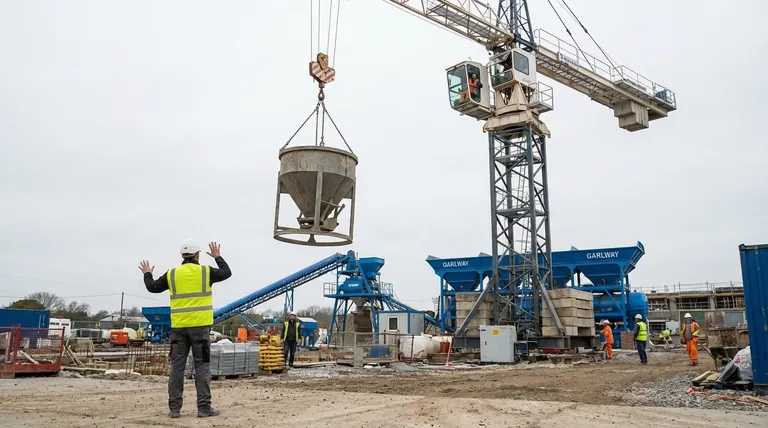
When a signal is unclear, the only correct action is to stop. This is the foundational rule of safe hoist operation. The operator must immediately cease all hoist and load movement and wait for a new, clear, and understandable signal before proceeding. There is no room for interpretation or guesswork when managing a suspended load.
The fundamental principle of hoist operation is that ambiguity equals danger. An unclear signal is not a suggestion to slow down or guess; it is an immediate and non-negotiable command to stop all movement until certainty is re-established.
The "Stop on Sight" Principle: Why Hesitation is a Hazard
The protocol to stop on an unclear signal is not arbitrary; it is a critical defense against catastrophic failure. It stems from the understanding that any movement of a suspended load carries inherent risk.
The Default State is "Safe"
A hoist's safest state is when it is motionless. Every movement—lifting, lowering, or traversing—introduces dynamic forces and potential hazards. Therefore, any action that moves the load requires explicit, clear, and continuous authorization in the form of a signal.
Eliminating Interpretation and Guesswork
The danger of an unclear signal lies in the temptation for an operator to guess the signal person's intent. A slight misinterpretation can lead to the load striking an object, damaging equipment, or, in the worst-case scenario, causing serious injury or fatality.
Re-establishing Clear Communication
Stopping is the first step. The operator must then wait until clear and confident communication is re-established with the signal person. Only after a new, unambiguous signal is given can the operation resume.
Operator Responsibility Extends Beyond the Controls
A proficient hoist operator understands their responsibility is not just to manipulate the controls but to ensure the overall safety of the entire lifting operation. This requires constant situational awareness.
Maintaining a Clear Zone
The operator, in concert with the ground crew, is responsible for ensuring the area around and directly under the load is clear of all personnel. No one should ever be positioned under a suspended load.
An unclear signal might be an attempt by the signal person to warn of an unforeseen hazard, such as a person unexpectedly entering the lift zone. Stopping immediately allows time to assess the entire environment.
The Importance of Remaining at the Post
The rule that an operator must not leave their post during a hoist operation is directly related to this principle. Your full attention and immediate control are required at all times. Abandoning the controls, even for a moment, removes the ability to respond to changing conditions or signals.
Understanding the Trade-offs: Speed vs. Safety
In any industrial environment, there is pressure to maintain efficiency and speed. However, this pressure must never compromise fundamental safety protocols.
The Fallacy of "Saving Time"
An operator might feel tempted to proceed through a moment of signal uncertainty to avoid a minor delay. This is a critical error in judgment. The seconds "saved" by not stopping are insignificant compared to the minutes, hours, or days of downtime that an accident will cause.
An incident caused by misinterpreting a signal will always result in a far greater loss of time and resources than the simple act of stopping to clarify.
Fostering a Culture of Safety
When an operator consistently and professionally stops on any unclear signal, it reinforces a positive safety culture for the entire team. It demonstrates that protocols are taken seriously and that no amount of pressure will lead to an unsafe act. This builds trust between the operator, the signal person, and the ground crew.
A Simple Framework for Hoist Signal Response
To ensure safety, your response to any signal ambiguity should be immediate and predictable. Use these guidelines as your standard operating procedure.
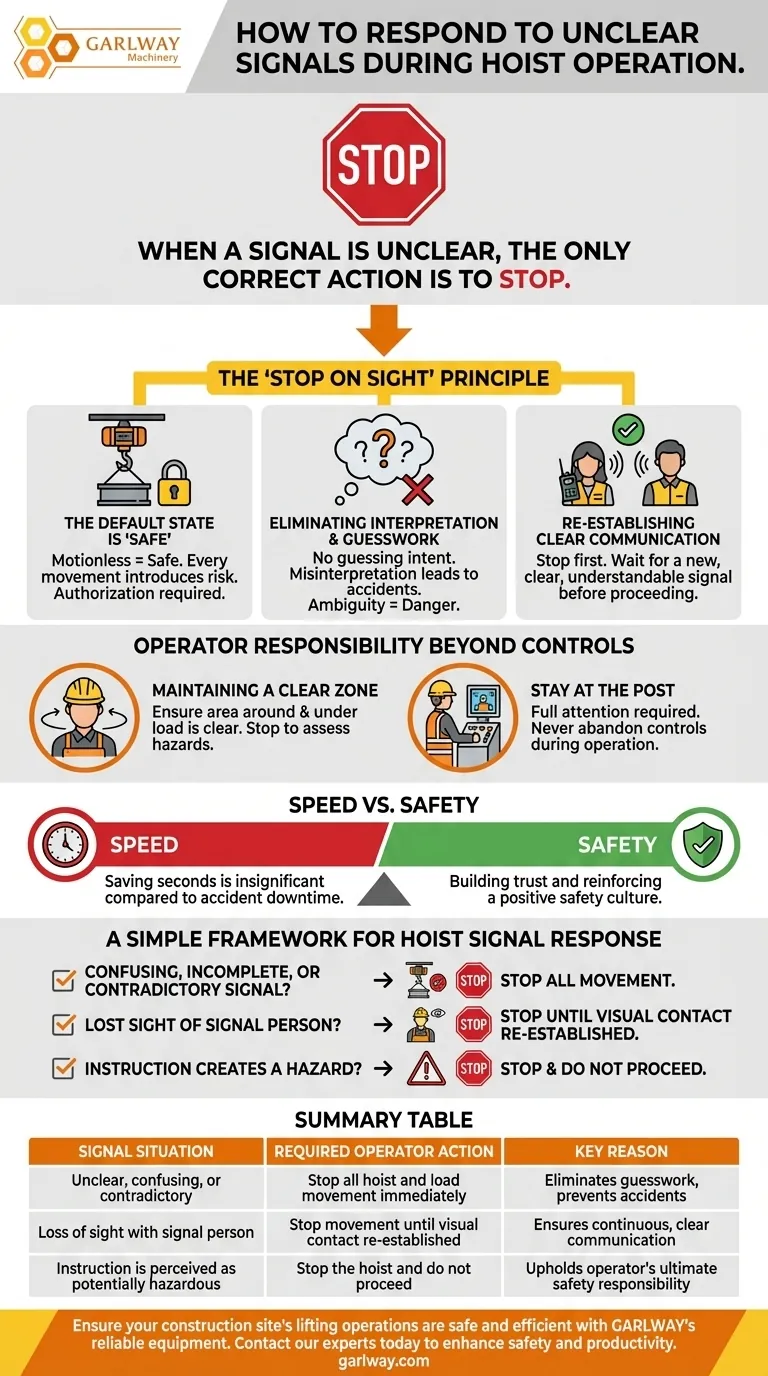
- If a signal is confusing, incomplete, or contradictory: Immediately stop all hoist movement.
- If you lose sight of the signal person: Stop all hoist movement until you can re-establish direct visual contact and communication.
- If you believe any instruction could create a hazard: Stop the hoist and do not proceed. You have the ultimate authority and responsibility to prevent an unsafe lift.
Your primary duty as an operator is not simply to move the load, but to ensure every movement is made with absolute certainty and safety.
Summary Table:
| Signal Situation | Required Operator Action | Key Reason |
|---|---|---|
| Signal is unclear, confusing, or contradictory | Stop all hoist and load movement immediately | Eliminates guesswork and prevents catastrophic accidents |
| Loss of sight with the signal person | Stop movement until visual contact is re-established | Ensures continuous, clear communication for safe operation |
| Instruction is perceived as potentially hazardous | Stop the hoist and do not proceed | Upholds the operator's ultimate responsibility for lift safety |
Ensure your construction site's lifting operations are safe and efficient with GARLWAY's reliable equipment.
As a specialist in construction machinery, GARLWAY provides robust winches, concrete mixers, and batching plants designed for the demanding needs of construction companies and contractors worldwide. Our equipment is built to support the strict safety protocols your operators depend on.
Contact our experts today to discuss how our machinery can enhance safety and productivity on your next project.
Visual Guide
Related Products
- Electric Hoist Winch Boat Anchor Windlass for Marine Applications
- Electric and Hydraulic Winch for Heavy Duty Applications
- Hydraulic Winding Engine Harbor Freight Winch
People Also Ask
- How does an electric anchor winch work? Power, Safety, and Reliable Operation Explained
- What are the advantages of installing an electric anchor winch on a boat? Boost Safety & Ease for Boaters
- What are the operational differences between electric hoists and winches? A Guide to Safe Lifting vs. Pulling
- What are the main benefits of a boat anchor winch? Boost Safety & Efficiency for Your Vessel
- How does a boat anchor winch work? A Guide to Reliable Anchor Handling