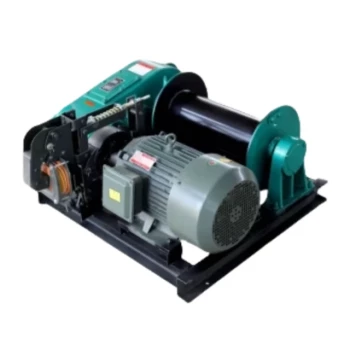
At its core, an electric anchor winch converts electrical energy into mechanical force to do one job: raise or lower a heavy anchor with the simple press of a button. This process relies on an electric motor to turn a central drum, which winds or unwinds the anchor line. A critical, automatic braking system engages the moment you release the button, ensuring the anchor is held securely without any manual intervention.
An electric anchor winch is a system where an electric motor drives a rotating drum to wind or unwind the anchor line. The most crucial component is a fail-safe brake that is electromagnetically released during operation and automatically engages to hold the load securely whenever the motor is not active.
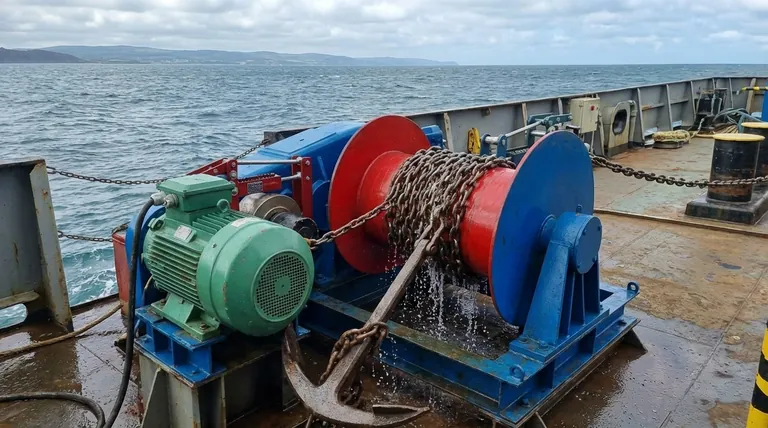
The Core Components and Their Roles
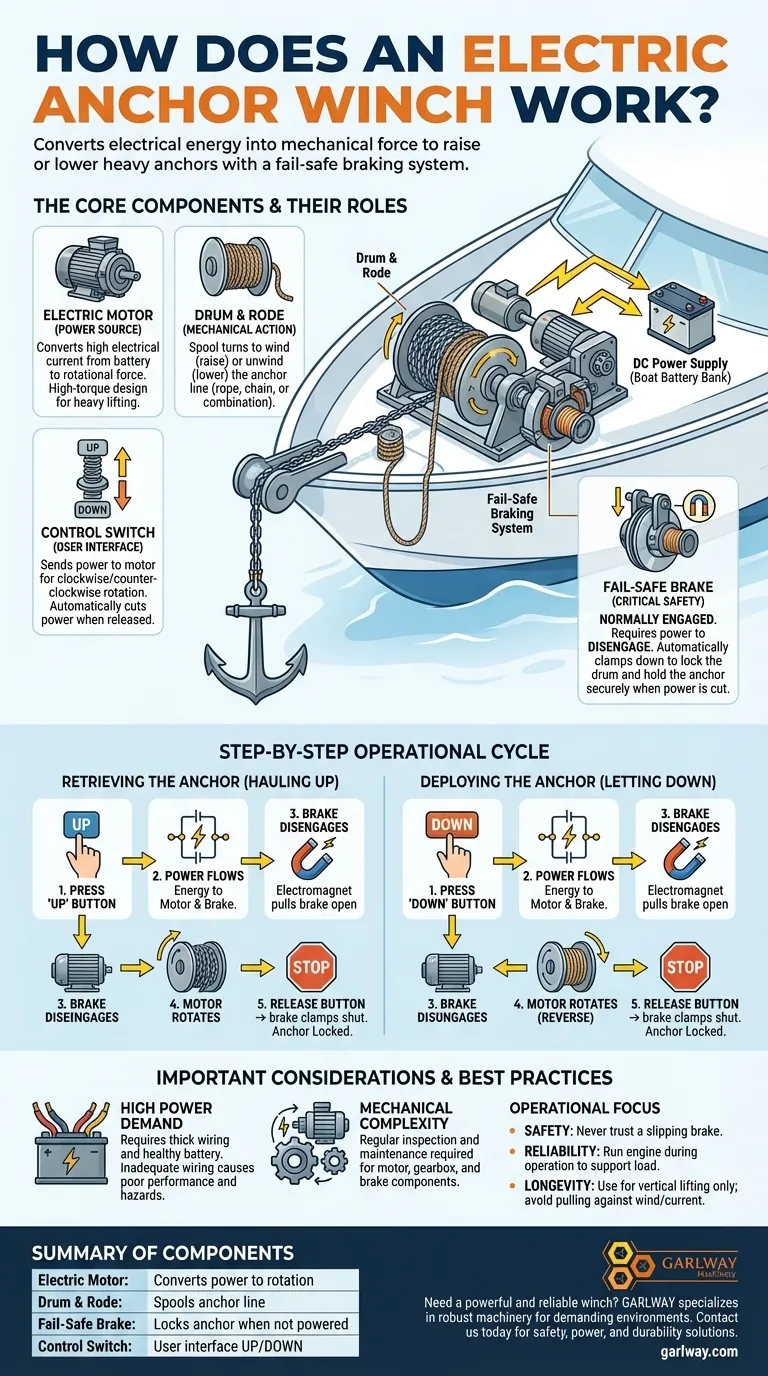
To truly understand how the winch works, we need to look at its three primary components: the motor, the drum, and the brake. These parts work in concert to provide controlled power and absolute safety.
The Electric Motor
The motor is the heart of the system. It's a powerful DC motor that draws a significant amount of current from your boat's battery system. When you press the switch on your dashboard, you are sending electricity to this motor, which converts that electrical energy into rotational force.
The Drum and Rode
The drum is the spool that the motor turns. Your anchor line, also known as the rode (which can be a rope, a chain, or a combination), is wound around this drum. As the drum rotates one way, it pulls the rode in, raising the anchor. When it rotates the other way, it lets the rode out, lowering the anchor.
The Control Switch
This is your user interface, typically a simple, spring-loaded toggle switch on the helm. Pressing it one way sends power to the motor to rotate clockwise; pressing it the other way reverses the polarity, causing it to spin counter-clockwise. When you let go, it returns to a neutral position, cutting all power.
The Braking System: The Critical Safety Feature
This is the most important part of the design. The winch's brake is "normally engaged," meaning it is clamped down hard by default, often using a powerful spring or a weight system. It requires electrical power to disengage.
An electromagnet is used to release the brake. When you press the button to raise or lower the anchor, electricity flows to the electromagnet at the same time it flows to the motor. The magnetic force pulls the brake pads away from the drum, allowing it to turn freely. The instant you release the button, power is cut, the electromagnet deactivates, and the brake clamps back down, locking the drum and the anchor in place.
The Step-by-Step Operational Cycle
Understanding the components makes the sequence of operations clear and intuitive.
Retrieving the Anchor (Hauling Up)
- You press and hold the 'UP' button on the control switch.
- An electrical circuit energizes both the motor and the brake's electromagnet.
- The electromagnet immediately disengages the brake.
- Simultaneously, the motor rotates the drum to wind the anchor rode, lifting the anchor from the seabed.
- When you release the button, power is cut to both components. The motor stops, and the brake instantly re-engages, locking the anchor securely.
Deploying the Anchor (Letting Down)
- You press and hold the 'DOWN' button.
- Again, the circuit energizes the motor and the brake's electromagnet.
- The electromagnet disengages the brake.
- The motor turns the drum in the opposite direction, providing a controlled release of the anchor rode.
- When the anchor is set, you release the button. Power is cut, and the brake engages, holding the boat fast.
Understanding the Trade-offs
While incredibly useful, an electric winch is a powerful system with important considerations.
High Power Demand
These winches are one of the highest-load electrical devices on a recreational boat. They require thick, high-quality wiring and a healthy, well-charged battery bank to operate effectively and safely. Inadequate wiring is a common source of poor performance and can be a fire hazard.
Mechanical Complexity
An electric winch adds another complex mechanical system to your boat. The motor brushes, gearbox, and brake components can all wear over time and require periodic inspection and maintenance to ensure reliable operation.
Controlled vs. Free-Fall Deployment
Most standard electric winches use the motor to power the anchor down. This provides excellent control but can be slower than a manual release. Some more advanced models offer a "free-fall" feature that completely disengages the drum for a much faster drop, but this adds another layer of mechanical complexity.
Making the Right Choice for Your Goal
Your understanding of how a winch works directly informs how you operate and maintain it.
- If your primary focus is safety: Recognize the fail-safe brake is the most critical feature. Never trust a winch whose brake seems to be slipping or failing to engage instantly.
- If your primary focus is reliability: Always run your boat's engine while operating the winch to ensure the alternator is helping supply the massive electrical load and keeping the battery topped up.
- If your primary focus is longevity: Use the winch for what it was designed for—primarily vertical lifting. Avoid using it to pull the boat forward against wind or current, as this puts an enormous strain on the motor and gearbox.
By understanding these core principles, you are empowered to operate your electric anchor winch safely and maintain it for years of dependable service.
Summary Table:
| Component | Function | Key Feature |
|---|---|---|
| Electric Motor | Converts battery power to rotational force | High-torque DC motor for heavy lifting |
| Drum & Rode | Spools the anchor line (rope/chain) in or out | Provides controlled deployment and retrieval |
| Fail-Safe Brake | Locks the anchor securely when not powered | Automatically engages when the button is released |
| Control Switch | User interface for UP/DOWN commands | Spring-loaded for safe, momentary operation |
Need a powerful and reliable winch for your marine or construction project? GARLWAY specializes in robust machinery, offering a range of winches, concrete mixers, and batching plants designed for demanding environments. Our solutions provide the safety, power, and durability that contractors and marine operators depend on.
Contact GARLWAY today to discuss your specific requirements and discover how our equipment can enhance your operational efficiency and safety.
Visual Guide
Related Products
- Electric Hoist Winch Boat Anchor Windlass for Marine Applications
- 12000 lb Electric Boat Trailer Winch with Windlass Anchor Warn
- Heavy Duty Electric Boat Winch Windlass Anchor
- Electric 120V Boat Winch by Badlands
- Electric and Hydraulic Winch for Heavy Duty Applications
People Also Ask
- What are the advantages of installing an electric anchor winch on a boat? Boost Safety & Ease for Boaters
- What are the operational differences between electric hoists and winches? A Guide to Safe Lifting vs. Pulling
- What are the main benefits of a boat anchor winch? Boost Safety & Efficiency for Your Vessel
- How does a boat anchor winch work? A Guide to Reliable Anchor Handling
- What is the difference in efficiency between single-drum and double-drum electric hoists?