
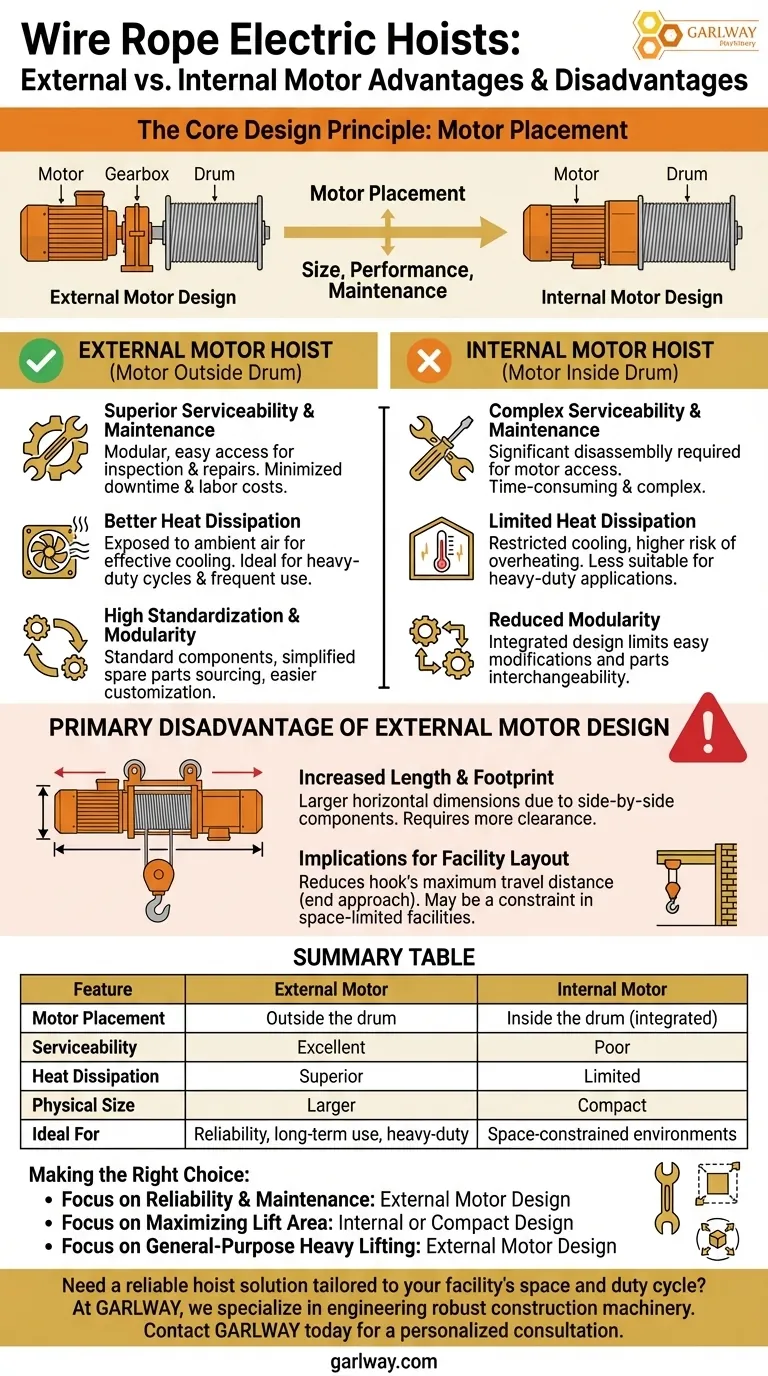
The primary advantage of a wire rope electric hoist with the motor outside the drum is its excellent serviceability and ease of maintenance. Because the components are modular and accessible, repairs are simpler and faster. The main disadvantage is its larger physical size, specifically its overall length, which can be a limitation in space-constrained environments.
The decision to use a hoist with an external motor comes down to a fundamental trade-off: prioritizing long-term serviceability and thermal performance over achieving the most compact horizontal footprint.
The Core Design Principle: Motor Placement
The configuration of a hoist's motor, transmission, and drum is the most critical factor influencing its size, performance, and maintenance requirements. The choice between an external or internal motor design has significant practical consequences.
How an External Motor Works
In this common design, the lifting motor is mounted alongside the wire rope drum. The motor, gearbox, and drum are distinct, modular components connected in a line.
This separation makes each part individually accessible for inspection, repair, or replacement.
The Alternative: The Integrated Drum Motor
For comparison, the most compact design places the motor directly inside the hollow of the wire rope drum.
While this drastically reduces the hoist's overall length, it creates challenges for cooling and makes maintenance significantly more complex, as the hoist must be substantially disassembled to access the motor.
Analyzing the Advantages of an External Motor
The modular, external motor design is often the default choice for heavy-duty applications due to its practical benefits in reliability and long-term cost of ownership.
Superior Serviceability and Maintenance
With the motor and gearbox located outside the drum, technicians can easily access them. This simplifies routine inspections, lubrication, and repairs, minimizing downtime and labor costs.
Better Heat Dissipation
An external motor is exposed to ambient air, allowing it to cool far more effectively than one enclosed within a drum. This superior thermal management is critical for preventing overheating during frequent or heavy-duty lifting cycles, extending the motor's operational life.
High Standardization and Modularity
This design often uses standardized components that are easily grouped and interchanged. This modularity simplifies sourcing spare parts and allows for easier customization or modification of the hoist, such as changing the lifting height.
Understanding the Primary Disadvantage
The trade-off for the accessibility and robustness of an external motor design is its physical size.
Increased Length and Footprint
Placing the motor, gearbox, and drum side-by-side inevitably increases the hoist's horizontal dimensions. This makes the entire unit longer than integrated designs.
Implications for Facility Layout
The larger size can be a significant constraint. It requires more clearance along the crane's runway beam and can reduce the hook's maximum travel distance, particularly the "end approach" to the walls of the facility.
Making the Right Choice for Your Application
Selecting the correct hoist configuration depends entirely on the operational priorities and physical constraints of your environment.
- If your primary focus is reliability and ease of maintenance: The external motor design is the superior choice due to its accessibility and better cooling for heavy-duty use.
- If your primary focus is maximizing lift area in a space-constrained facility: An integrated or other compact design may be necessary, but you must account for more difficult maintenance and potential heat limitations.
- If your primary focus is general-purpose heavy lifting: The external motor hoist is typically the standard, offering a proven balance of performance and long-term serviceability.
Ultimately, understanding this core design difference empowers you to select a hoist that aligns with your operational needs and facility limitations.
Summary Table:
| Feature | Advantage | Disadvantage |
|---|---|---|
| Motor Placement | Outside the drum | Inside the drum (integrated design) |
| Serviceability | Excellent - Easy access for maintenance | Poor - Complex disassembly required |
| Heat Dissipation | Superior cooling, ideal for heavy-duty cycles | Limited cooling, risk of overheating |
| Physical Size | Larger overall length | Compact horizontal footprint |
| Ideal For | Reliability, long-term use, heavy-duty applications | Space-constrained environments where size is critical |
Need a reliable hoist solution tailored to your facility's space and duty cycle?
At GARLWAY, we specialize in engineering robust construction machinery, including wire rope electric hoists designed for durability and easy maintenance. Whether you're a construction company or a contractor, our experts can help you select the perfect hoist that balances performance with your operational constraints.
Contact GARLWAY today for a personalized consultation and discover how our hoists can enhance your productivity and reduce long-term costs.
Visual Guide
Related Products
- Electric Hoist Winch Boat Anchor Windlass for Marine Applications
- Best 18000 Pound Drum Anchor Trailer Winch
- Electric and Hydraulic Winch for Heavy Duty Applications
People Also Ask
- How does an electric anchor winch work? Power, Safety, and Reliable Operation Explained
- What are the advantages of installing an electric anchor winch on a boat? Boost Safety & Ease for Boaters
- What are the operational differences between electric hoists and winches? A Guide to Safe Lifting vs. Pulling
- What are the main benefits of a boat anchor winch? Boost Safety & Efficiency for Your Vessel
- How does a boat anchor winch work? A Guide to Reliable Anchor Handling


