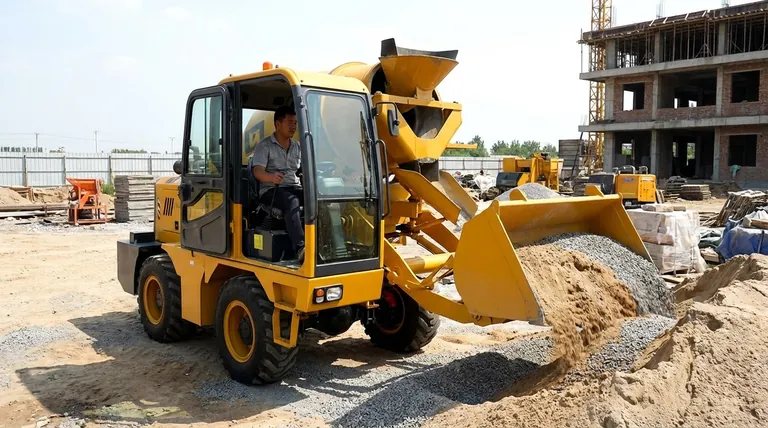
At its core, a self-loading concrete mixer is designed to be operated by a single person. This remarkable efficiency is achieved by integrating the entire concrete production process—loading, weighing, mixing, and transporting—into one autonomous machine controlled from a central operator's cabin.
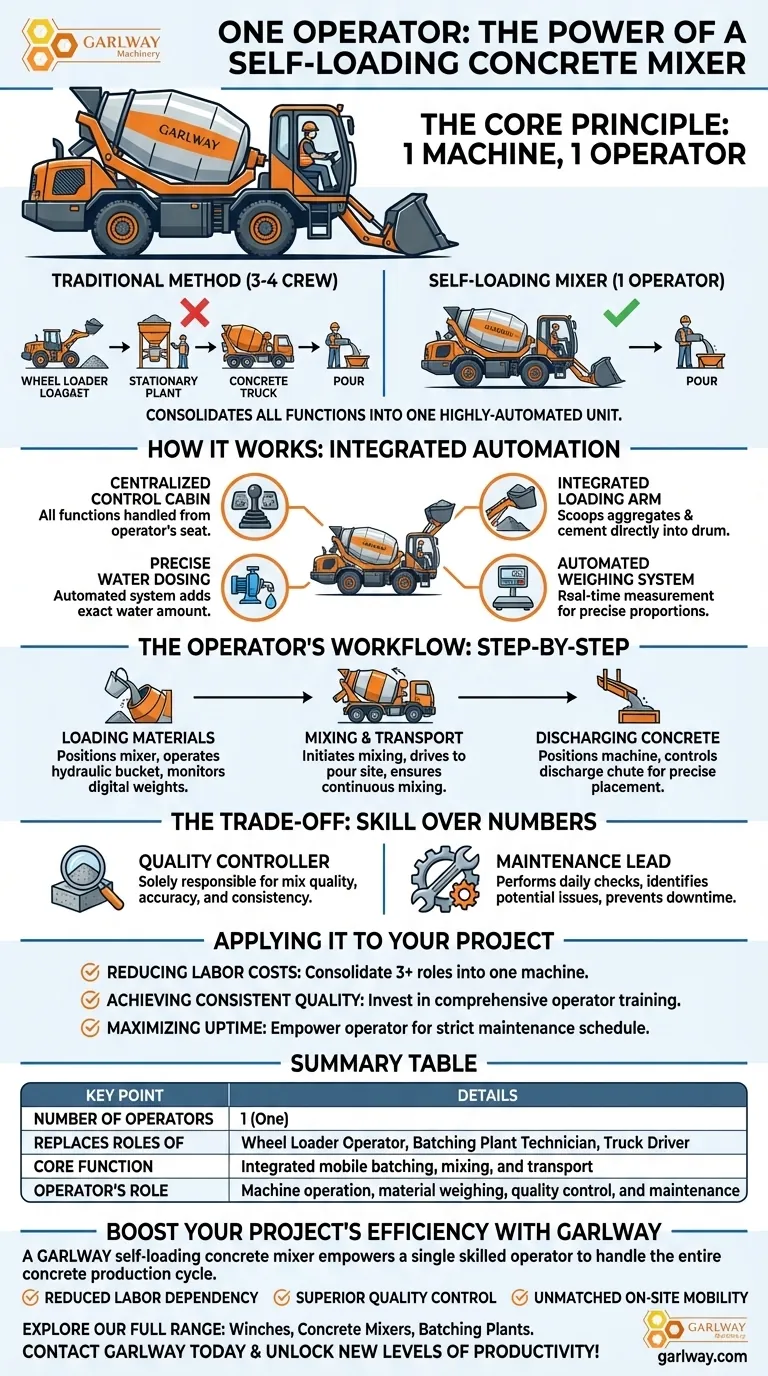
The key takeaway is not just the number of operators, but the principle behind it: a self-loading mixer replaces the need for separate wheel loader operators, batching plant technicians, and truck drivers by consolidating all functions into a single, highly-automated unit managed by one skilled individual.
How One Operator Manages the Entire Production Cycle
The ability to use a single operator stems from the machine's all-in-one design. It functions as a mobile batching plant, with key systems that automate tasks that would otherwise require a full team.
The Centralized Control Cabin
Every function, from driving the vehicle to operating the loading arm and managing the mix, is handled from the operator's seat. This eliminates the need for communication between different workers and streamlines the entire process.
The Integrated Loading Arm
The hydraulic loading arm and bucket are controlled by the operator to scoop aggregates and cement directly into the drum. This single action replaces the need for a separate wheel loader and its operator.
The Automated Weighing System
A built-in electronic weighing system measures materials in real-time as they are loaded. The operator monitors the weights from the cabin, ensuring precise and consistent mix proportions without manual calculation or a separate batching technician.
The Precise Water Dosing System
The operator initiates the water pump from the cabin, and an automated system adds the exact amount of water required for the mix. This ensures consistent slump and concrete quality for every batch.
The Operator's Role: Step-by-Step
While the machine is highly automated, the single operator is actively engaged and responsible for the entire workflow, from raw materials to final placement.
Stage 1: Loading Materials
The operator positions the mixer near the material stockpiles. Using joystick controls, they operate the hydraulic bucket to scoop the required amounts of sand, gravel, and cement, relying on the cab's digital display to hit the target weights for the mix design.
Stage 2: Mixing and Transport
Once all materials and water are in the drum, the mixing process begins. The operator can then drive the mixer directly to the pour site, with the drum continuing to rotate to ensure the concrete remains perfectly mixed upon arrival.
Stage 3: Discharging Concrete
At the destination, the operator positions the machine and uses the controls to adjust the rotating discharge chute, placing the concrete precisely where it's needed. This level of control minimizes waste and the need for extra ground crew to guide the pour.
Understanding the Trade-off: Skill Over Numbers
Reducing your crew to a single operator introduces a critical trade-off. You are exchanging the need for multiple laborers for the need for one highly competent and responsible individual.
The Operator as a Quality Controller
The single operator is not just a driver; they are the sole quality control technician for the concrete. Their skill in accurately weighing materials, managing the water content, and monitoring the mix directly determines the quality and consistency of the final product.
The Operator as a Maintenance Lead
With a complex, multi-function machine, the operator becomes the first line of defense against downtime. They are responsible for daily pre-operation checks and identifying potential maintenance issues before they become critical failures that halt the entire operation.
How to Apply This to Your Project
Understanding the role of the single operator is key to leveraging the full potential of a self-loading mixer.
- If your primary focus is reducing on-site labor costs: A self-loading mixer is an exceptional choice, as it consolidates the roles of at least three workers into one.
- If your primary focus is achieving consistent concrete quality: Invest in comprehensive training for your operator, as their skill is the most critical factor in the production process.
- If your primary focus is maximizing project efficiency and uptime: Empower your operator to manage a strict daily maintenance and inspection schedule for the equipment.
By placing a skilled operator at the helm, a self-loading mixer transforms from a piece of equipment into a complete mobile production solution.
Summary Table:
| Key Point | Details |
|---|---|
| Number of Operators | 1 (One) |
| Replaces Roles Of | Wheel Loader Operator, Batching Plant Technician, Truck Driver |
| Core Function | Integrated mobile batching, mixing, and transport |
| Operator's Role | Machine operation, material weighing, quality control, and maintenance |
Ready to Boost Your Project's Efficiency?
A GARLWAY self-loading concrete mixer empowers a single skilled operator to handle the entire concrete production cycle, significantly cutting your labor costs and streamlining on-site operations.
For construction companies and contractors worldwide, GARLWAY delivers:
- Reduced Labor Dependency: Replace a crew of 3-4 with one efficient machine.
- Superior Quality Control: Ensure consistent, high-quality concrete mix every time.
- Unmatched On-Site Mobility: Mix and pour concrete exactly where it's needed, without relying on separate batching plants and transit mixers.
Explore our full range of construction machinery, including winches, concrete mixers, and batching plants, designed to meet the rigorous demands of your projects.
Contact GARLWAY today to find the perfect self-loading mixer solution for your business and unlock new levels of productivity and profitability!
Visual Guide
Related Products
- Skid Steer Self Loading Concrete Mixers for Construction
- Belle Mixer Drum Self Loading Mortar Mixers JS3000
- Portable Cement Mixer with Lift Concrete Machine
- Portable Concrete Mixer Machine Equipment for Mixing Concrete
- Portable Ready Mix Concrete Mixer Equipment
People Also Ask
- How does the control system improve production efficiency in a self loading concrete mixer? Automate Mixing for Speed & Quality
- What is the purpose of keeping the drum rotating during transportation in a self loading concrete mixer? Ensure Quality & Consistency
- How does the weighing process work in a self loading concrete mixer? Achieve Precise, On-Site Concrete Batching
- What components are involved in the loading process of a self loading concrete mixer? A Guide to the Key Systems
- How should materials be loaded into a self-loading concrete mixer? Master the Step-by-Step Process