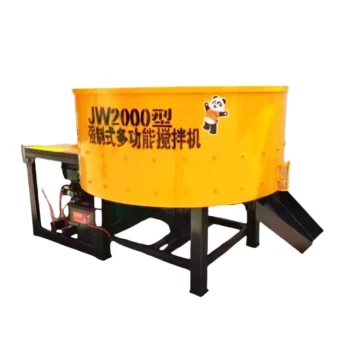
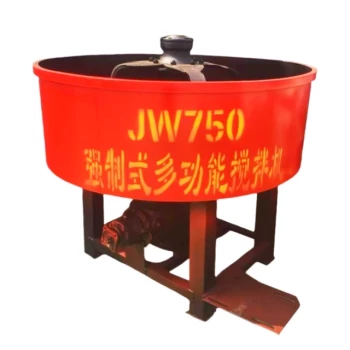
At their core, concrete mixer trucks perform two critical functions: they maintain the precise mixture of concrete during transport and deliver it directly to the point of use. This combination of mobile mixing and transportation eliminates the immense labor of on-site batching, ensures a consistent, high-quality product, and is fundamental to the speed and scale of modern construction.
The true role of a concrete mixer truck is not merely to transport material, but to transform concrete into a reliably engineered product delivered on-demand. This capability underpins project efficiency, structural integrity, and financial viability.
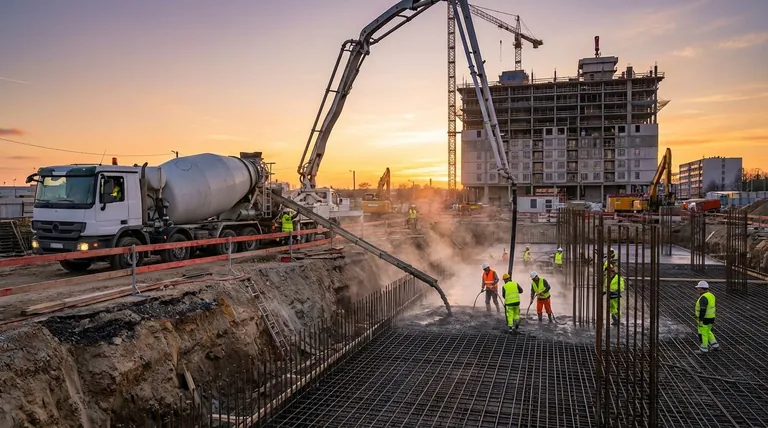
The Core Functions: More Than Just a Truck
Concrete mixer trucks solve the fundamental challenge of getting a perishable, heavy, and precisely mixed material from a batching plant to a construction site without it losing its specified properties.
Ensuring Mix Consistency from Plant to Pour
The constantly rotating drum is the most recognizable feature of a mixer truck. This continuous agitation prevents segregation, where heavy aggregates settle, and ensures the water, cement, and aggregates remain a uniform, or homogeneous, mixture.
Modern trucks often include dedicated water tanks and control systems. These allow for fine-tuning the slump (a measure of consistency) on-site, just before the pour, without compromising the water-to-cement ratio and final strength.
Eliminating Manual Labor and On-Site Batching
Before mixer trucks became ubiquitous, concrete was mixed on-site in small batches. This process was extremely slow, labor-intensive, and prone to human error, resulting in inconsistent quality from one batch to the next.
Mixer trucks centralize the mixing process at a controlled batch plant and automate delivery. This dramatically reduces the on-site labor required for concrete production, freeing up personnel for other critical tasks.
Enabling Continuous and Timely Pours
Many structural elements, such as large foundations or suspended slabs, require a continuous pour to avoid "cold joints" that can compromise structural integrity.
A fleet of mixer trucks can provide an uninterrupted flow of concrete, ensuring that these large-scale pours can be completed quickly and correctly, maintaining the monolithic nature of the structure.
Strategic Advantages in Project Management
The operational role of a mixer truck translates directly into significant advantages for project planning, budgeting, and execution.
Significant Gains in Efficiency and Productivity
The ability to deliver large volumes of ready-mixed concrete precisely when and where it is needed accelerates project timelines significantly. This efficiency is a cornerstone of modern construction scheduling.
Specialized units like self-loading mixers further enhance this by consolidating loading, mixing, and transport into a single machine, which is invaluable for remote sites or projects requiring varied mixes.
Enhanced Quality Control
By relying on a professional batch plant, developers gain a high degree of confidence in the quality and consistency of their concrete. The mix is produced to exact specifications in a controlled environment.
This centralized quality control, maintained during transit by the truck, is far superior to the variability of on-site mixing, leading to better and more predictable structural performance.
Direct Impact on Cost and Waste Reduction
While there is a cost to ready-mix concrete delivery, it is often far outweighed by the savings. Labor costs are drastically reduced, and because concrete is delivered as needed, material waste from over-mixing or spoiled batches is minimized.
Portable or volumetric mixers offer the ultimate control over waste by mixing the exact required amount of concrete on-site from raw materials they carry.
Understanding the Trade-offs and Pitfalls
While indispensable, relying on concrete mixer trucks introduces operational dependencies and challenges that must be managed carefully.
The Critical Challenge of Timing
Concrete has a limited workable lifespan, typically around 90 minutes. Any delay in transit—from traffic, plant issues, or poor site access—can result in the entire load being rejected, causing costly delays and waste.
The Risk of Inconsistent Batches
Although each truckload is internally consistent, there can be slight variations between different batches from the plant. Proper on-site testing, such as slump tests for every truck, remains a critical quality assurance step.
Site Access and Preparation
Concrete mixer trucks are large, heavy vehicles. The construction site must have clear, stable access routes to the pour location. Poor planning can lead to trucks getting stuck or being unable to discharge the concrete where it's needed most.
Making the Right Choice for Your Goal
Selecting the right concrete delivery method is a strategic decision based on your project's scale, location, and specific requirements.
- If your primary focus is large-scale, continuous pouring: Rely on standard transit mixers from a reputable local batch plant for the most efficient and cost-effective supply.
- If your primary focus is remote work or all-in-one efficiency: A self-loading mixer is the ideal solution, as it removes the dependency on separate loading equipment and a nearby plant.
- If your primary focus is precision, minimal waste, or multiple small pours: A portable volumetric mixer provides unparalleled on-site control over the mix design and quantity.
Ultimately, understanding the role of the concrete mixer is to see it as a key component in a logistical chain that ensures the quality and efficiency of your entire construction project.
Summary Table:
| Function | Strategic Advantage | Key Consideration |
|---|---|---|
| Maintains mix consistency during transit | Enhances structural integrity & quality control | Requires precise timing to avoid concrete setting |
| Eliminates on-site manual batching | Drastically reduces labor costs & improves efficiency | Site must have stable access for large vehicles |
| Enables large-scale, continuous pours | Accelerates project timelines & supports monolithic structures | Slight batch variations between truckloads may occur |
Ready to ensure your project's concrete delivery is efficient and reliable?
At GARLWAY, we specialize in providing robust construction machinery, including concrete mixers and batching plants, tailored for construction companies and contractors worldwide. Our equipment is engineered to deliver the consistent quality and on-time performance your projects demand, helping you save on labor costs and minimize waste.
Contact GARLWAY today to discuss your specific needs and discover how our solutions can build a stronger foundation for your success.
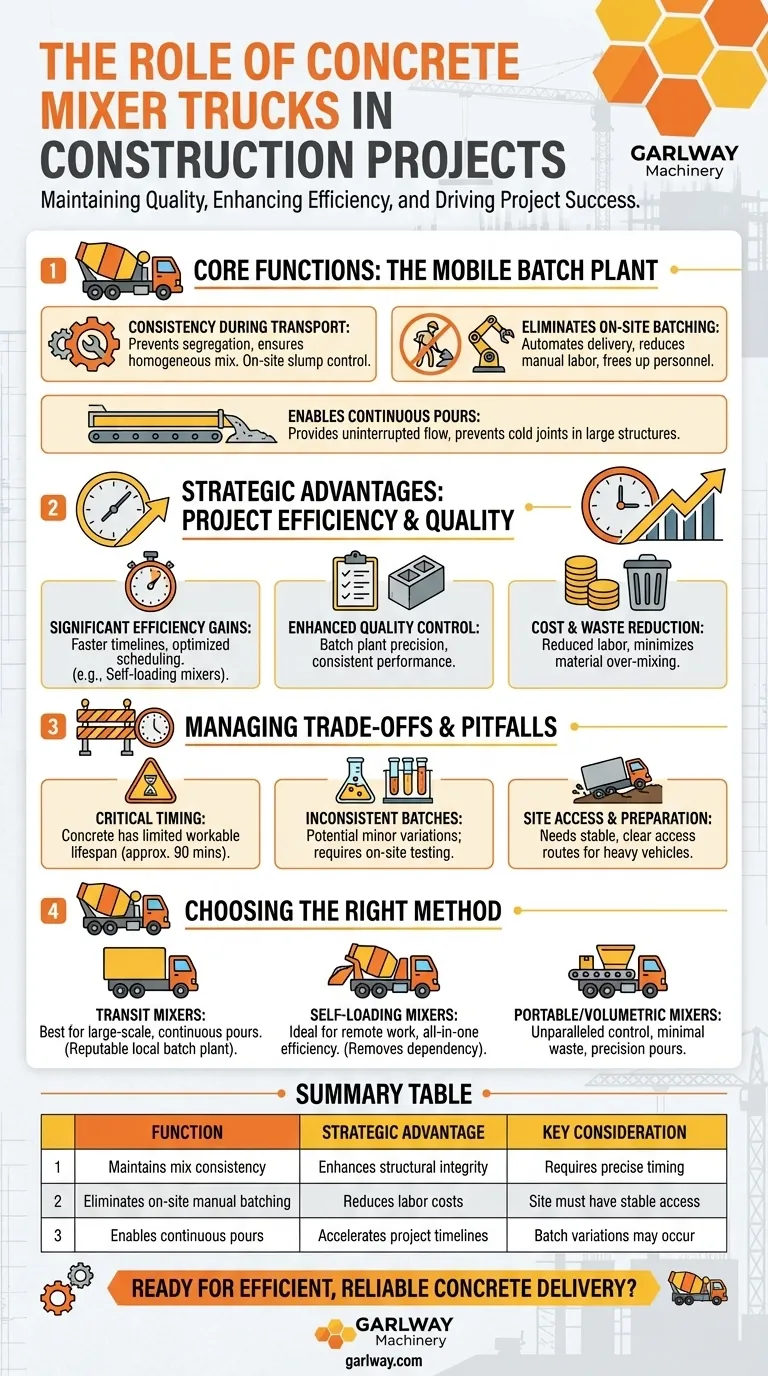
Visual Guide
Related Products
- Ready Mixer Machine for Construction Ready Mix Machinery
- JW1000 Mobile Cement Mixer Concrete Mixer Truck and Batching Plant
- Mini Cement Mortar Mixer Truck for Construction
- Harbor Freight JS1500 On Site Concrete Mixing Volumetric Cement Mixer
- HZS90 Large Multiquip Concrete Mixers for Construction
People Also Ask
- What are the purposes of low-speed agitation in truck mixers? Preserve Concrete Quality During Transit
- How is ready-mixed concrete transported from a commercial concrete batching plant? Ensuring Quality & Timely Delivery
- What are the main ingredients mixed in a concrete mixer truck? Master the Formula for Strong Concrete
- In what ways does a mobile concrete mixer improve quality control and consistency? Achieve Superior On-Site Concrete Quality
- What types of construction projects typically use concrete mixer trucks? From Highways to Home Foundations