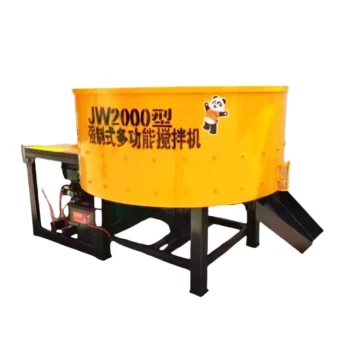
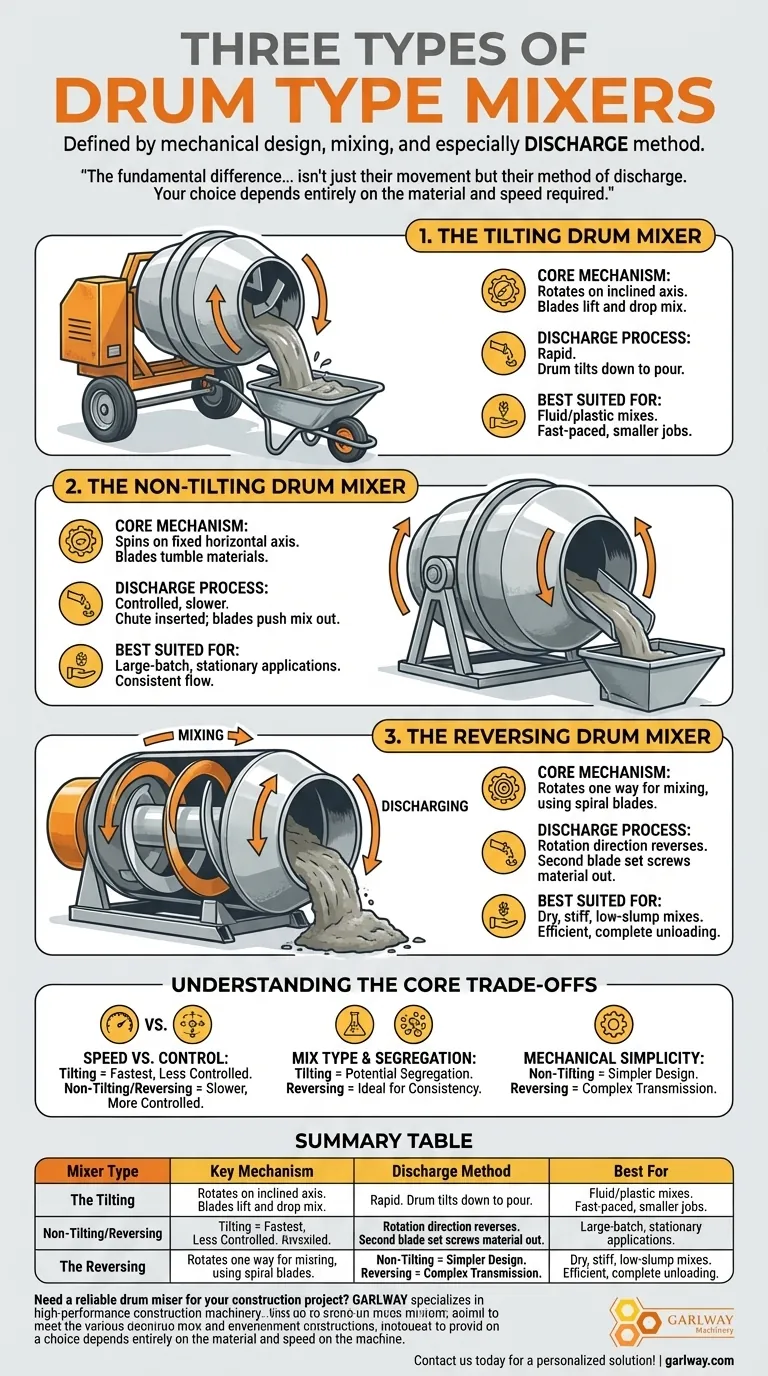
The three primary types of drum mixers are tilting drum mixers, non-tilting drum mixers, and reversing drum mixers. Each is defined by its distinct mechanical design, which directly dictates how it mixes ingredients and, most importantly, how it discharges the final product.
The fundamental difference between the three types of drum mixers isn't just their movement but their method of discharge. Your choice depends entirely on the type of material you are mixing and the speed required for your operation.
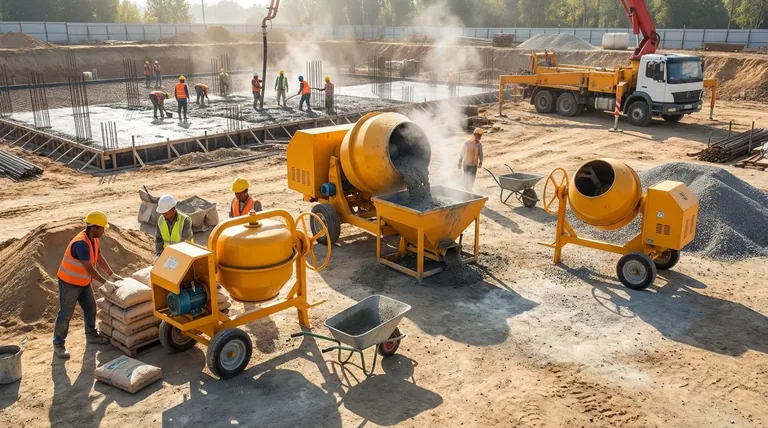
1. The Tilting Drum Mixer
A tilting mixer is characterized by a drum that pivots or tilts on an axis to pour out its contents. This design is often used for its speed and simplicity.
Core Mechanism
The drum rotates on an inclined axis to mix the materials. The mixing action is achieved by lifting the ingredients with internal fins and letting them fall back into the mix.
Discharge Process
Discharge is incredibly straightforward and rapid. The entire drum is tilted downwards, allowing the mixed concrete or other material to pour out quickly into a wheelbarrow or hopper.
Best Suited For
This type is ideal for fluid or plastic mixes with a higher water content. Its fast discharge cycle makes it highly efficient for smaller to medium-sized jobs where speed is a priority.
2. The Non-Tilting Drum Mixer
As the name implies, a non-tilting mixer has a drum that rotates on a fixed horizontal axis. The drum itself does not change its orientation to unload the material.
Core Mechanism
The drum spins continuously on its horizontal axis. Like the tilting mixer, internal blades or fins lift and tumble the materials to ensure a homogenous mix.
Discharge Process
Discharge is managed by inserting a chute into the drum's opening. The rotating blades push the mixed material onto the chute, which then guides it out of the mixer. This process is slower and more controlled than a tilting mixer.
Best Suited For
These mixers are often found in larger, more stationary setups. Their controlled discharge makes them suitable for applications requiring a consistent, steady flow of material.
3. The Reversing Drum Mixer
A reversing drum mixer uses the direction of its rotation to control both the mixing and discharging processes from a single opening.
Core Mechanism
The drum rotates in one direction for mixing, using one set of internal spiral blades to fold the material toward the back of the drum. This creates a thorough mixing action.
Discharge Process
To discharge the mix, the direction of the drum's rotation is reversed. A second set of spiral blades then engages, effectively "screwing" or pushing the material out of the front opening.
Best Suited For
Reversing drum mixers excel at handling dry, stiff, or low-slump concrete mixes. The powerful discharging action ensures that even less-fluid materials are unloaded completely and efficiently.
Understanding the Core Trade-offs
Choosing a mixer involves balancing speed, mix consistency, and mechanical complexity. No single type is universally superior; the best choice is always application-dependent.
Speed vs. Control
Tilting mixers offer the fastest discharge, making them highly productive. However, this speed can be less controlled. Non-tilting and reversing mixers provide a much more controlled, albeit slower, discharge process.
Mix Type and Segregation
The aggressive pouring action of a tilting mixer can sometimes cause segregation in certain mixes, where heavier aggregates separate from the cement paste. The controlled process of reversing mixers makes them ideal for sensitive or dry mixes where consistency is paramount.
Mechanical Simplicity
Non-tilting mixers often have a simpler mechanical design with fewer moving parts related to the discharge mechanism compared to tilting models. Reversing mixers require a more complex transmission to handle the bidirectional rotation.
Making the Right Choice for Your Project
Your decision should be guided by the material you are working with and your operational priorities.
- If your primary focus is speed with fluid mixes: The tilting drum mixer is your most efficient option due to its rapid discharge cycle.
- If your primary focus is large-batch consistency and controlled flow: The non-tilting drum mixer provides a steady, reliable output for stationary applications.
- If your primary focus is dry, stiff, or low-slump mixes: The reversing drum mixer offers the most effective mixing and discharging action for challenging materials.
Ultimately, understanding how each mixer type discharges its contents is the key to selecting the right tool for the job.
Summary Table:
| Mixer Type | Key Mechanism | Discharge Method | Best For |
|---|---|---|---|
| Tilting Drum Mixer | Drum tilts on an axis to mix | Fast pouring by tilting the drum | Fluid/plastic mixes, fast-paced jobs |
| Non-Tilting Drum Mixer | Drum rotates on a fixed horizontal axis | Controlled flow via a chute | Large-batch, stationary applications |
| Reversing Drum Mixer | Drum reverses rotation direction | Material is pushed out by reversing blades | Dry, stiff, or low-slump concrete mixes |
Need a reliable drum mixer for your construction project? GARLWAY specializes in high-performance construction machinery, including durable concrete mixers and batching plants designed for contractors and construction companies worldwide. Let our experts help you select the perfect mixer to boost your efficiency and ensure consistent results. Contact us today for a personalized solution!
Visual Guide
Related Products
- Concrete Cement Mixer Machine Drum Mixer for Construction
- Belle Mixer Drum Self Loading Mortar Mixers JS3000
- Harbor Freight JS1500 On Site Concrete Mixing Volumetric Cement Mixer
- JDY350 Electric Hydraulic Mortar Mud Concrete Mixer
- Hydraulic Concrete Mixer Machine Cement Mixing Equipment for Mixture Concrete
People Also Ask
- What are the key advantages of using drum mixers in concrete mixing? Boost Volume & Efficiency on Your Site
- What are the key components that maintain concrete mix consistency in the drum? Ensure Uniform Quality from Plant to Site
- How do cement mixers enhance safety on construction sites? Reduce Strain, Hazards, and Accidents
- When was the first concrete mixer developed and by whom? Discover the 1900 Breakthrough
- What is the average lifespan of a concrete mixer? Maximize Your Equipment's Lifespan & ROI