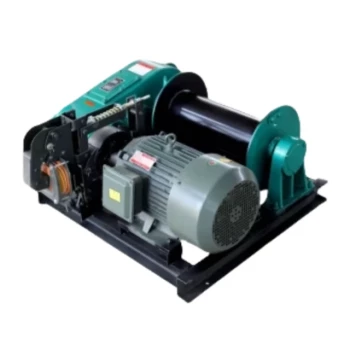
At its core, a trailer winch cable system works by using a geared mechanism to wind a cable or strap onto a central drum. This process converts a small input force—either from you turning a crank or from an electric motor—into a powerful, controlled pull, giving you the mechanical advantage needed to move a heavy boat onto a trailer.
A winch is essentially a force multiplier. Whether manual or electric, its primary job is to translate low-power input into high-power output through gear reduction, allowing a single person to handle loads weighing thousands of pounds.
The Core Mechanics: How a Winch Generates Force
To understand how the cable system functions, you must first understand the key components that work together inside the winch housing.
The Drum and Cable
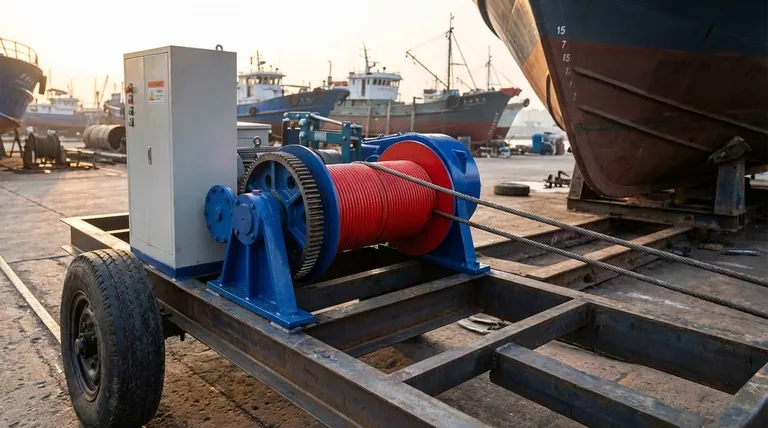
The drum is the cylinder that the winch cable or strap is wound around. As the drum rotates, it either pulls the cable in (retrieving) or lets it out (launching). The cable itself is the direct connection to your boat.
The Gear Train
This is the heart of the winch. A series of interlocking gears takes the rapid, low-force rotation from the handle or motor and converts it into slow, high-force rotation at the drum. This gear ratio is what determines the winch's pulling power.
The Ratchet and Pawl (Manual Winches)
In a manual winch, the signature "clicking" sound comes from the ratchet and pawl. This is a critical safety device. The pawl is a small lever that engages with the teeth of a ratchet gear, preventing the drum from unwinding under load. It ensures that the boat can't pull the cable back out when you stop cranking.
The Drive System
This is what provides the initial input power. There are two primary types.
- Manual: A hand-cranked handle is attached to the gear train.
- Electric: A 12-volt motor, powered by a battery, drives the gear train at the push of a button.
Manual vs. Electric: Two Approaches to Power
While both systems pull a cable onto a drum, the way they are operated and released differs significantly.
How Manual Winches Operate
With a manual winch, you provide the power by turning the crank handle. Each turn engages the gear train and the ratchet mechanism, slowly and safely pulling the boat onto the trailer. To release the cable, you typically flip the pawl to disengage it and unwind the handle.
How Electric Winches Automate the Process
An electric winch uses a 12-volt motor to do all the work. A simple remote or switch powers the motor to pull the boat in. This is especially useful for heavier boats where manual cranking would be strenuous.
Releasing the Load: The Role of Freewheeling
Many electric winches (and some manual ones) feature a freewheel or clutch setting. This disengages the drum from the gear train, allowing the cable to pull out freely. For launching a boat, this lets gravity slide the boat off the trailer quickly without needing to power the winch in reverse.
Understanding the Trade-offs
Choosing between a manual and electric system involves balancing simplicity against convenience. Each has distinct advantages and disadvantages.
Manual Winch: Simplicity and Reliability
The greatest strength of a manual winch is its lack of complexity. With no motors, wires, or batteries, there are fewer points of failure. They are dependable, cost-effective, and require no external power source. Their main drawback is the physical effort required.
Electric Winch: Convenience and Power
Electric winches make retrieving a boat, especially a heavy one, nearly effortless. Pushing a button is far easier than extended manual cranking. However, they require a reliable battery, proper wiring, and are more complex, meaning there are more components that could potentially fail over time.
Making the Right Choice for Your Goal
Your decision should be based on your boat's weight, how you use it, and your personal priorities.
- If your primary focus is reliability and you have a lighter boat: A manual winch offers a robust, cost-effective, and fail-safe solution.
- If your primary focus is convenience and handling heavy loads: An electric winch is the superior option, saving you significant time and physical effort.
- If your primary focus is safety: Always understand your specific winch's release mechanism, whether it's a freewheel clutch or a manual ratchet release, before you are on a slippery boat ramp.
Ultimately, understanding these core mechanics empowers you to operate your winch safely and choose the right tool for the job.
Summary Table:
| Feature | Manual Winch | Electric Winch |
|---|---|---|
| Power Source | Hand Crank | 12V Motor & Battery |
| Best For | Lighter Boats, Reliability | Heavy Boats, Convenience |
| Key Mechanism | Ratchet & Pawl | Freewheel Clutch |
| Operation | Physical Cranking | Push-Button Remote |
Need a reliable winch for your construction or marine project?
GARLWAY specializes in durable, high-performance construction machinery, including winches, concrete mixers, and batching plants. Our equipment is engineered for contractors and construction companies worldwide who demand power and reliability.
Let us help you find the perfect solution for your heavy lifting needs. Contact our experts today for a personalized consultation!
Visual Guide

Related Products
- 12000 lb Electric Boat Trailer Winch with Windlass Anchor Warn
- Portable Small Trailer Winch
- Best 18000 Pound Drum Anchor Trailer Winch
- Warn Winch Windlass Boat Trailer Winch
- Quick Windlass Portable Winch for Truck and Boat Best Boat Winch
People Also Ask
- How does an electric boat trailer winch differ from a manual one? Effort vs. Control Explained
- What size winch do I need for my boat? Get the Right Capacity for Safe Hauling
- How should a boat trailer winch be properly used? A Step-by-Step Guide for Safe Loading
- What maintenance steps are specific to boat trailer winches? Ensure Safety & Reliability at the Ramp
- How strong of a winch do I need for my boat? Get the Right Pulling Power for Trailering & Anchoring