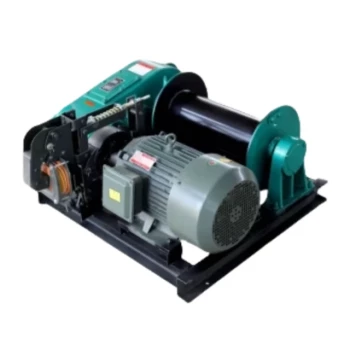
In vehicle maintenance and transportation, a winch is a foundational tool for applying controlled pulling force to an object that cannot move on its own. It transforms potentially dangerous and difficult tasks, like loading a non-running car onto a trailer or repositioning a vehicle with locked wheels, into a manageable and safe process.
A winch is far more than an off-road recovery device; it is a force multiplier for the workshop and transporter. Its core function is to provide the immense, controllable power needed to safely manipulate heavy, immobile vehicles when their own powertrain is not an option.
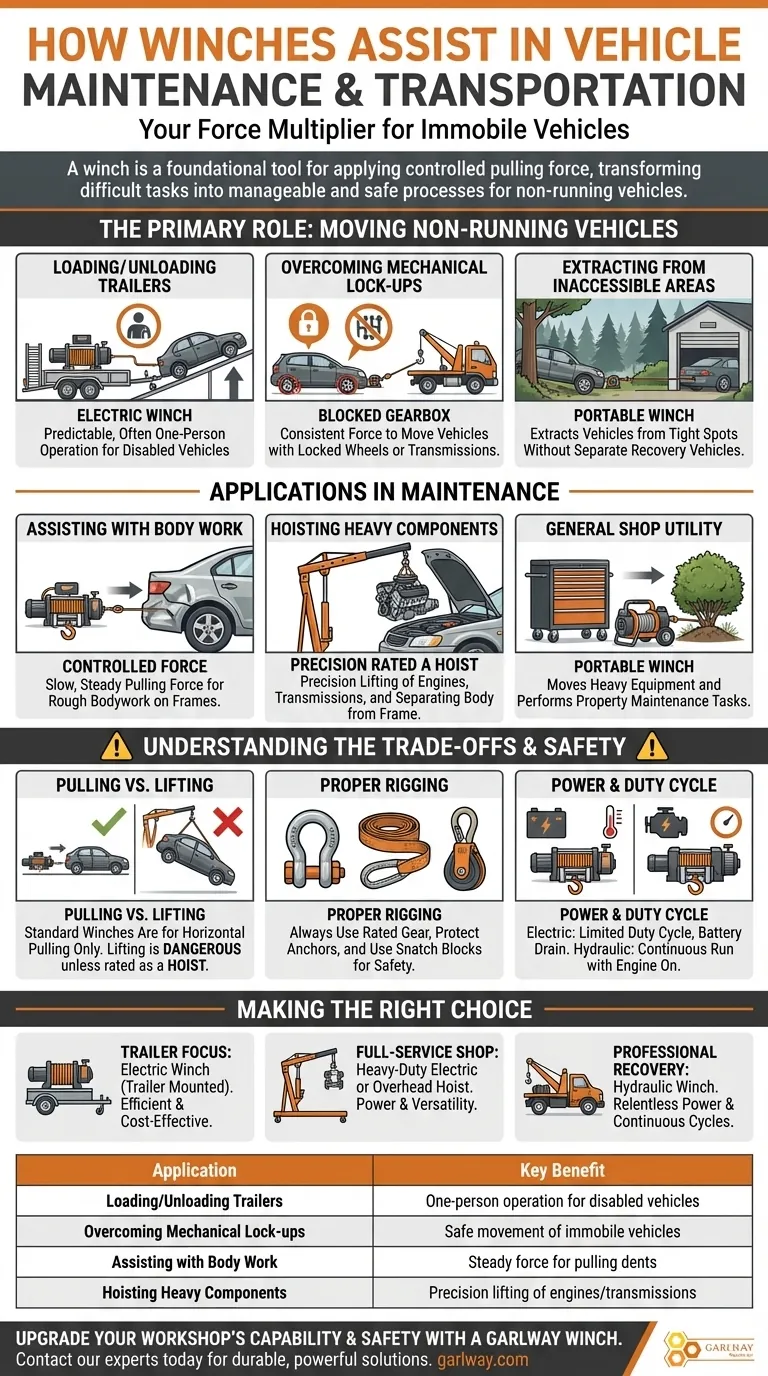
The Primary Role: Moving Non-Running Vehicles
A winch’s most common application in maintenance and transport is overcoming a vehicle's inability to move. It provides the muscle for scenarios where pushing or towing is impractical or unsafe.
Loading and Unloading from Trailers
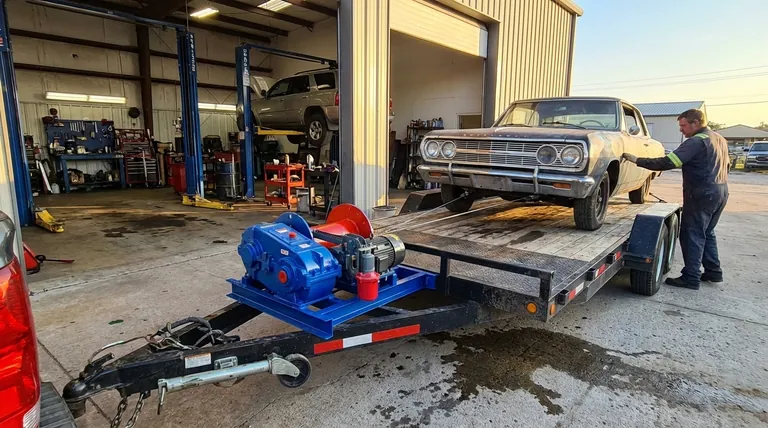
A winch makes loading a disabled vehicle onto a trailer a predictable, often one-person operation. This is especially critical for project cars or vehicles awaiting repair that cannot be driven up a ramp.
Overcoming Mechanical Lock-ups
When a vehicle's transmission is stuck in gear or its wheels are locked, pushing it is nearly impossible. A winch can provide the consistent force needed to drag the vehicle into a desired position for transport or repair.
Extracting from Inaccessible Areas
Vehicles are often stored in tight spots, such as behind a garage, in dense woods, or deep in a property. A winch allows you to extract these vehicles and bring them into a serviceable area without needing a separate recovery vehicle.
Beyond Transportation: Applications in Maintenance
While its primary use is moving entire vehicles, the controlled power of a winch can be adapted for specific maintenance tasks within the shop.
Assisting with Body Work
When properly configured with the right anchor points, a winch can be used to perform rough bodywork. It can provide the slow, steady pulling force required to pull out significant dents in frames or body panels.
Hoisting Heavy Components
Drawing from principles used in industrial settings, a winch rated for lifting (often called a hoist) can be an invaluable shop tool. It can be used to lift engine blocks, transmissions, or even separate a vehicle's body from its frame with precision.
General Shop and Property Utility
The utility of a portable winch extends beyond the vehicle itself. It can be used to pull and remove large shrubs, reposition heavy tool chests, or move other cumbersome equipment around the property.
Understanding the Trade-offs and Safety
Using a winch effectively requires an understanding of its limitations and a strict adherence to safety protocols. It is a powerful tool that commands respect.
Winches Are for Pulling, Not Lifting
A standard vehicle recovery winch is designed exclusively for horizontal pulling. Using it for vertical lifting is extremely dangerous unless it is specifically rated as a hoist. The braking systems are fundamentally different.
The Importance of Proper Rigging
A winch's power can become a hazard if not anchored and connected correctly. Always use rated shackles, tree-saver straps to protect anchors, and snatch blocks to change pulling angles or increase power. An improper setup can lead to catastrophic failure of equipment.
Power and Duty Cycle Limits
Electric winches draw immense power and can quickly drain a vehicle's battery. They also have a limited duty cycle, meaning they can overheat if used continuously for too long. In contrast, hydraulic winches, common on commercial tow trucks, can run continuously as long as the vehicle's engine is on.
Making the Right Choice for Your Goal
Selecting the right winch depends entirely on its intended application.
- If your primary focus is loading project cars onto a trailer: A properly sized electric winch mounted to the trailer is the most efficient and cost-effective solution.
- If your primary focus is a full-service auto shop: A heavy-duty, stationary electric winch or a dedicated overhead hoist offers the power and versatility for moving vehicles and heavy components.
- If your primary focus is professional vehicle recovery: A hydraulic winch is the industry standard, delivering the relentless power and long duty cycles required for commercial operations.
By viewing a winch as a versatile tool for controlled pulling, you unlock a safer and more efficient way to manage vehicle maintenance and transportation challenges.
Summary Table:
| Application | Key Benefit |
|---|---|
| Loading/Unloading Trailers | One-person operation for disabled vehicles |
| Overcoming Mechanical Lock-ups | Safe movement of immobile vehicles |
| Assisting with Body Work | Steady force for pulling dents |
| Hoisting Heavy Components | Precision lifting of engines/transmissions |
Upgrade your workshop's capability and safety with a GARLWAY winch. As a specialist in construction machinery, GARLWAY offers durable, powerful winches perfect for construction companies and contractors needing reliable solutions for vehicle maintenance and transportation. Let us help you find the right tool for your specific challenges. Contact our experts today to discuss your needs and get a personalized recommendation!
Visual Guide
Related Products
- Warn Winch Windlass Boat Trailer Winch
- Small Electric Winch 120V and 240V for Compact Applications
- Electric and Hydraulic Winch for Heavy Duty Applications
- Quick Windlass Portable Winch for Truck and Boat Best Boat Winch
- Portable Small Trailer Winch
People Also Ask
- What are the main components of a boat trailer winch? A Guide to Safe & Efficient Boat Loading
- What factors should be considered when choosing a boat trailer winch? Ensure Safe and Effortless Boat Loading
- What is the purpose of boat trailer winches? Safely and Efficiently Load Your Boat
- What are the two main types of boat trailer winches? Manual vs. Electric Explained
- How often should a boat trailer winch be replaced? Your Guide to Safety and Longevity