
The primary advantage of an electric trolley is its ability to move heavy loads with superior safety and minimal physical effort. Unlike manual trolleys that rely on an operator's strength, an electric trolley uses a motor for powered horizontal movement, which includes a critical braking system to prevent dangerous momentum buildup.
The core value of an electric trolley is not just movement, but controlled movement. It transforms the task of traversing a heavy load from a physically demanding and potentially hazardous act into a precise, safe, and efficient operation.
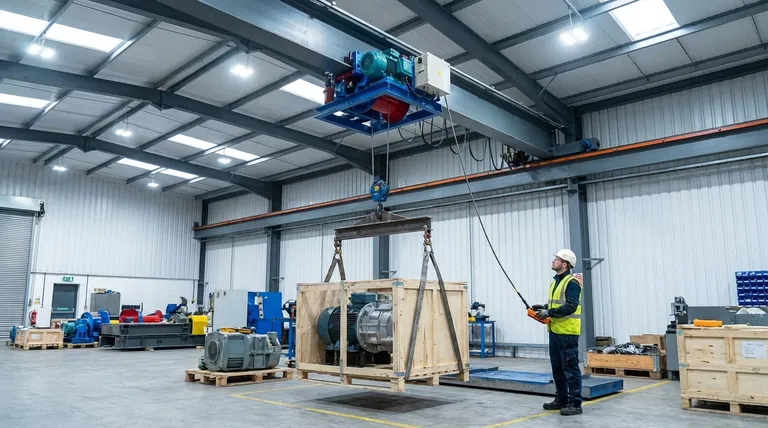
The Core Advantages of Motorized Control
When you choose an electric trolley, you are investing in a system that prioritizes safety, precision, and operator well-being, especially as load weights increase or the frequency of use goes up.
Enhanced Safety Through Controlled Deceleration
An electric trolley's most significant safety feature is its integrated brake. This mechanism actively slows and stops the trolley's travel.
This is crucial for preventing a heavy load from gaining momentum, which can be extremely difficult and dangerous to stop manually. Controlled deceleration eliminates the risk of the load coasting into a hard stop, swinging uncontrollably, or overshooting its target.
Superior Precision and Load Spotting
Motorized control allows for smooth, incremental movements that are nearly impossible to replicate by manually pushing or pulling a heavy hoist.
This precision is essential when positioning expensive machinery, aligning components for assembly, or placing delicate materials. The operator can "jog" the trolley in small increments for perfect placement, reducing the risk of product damage.
Drastically Reduced Operator Fatigue
Manually moving loads, especially those approaching or exceeding a ton, is physically taxing. An electric trolley eliminates this strenuous effort.
Reducing operator fatigue leads directly to higher productivity throughout a work shift and significantly lowers the risk of musculoskeletal injuries associated with pushing and pulling heavy objects.
Increased Operational Speed and Efficiency
For applications requiring frequent movement over longer beam distances, an electric trolley is significantly faster than a manual alternative.
This boosts overall operational tempo, allowing more lifts to be completed in the same amount of time and reducing bottlenecks in the workflow.
Understanding the Trade-offs
While powerful, an electric trolley is not the universal solution. Acknowledging its specific requirements is key to making a sound decision.
Higher Initial Cost
The most obvious trade-off is the initial investment. The motor, gearbox, controls, and braking system make an electric trolley more expensive than a simple push or geared manual trolley.
Power and Maintenance Requirements
Electric trolleys require a power source, typically supplied by a festoon cable system that runs along the beam. This adds complexity to the installation.
Furthermore, with more moving parts like a motor and electrical components, they have greater maintenance needs over their lifespan compared to a purely mechanical manual trolley.
Not Ideal for All Environments
Standard electric trolleys are not suitable for all working conditions. In environments with explosive gases or combustible dust, specially designed and significantly more expensive explosion-proof models are required to prevent ignition hazards.
Making the Right Choice for Your Application
Your decision should be driven by the specific demands of your lifting tasks, balancing upfront cost with long-term safety and efficiency.
- If your primary focus is safety with heavy or frequently moved loads: An electric trolley is the definitive choice for its braking and effortless control.
- If your primary focus is precision and load positioning: The fine control offered by a motorized trolley is essential for accurate and damage-free placement.
- If your primary focus is low cost for light, infrequent lifts: A simpler and less expensive push or geared manual trolley may be a more practical solution.
Ultimately, choosing an electric trolley is an investment in a safer, more precise, and more productive lifting operation.
Summary Table:
| Advantage | Key Benefit |
|---|---|
| Enhanced Safety | Integrated brake prevents dangerous momentum buildup. |
| Superior Precision | Motorized control allows for smooth, incremental movements. |
| Reduced Operator Fatigue | Eliminates strenuous manual effort for moving heavy loads. |
| Increased Efficiency | Faster travel speeds for frequent or long-distance moves. |
Ready to enhance the safety and efficiency of your lifting operations?
GARLWAY specializes in robust construction machinery, including electric trolleys designed for demanding industrial use. Our solutions help construction companies and contractors globally achieve safer, more precise, and more productive material handling.
Contact our experts today to find the perfect electric trolley for your needs and get a personalized solution!
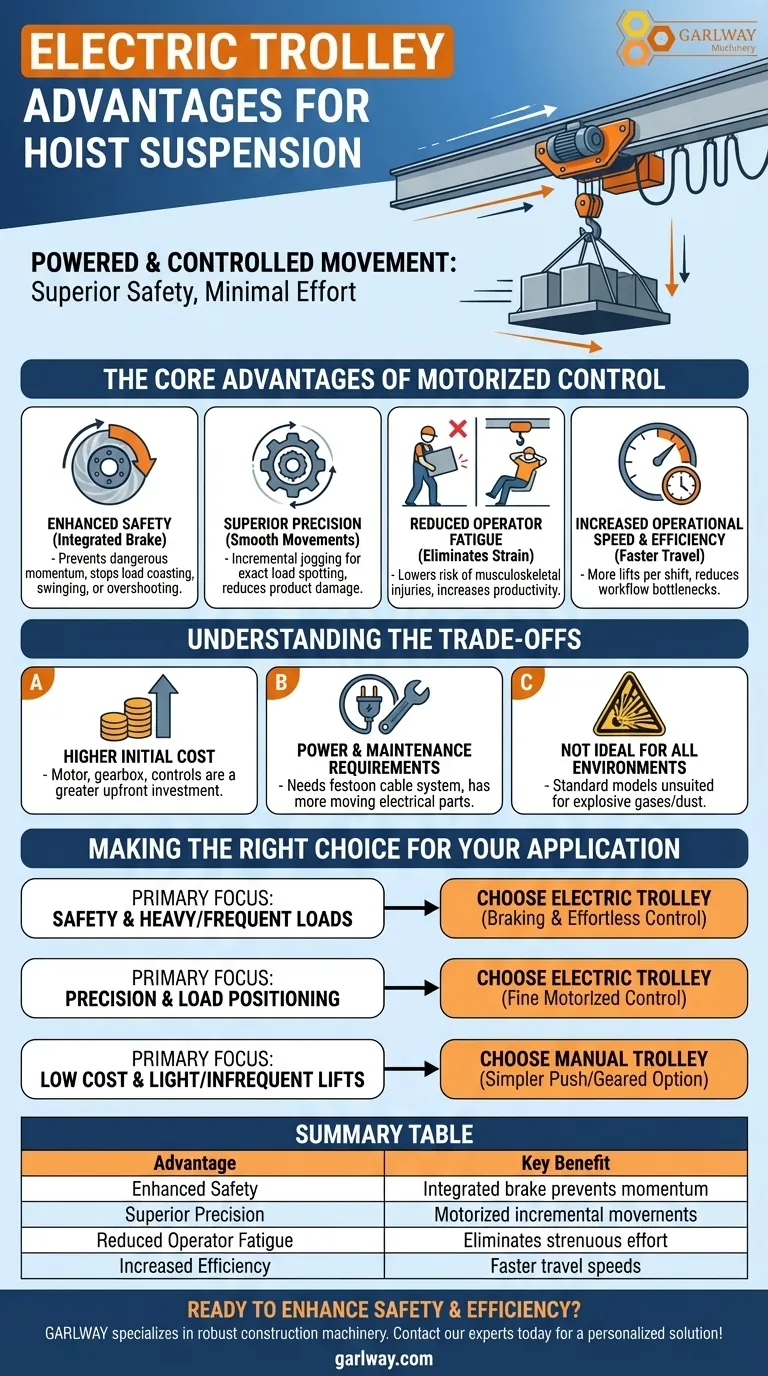
Visual Guide
Related Products
- Electric Hoist Winch Boat Anchor Windlass for Marine Applications
- Electric and Hydraulic Winch for Heavy Duty Applications
People Also Ask
- How does an electric anchor winch work? Power, Safety, and Reliable Operation Explained
- What are the advantages of installing an electric anchor winch on a boat? Boost Safety & Ease for Boaters
- What are the operational differences between electric hoists and winches? A Guide to Safe Lifting vs. Pulling
- What are the main benefits of a boat anchor winch? Boost Safety & Efficiency for Your Vessel
- How does a boat anchor winch work? A Guide to Reliable Anchor Handling

