
In a river crossing, a winch acts as your most critical safety net. It provides a powerful, external pulling force to recover your vehicle if it becomes immobilized by a strong current, loses traction on a slippery riverbed, or gets trapped by an unseen underwater obstacle.
The primary role of a winch in this scenario is not to pull a vehicle through the water as a means of propulsion, but to serve as a recovery device when the vehicle can no longer move under its own power.
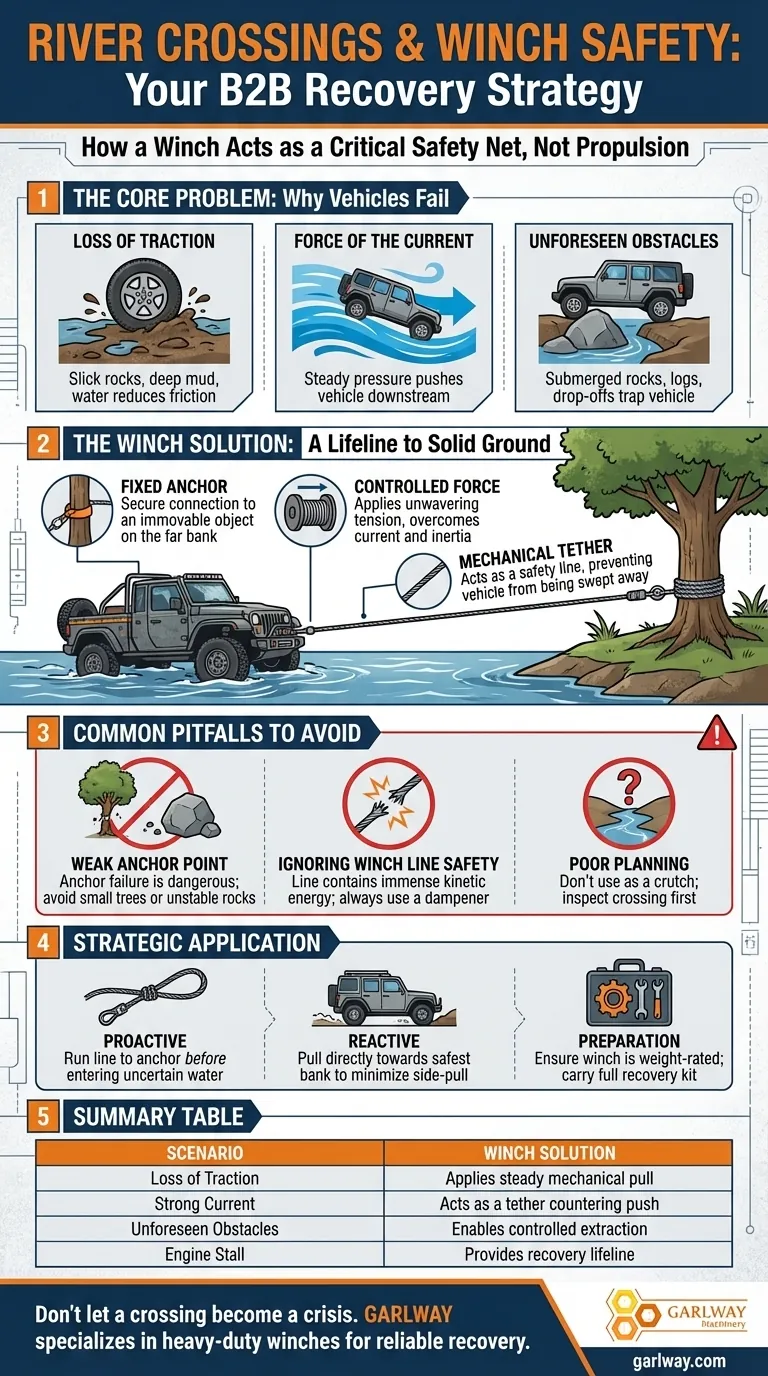
The Core Problem: Why Vehicles Fail in Water
To understand the winch's value, you must first understand the forces working against a vehicle during a water crossing. These situations can escalate from manageable to dangerous in seconds.
Loss of Traction
The riverbed is often composed of slick rocks, deep mud, or loose sand. Water reduces the friction between your tires and the ground, making it very easy to lose traction and for your wheels to spin uselessly.
The Force of the Current
Water is heavy and powerful. A steady current exerts significant and constant pressure on the side of your vehicle, relentlessly pushing it downstream. If you stall or get stuck, this force can be enough to sweep your vehicle away.
Unforeseen Underwater Obstacles
You cannot see what lies beneath the surface. A hidden drop-off, a large boulder, or a submerged log can easily trap a wheel, bringing your vehicle to an immediate and unrecoverable halt without assistance.
How a Winch Provides a Solution
A winch systematically counteracts the forces that immobilize a vehicle, providing a lifeline to a stable point and allowing for a controlled extraction.
Establishing a Fixed Anchor
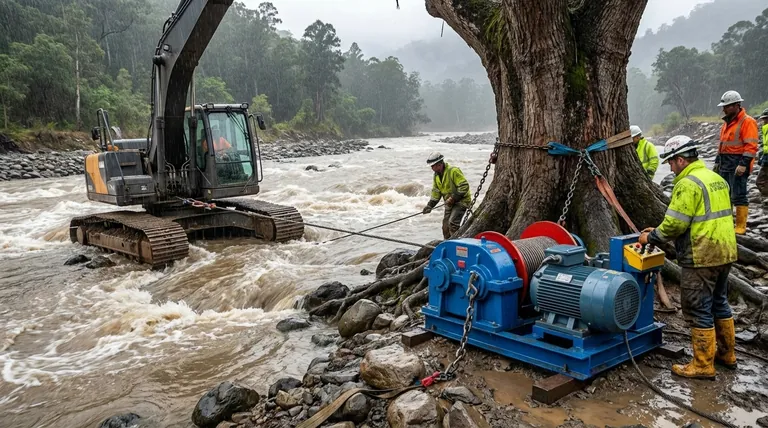
The fundamental principle is connecting the winch cable to an immovable object, typically a sturdy tree or another heavy vehicle on the far bank. This creates a secure connection to solid ground.
Applying Constant, Controlled Force
Unlike spinning tires that can dig a vehicle deeper into mud, a winch applies steady, unwavering tension. This mechanical pulling power is far more effective at overcoming the river's current and the vehicle's own inertia.
Serving as a Mechanical Tether
Once connected, the winch line acts as a physical safety tether. Even if the engine stalls and all power is lost, the line prevents the vehicle from being carried away, buying you crucial time to execute a safe and methodical recovery.
Common Pitfalls to Avoid
Using a winch is a serious task that requires knowledge and caution. Misuse can be ineffective and dangerous.
Choosing a Weak Anchor Point
A winch is only as strong as its anchor. Attaching it to a small tree, an insecure rock, or another unstably parked vehicle can result in the anchor failing, creating a highly dangerous situation.
Ignoring Winch Line Safety
A winch line under tension contains an enormous amount of kinetic energy. If it snaps, it can whip back with lethal force. Always use a line dampener and ensure all people are a safe distance away from the line during operation.
Using it as a Crutch for Poor Planning
A winch is a recovery tool, not a substitute for good judgment. It should not be used to attempt a crossing that is obviously too deep or swift. Always inspect a crossing on foot first if it is safe to do so.
How to Apply This to Your Crossing
Your strategy for using a winch depends on your assessment of the risk before you begin.
- If your primary focus is proactive safety: For uncertain or challenging crossings, it is wise to run the winch line to a solid anchor on the far bank before you even enter the water.
- If your primary focus is reactive recovery: Should you become unexpectedly stuck, use the winch to pull the vehicle directly toward the nearest and safest bank, minimizing any side-pull which can increase instability.
- If your primary focus is preparation: Ensure your winch is properly rated for your vehicle's gross weight and that you are equipped with a full recovery kit, including tree trunk protectors, rated shackles, and a line dampener.
Ultimately, a winch transforms a water crossing from a gamble against unpredictable forces into a calculated and recoverable maneuver.
Summary Table:
| Scenario | Winch Solution |
|---|---|
| Loss of Traction | Applies steady, mechanical pull to overcome slippery riverbeds. |
| Strong Current Force | Acts as a tether, countering the water's push to prevent drifting. |
| Unforeseen Obstacles | Enables controlled extraction from hidden rocks, logs, or drop-offs. |
| Engine Stall | Provides a recovery lifeline even if the vehicle loses all power. |
Don't let a river crossing turn into a crisis. GARLWAY specializes in heavy-duty winches and construction machinery, providing the reliable power that construction companies and contractors need for safe, effective vehicle recovery in challenging environments. Ensure your team is equipped for any terrain — contact our experts today to find the perfect winch for your fleet.
Visual Guide
Related Products
- Warn Winch Windlass Boat Trailer Winch
- Electric and Hydraulic Winch for Heavy Duty Applications
- Small Electric Winch 120V and 240V for Compact Applications
- Quick Windlass Portable Winch for Truck and Boat Best Boat Winch
- Hydraulic Winding Engine Harbor Freight Winch
People Also Ask
- What are the main components of a boat trailer winch? A Guide to Safe & Efficient Boat Loading
- What factors should be considered when choosing a boat trailer winch? Ensure Safe and Effortless Boat Loading
- What is the purpose of boat trailer winches? Safely and Efficiently Load Your Boat
- What are the two main types of boat trailer winches? Manual vs. Electric Explained
- How often should a boat trailer winch be replaced? Your Guide to Safety and Longevity





