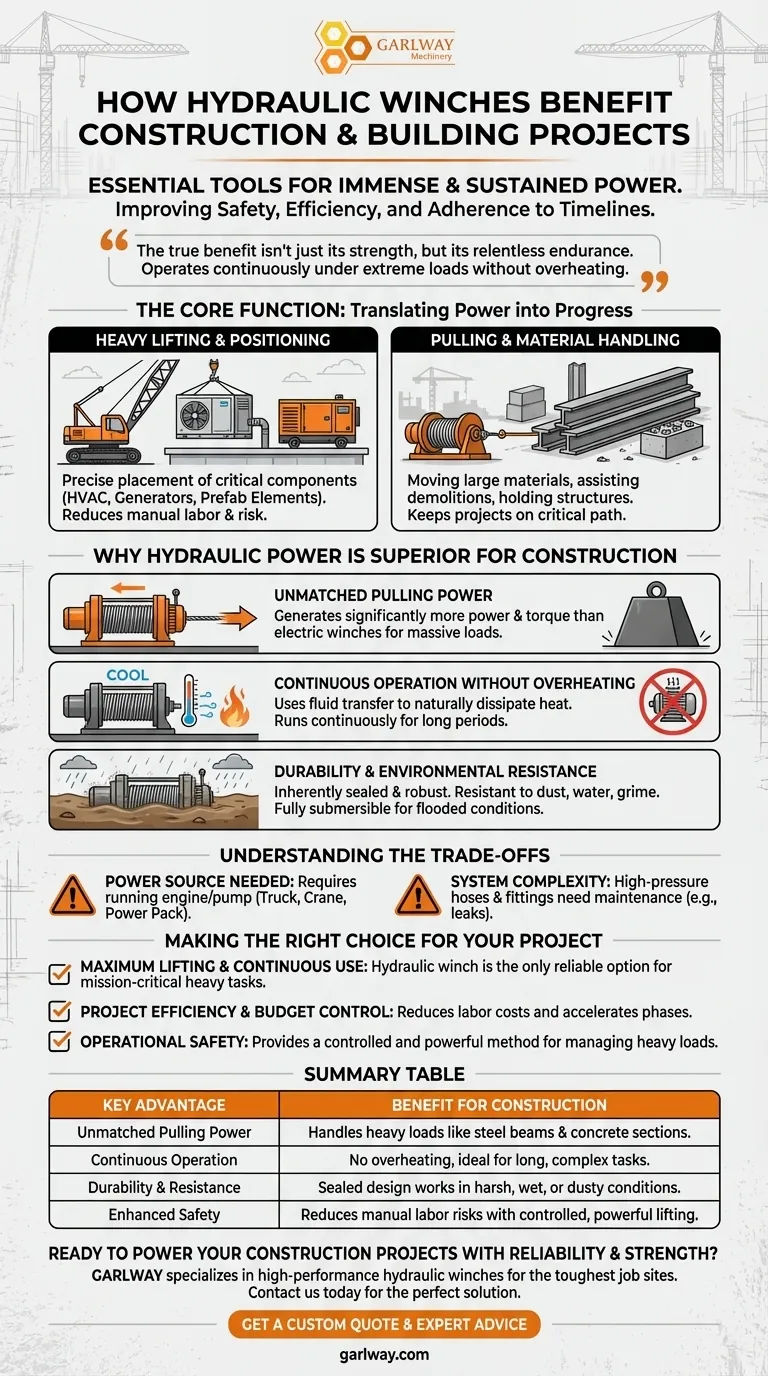
In short, hydraulic winches are essential tools in construction because they provide the immense and sustained power required for heavy lifting and pulling, directly improving project safety, efficiency, and adherence to timelines. They excel at tasks that would overwhelm manual labor or less robust equipment.
The true benefit of a hydraulic winch in construction isn't just its strength, but its relentless endurance. Unlike electric counterparts, its design allows it to operate continuously under extreme loads without overheating, making it the definitive choice for the most demanding project-critical tasks.
The Core Function: Translating Power into Progress
Hydraulic winches are a force multiplier on any construction site. Their primary role is to manage loads that are too heavy or cumbersome for other equipment.
Heavy Lifting and Positioning
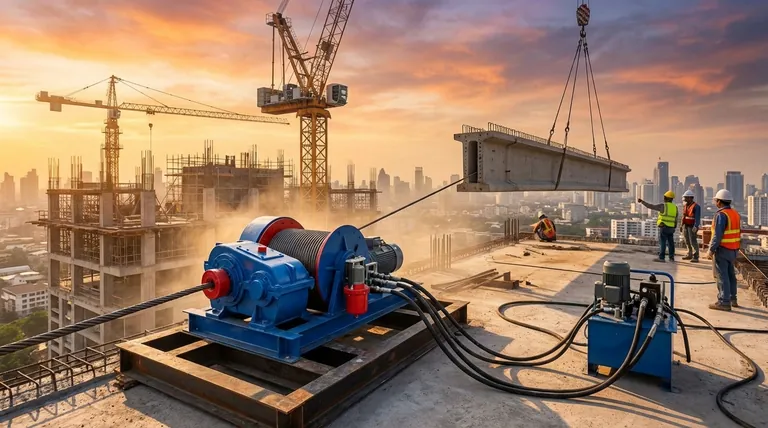
A key application is the precise lifting and placement of critical components. This includes positioning large HVAC units, heavy generators, or prefabricated structural elements onto buildings.
This capability significantly reduces the need for extensive manual labor, which is often slower and carries a higher risk of injury.
Pulling and Material Handling
Hydraulic winches are also used for horizontal pulling tasks. They can move large construction materials across a site, assist in demolitions, or hold massive structures securely in place during assembly.
This ensures that materials are where they need to be, when they need to be, keeping the project on its critical path.
Why Hydraulic Power is the Superior Choice for Construction
The choice of hydraulic power is not arbitrary; it is a direct response to the harsh realities and high demands of the construction environment.
Unmatched Pulling Power
Hydraulic systems generate significantly more pulling power and torque than comparably sized electric winches. This raw strength is a necessity for lifting steel beams, concrete sections, and other massive materials common on large-scale projects.
Continuous Operation Without Overheating
This is the most critical advantage. Electric winches can overheat and burn out under sustained, heavy use. Hydraulic winches use fluid to transfer power, a system that naturally dissipates heat.
This immunity to overheating allows them to run continuously for long periods, which is essential for complex, time-consuming lifts or pulls without risking equipment failure.
Durability and Environmental Resistance
Hydraulic systems are inherently sealed and robust. This makes them highly resistant to the dust, water, and grime of a construction site.
Many hydraulic winches are fully submersible, meaning they can operate reliably in flooded or muddy conditions where an electric winch would fail immediately.
Understanding the Trade-offs
While powerful, hydraulic winches are part of a larger system, which introduces specific considerations.
The Need for a Hydraulic Power Source
A hydraulic winch cannot operate on its own. It requires a running engine with a hydraulic pump, typically from a heavy truck, crane, or a dedicated hydraulic power pack.
This dependency means the vehicle or power unit must be operational and positioned correctly for the winch to function, adding a layer of logistical planning.
System Complexity
The system involves high-pressure hoses, fittings, and hydraulic fluid. While robust, this creates more potential points for maintenance issues, such as leaks, compared to a simpler electric system.
Making the Right Choice for Your Project
Selecting the right winch means aligning its capabilities with your primary project goals.
- If your primary focus is maximum lifting capacity and continuous use: The superior power and heat immunity of a hydraulic winch make it the only reliable option for mission-critical heavy tasks.
- If your primary focus is project efficiency and budget control: A hydraulic winch reduces labor costs and accelerates key construction phases, helping to keep the project on time and within budget.
- If your primary focus is operational safety: Using a properly rated hydraulic winch provides a controlled and powerful method for managing heavy loads, creating a much safer environment than manual alternatives.
Ultimately, a hydraulic winch is a foundational tool that empowers construction projects to handle immense physical challenges with confidence and control.
Summary Table:
| Key Advantage | Benefit for Construction |
|---|---|
| Unmatched Pulling Power | Handles heavy loads like steel beams and concrete sections. |
| Continuous Operation | No overheating, ideal for long, complex tasks. |
| Durability & Resistance | Sealed design works in harsh, wet, or dusty conditions. |
| Enhanced Safety | Reduces manual labor risks with controlled, powerful lifting. |
Ready to power your construction projects with reliability and strength?
GARLWAY specializes in high-performance construction machinery, including robust hydraulic winches designed for the toughest job sites. Our winches deliver the continuous power and durability that construction companies and contractors worldwide rely on to lift, pull, and position heavy materials safely and efficiently.
Contact us today to find the perfect hydraulic winch solution for your specific project needs and keep your operations on schedule and within budget.
Get a Custom Quote & Expert Advice
Visual Guide
Related Products
- Hydraulic Winding Engine Harbor Freight Winch
- Electric and Hydraulic Winch for Heavy Duty Applications
- Small Electric Winch 120V and 240V for Compact Applications
- Electric 120V Boat Winch by Badlands
- 12000 lb Electric Boat Trailer Winch with Windlass Anchor Warn
People Also Ask
- What role does hydraulic fluid play in hydraulic winches? It's the Lifeblood of Your Heavy-Duty Pulling Power
- What vehicles commonly use hydraulic winches? For Industrial Trucks Needing Unmatched Power
- What are the features of hydraulic winches? Unmatched Power and Continuous Duty for Heavy Loads
- What preventive measures can be taken to avoid oil leakage in hydraulic winches? Ensure Long-Term Reliability
- What does 'power out' mean in a hydraulic winch? Achieve Absolute Control When Lowering Heavy Loads