
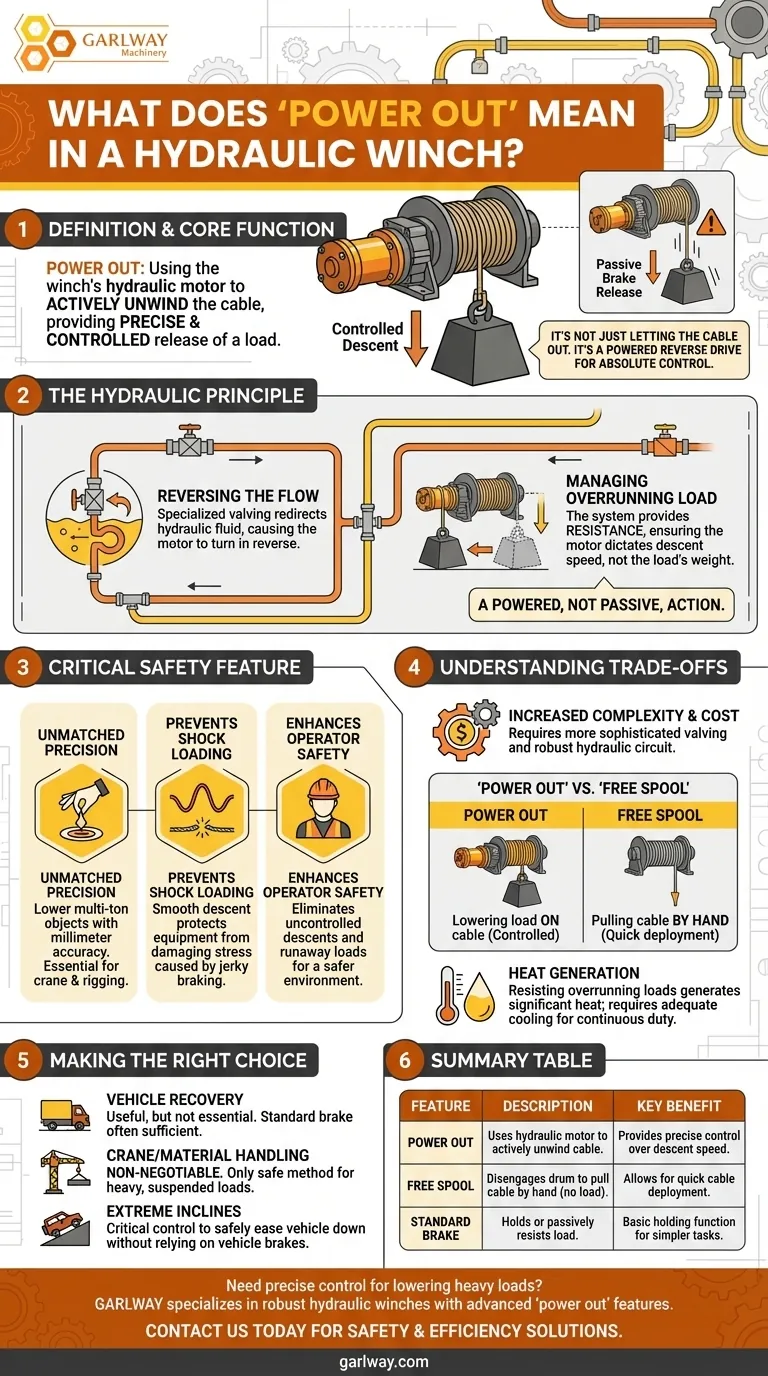
In the context of a hydraulic winch, 'power out' refers to the winch's ability to use its hydraulic motor to actively unwind the cable, providing precise and controlled release of a load. This is fundamentally different from a free-spool or simple brake release; it is a powered, reverse operation that gives the operator complete control over the descent speed.
Power out is not just about letting the cable out; it's about using the hydraulic motor to actively drive the drum in reverse. This provides absolute control when lowering a heavy load, preventing dangerous, uncontrolled drops.
The Hydraulic Principle Behind 'Power Out'
A hydraulic winch generates immense force using fluid pressure. The 'power out' feature is a sophisticated application of this principle, engineered for safety and precision.
Reversing the Hydraulic Flow
The function is achieved through specialized valving within the hydraulic system. This valving redirects the flow of hydraulic fluid, causing the hydraulic motor to turn in the reverse direction.
Managing an "Overrunning" Load
When lowering a heavy weight, the load itself tries to pull the cable out and spin the winch drum. This creates a condition known as an "overrunning load," where the load wants to move faster than the motor.
The hydraulic system must be designed to manage this force. It provides resistance, ensuring the motor dictates the speed of descent rather than the weight of the load.
A Powered, Not Passive, Action
Unlike a simple brake, which just resists motion, the 'power out' function actively drives the unwinding process. This allows for smooth, continuous, and highly adjustable lowering operations.
Why 'Power Out' is a Critical Safety Feature
The primary benefit of 'power out' is not convenience, but control. In applications where loads are suspended or lowered, this feature is often essential.
Unmatched Precision
It allows an operator to lower a multi-ton object with millimeter accuracy. This is critical in crane, rigging, or delicate positioning tasks.
Prevents Shock Loading
A simple brake release can be jerky, sending shock waves through the cable, winch, and mounting structure. A powered descent is smooth, protecting the equipment from damaging stress.
Enhances Operator Safety
By eliminating the risk of an uncontrolled descent or a "runaway" load, 'power out' provides a much safer operating environment when handling heavy objects.
Understanding the Trade-offs
While highly beneficial, the 'power out' feature adds a layer of mechanical complexity that isn't necessary for every application.
Increased System Complexity
A winch with 'power out' requires more sophisticated valving and a more robust hydraulic circuit compared to a simple power-in/brake-hold winch. This often translates to a higher initial cost.
'Power Out' vs. 'Free Spool'
These two functions serve entirely different purposes. Free spool disengages the drum from the geartrain, allowing you to pull the cable out by hand quickly when there is no load. Power out is used specifically to lower a load that is currently on the cable.
Heat Generation
Forcing the hydraulic system to resist an overrunning load generates significant heat. Systems designed for continuous 'power out' duty cycles must have adequate cooling capacity to prevent the hydraulic fluid from overheating and degrading.
Making the Right Choice for Your Goal
Whether you need 'power out' depends entirely on how you intend to use the winch.
- If your primary focus is vehicle recovery: 'Power out' is a useful but not essential feature. Most recovery involves pulling, and a standard brake system is sufficient for holding a load.
- If your primary focus is crane operations or material handling: 'Power out' is non-negotiable. It is the only safe and precise method for lowering heavy, suspended loads.
- If your primary focus is operating on extreme inclines: 'Power out' provides the critical control needed to safely ease a vehicle down a steep grade without relying solely on the vehicle's brakes.
Choosing a winch with 'power out' is a decision rooted in the need for absolute control and safety when lowering a load.
Summary Table:
| Feature | Description | Key Benefit |
|---|---|---|
| Power Out | Uses hydraulic motor to actively unwind cable. | Provides precise control over descent speed. |
| Free Spool | Disengages drum to pull cable by hand (no load). | Allows for quick cable deployment. |
| Standard Brake | Holds or passively resists load. | Basic holding function for simpler tasks. |
Need precise control for lowering heavy loads? GARLWAY specializes in robust hydraulic winches with advanced 'power out' features for construction companies and contractors. Our winches are engineered for safety and precision in demanding material handling and crane operations. Contact us today to discuss your specific requirements and get a solution that ensures safety and efficiency on your job site.
Visual Guide
Related Products
- Hydraulic Winding Engine Harbor Freight Winch
- Electric and Hydraulic Winch for Heavy Duty Applications
- Electric Hoist Winch Boat Anchor Windlass for Marine Applications
- Electric 120V Boat Winch by Badlands
- 12000 lb Electric Boat Trailer Winch with Windlass Anchor Warn
People Also Ask
- What role does hydraulic fluid play in hydraulic winches? It's the Lifeblood of Your Heavy-Duty Pulling Power
- What vehicles commonly use hydraulic winches? For Industrial Trucks Needing Unmatched Power
- What are the features of hydraulic winches? Unmatched Power and Continuous Duty for Heavy Loads
- What preventive measures can be taken to avoid oil leakage in hydraulic winches? Ensure Long-Term Reliability
- How do hydraulic winches assist in agriculture and farming? Boost Power & Reliability for Your Farm



