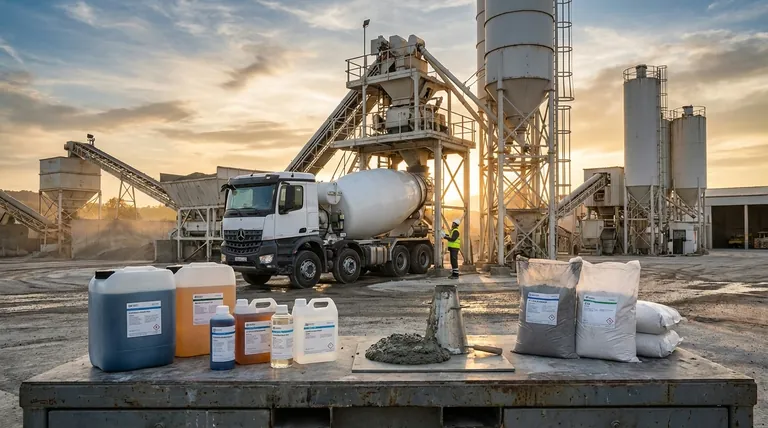
At their core, admixtures are specialized ingredients that chemically or physically alter the properties of fresh or hardened concrete. They are used in ready-mix concrete to enhance specific performance characteristics, such as increasing strength, improving durability, modifying setting times, and enhancing workability far beyond what is possible with a standard mix of cement, water, and aggregates.
The true value of admixtures lies in their ability to decouple conflicting concrete properties. They allow you to increase workability without adding excess water, or improve durability in freezing conditions with only a minimal impact on strength, turning standard concrete into a high-performance, engineered material.
The Primary Functions of Chemical Admixtures
Chemical admixtures are potent liquids or powders added in small, precise doses at the batching plant. Each type is engineered to solve a specific challenge related to the concrete's placement, curing, or long-term performance.
Modifying Water Content and Strength
A lower water-to-cement ratio is the fundamental driver of higher concrete strength. Water-reducing admixtures allow a mix to achieve a desired consistency, or slump, with significantly less water.
This directly increases the final compressive strength and density of the hardened concrete. High-range water reducers, known as superplasticizers, can create highly fluid, self-leveling concrete that flows easily into complex forms without requiring extensive vibration.
Controlling Setting Time
Retarders slow down the chemical reaction of hydration, extending the time concrete remains in a plastic, workable state. This is critical for long transit times from the plant to the job site or during hot weather pours, which can accelerate setting.
Conversely, accelerators speed up hydration to increase the rate of early strength gain. This is essential for cold weather pours to counteract low temperatures or when rapid formwork removal is needed to maintain project schedules.
Enhancing Durability
Air-entraining agents are crucial for concrete exposed to freezing and thawing cycles. They create a network of microscopic, stable air bubbles within the concrete.
When water in the concrete's pores freezes and expands, these tiny bubbles act as pressure-relief valves, preventing internal stress and cracking that would otherwise cause surface scaling and deterioration.
Counteracting Shrinkage
As concrete cures and dries, it naturally shrinks, which can lead to cracking. Expanding agents, or shrinkage-reducing admixtures, work to offset this natural volume loss.
By inducing a controlled expansion during the setting process, they minimize the risk of shrinkage cracks and improve the overall dimensional stability of the concrete structure.
The Role of Mineral Admixtures
Often referred to as supplementary cementitious materials (SCMs), mineral admixtures are fine, siliceous materials that can replace a portion of the Portland cement in a mix. They contribute to the properties of hardened concrete, often improving both strength and durability.
Fly Ash for Long-Term Performance
Fly ash is a byproduct of coal combustion. It reacts with the byproducts of cement hydration in a pozzolanic reaction, forming additional cementitious compounds over time.
While it can slow down early strength gain, fly ash significantly enhances long-term strength, improves workability, and increases resistance to chemical attack.
Slag for Strength and Durability
Ground-granulated blast-furnace slag is a byproduct of steel manufacturing. When used to replace a portion of the cement, slag can increase both early and ultimate strength.
It also improves concrete durability by creating a denser, less permeable paste, making the structure more resistant to chloride and sulfate ingress.
Understanding the Trade-offs
No admixture works in isolation. Introducing one to solve a problem often requires adjusting other aspects of the mix design to manage the resulting trade-offs. This precise balancing act is why admixtures are best handled in the controlled environment of a ready-mix plant.
Strength vs. Durability
The most common trade-off is between strength and freeze-thaw durability. While air-entraining agents are essential for durability, the introduction of air voids can cause a minor reduction in compressive strength. An effective mix design accounts for this and achieves the required balance for the project's specifications.
Workability vs. Segregation
Excessive use of water reducers or superplasticizers can lead to problems. If the mix becomes too fluid, the heavier aggregates can settle out of the cement paste (segregation), and excess water can rise to the surface (bleeding). Both phenomena create weak zones and compromise the concrete's integrity.
The Critical Need for Precision
Admixtures are effective in very small, prescribed doses. Overdosing or underdosing can have significant negative consequences, from failed strength tests to catastrophic set failure. This sensitivity is precisely why their use is integral to ready-mix production and generally not feasible for on-site mixing.
Making the Right Choice for Your Goal
The selection of an admixture is dictated entirely by the desired performance outcome and the specific challenges of the project environment.
- If your primary focus is maximum compressive strength: Use a water reducer or superplasticizer to lower the water-cement ratio while maintaining the required workability.
- If your primary focus is durability in freeze-thaw cycles: An air-entraining agent is non-negotiable, and the mix must be designed to achieve both durability and strength targets.
- If your primary focus is a long transit time or a hot weather pour: A retarder is essential to extend the concrete's plastic state and prevent premature setting.
- If your primary focus is rapid formwork removal or cold weather pouring: An accelerator is required to ensure sufficient early strength gain within your project's timeline.
Properly understood and applied, admixtures transform concrete from a simple commodity into a highly versatile and predictable engineering material.
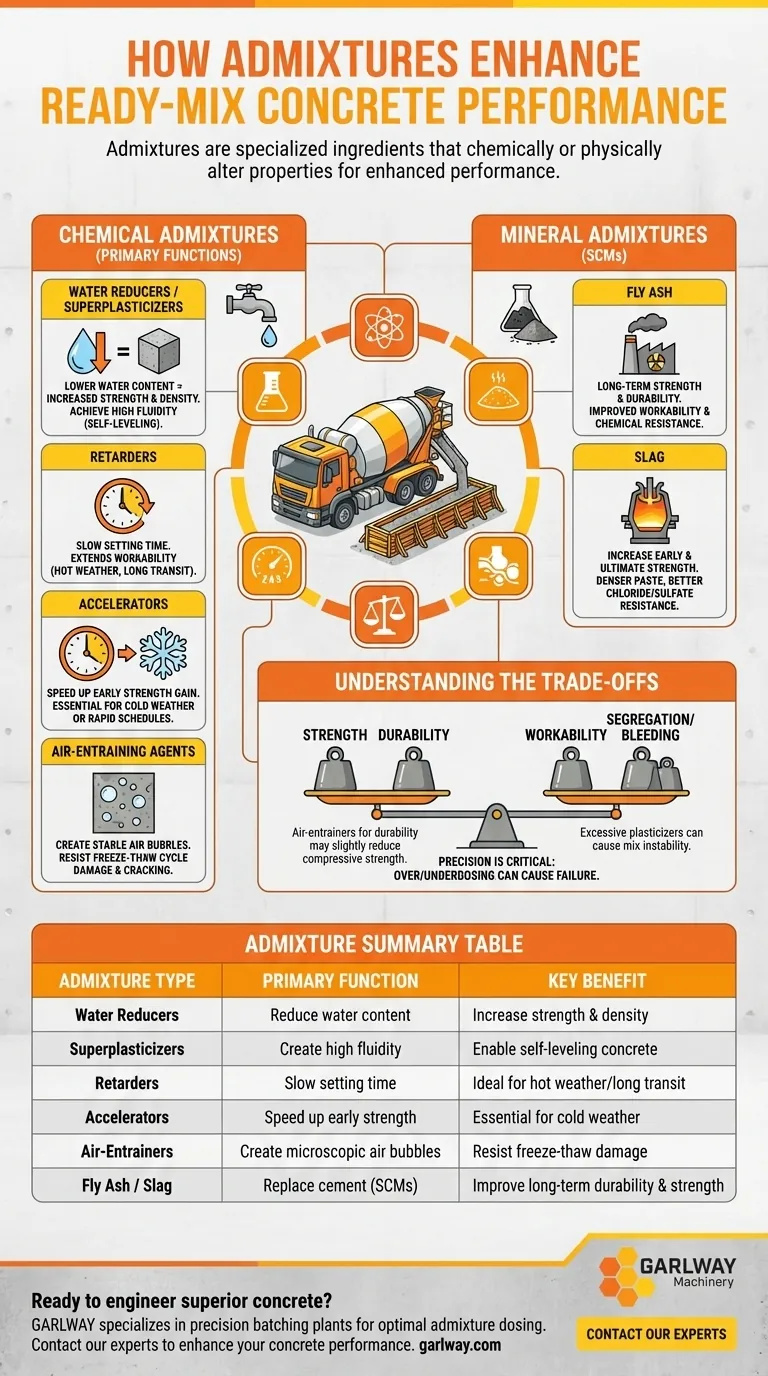
Summary Table:
| Admixture Type | Primary Function | Key Benefit |
|---|---|---|
| Water Reducers | Reduce water content | Increase strength & density |
| Superplasticizers | Create high fluidity | Enable self-leveling concrete |
| Retarders | Slow setting time | Ideal for hot weather/long transit |
| Accelerators | Speed up early strength | Essential for cold weather |
| Air-Entrainers | Create microscopic air bubbles | Resist freeze-thaw damage |
| Fly Ash / Slag | Replace cement (SCMs) | Improve long-term durability & strength |
Ready to engineer superior concrete for your project?
At GARLWAY, we specialize in providing the construction machinery and expertise that support high-performance concrete production. Our concrete batching plants are engineered for precision, ensuring your admixtures are dosed accurately for optimal results.
Whether you're a large construction company or a specialized contractor, we can help you achieve the perfect mix. Contact our experts today to discuss how our solutions can enhance your concrete performance and project efficiency.
Visual Guide
Related Products
- Portable Ready Mix Concrete Mixer Equipment
- HZS180 Ready Mix Concrete Plant for Foundations with Sand and Cement
- HZS120 Ready Mix Concrete Batching Plant Commercial Mud Cement Mixer
- Ready Mixer Machine for Construction Ready Mix Machinery
- HZS25 Best Cement Mixer for Quick Mix Concrete at Bunnings
People Also Ask
- What was the first recorded version of the portable concrete mixer and who invented it? Discover the 1904 Horse-Drawn Innovation
- How does a portable concrete mixer benefit construction projects? Boost Efficiency & Cut Costs On-Site
- How does the portable concrete mixer optimize time in small construction projects? Gain On-Demand Control & Efficiency
- What are the four main components of a portable concrete mixer? Build Better Concrete with the Right Mixer
- What is the use of a portable concrete mixer? Maximize On-Site Control & Efficiency