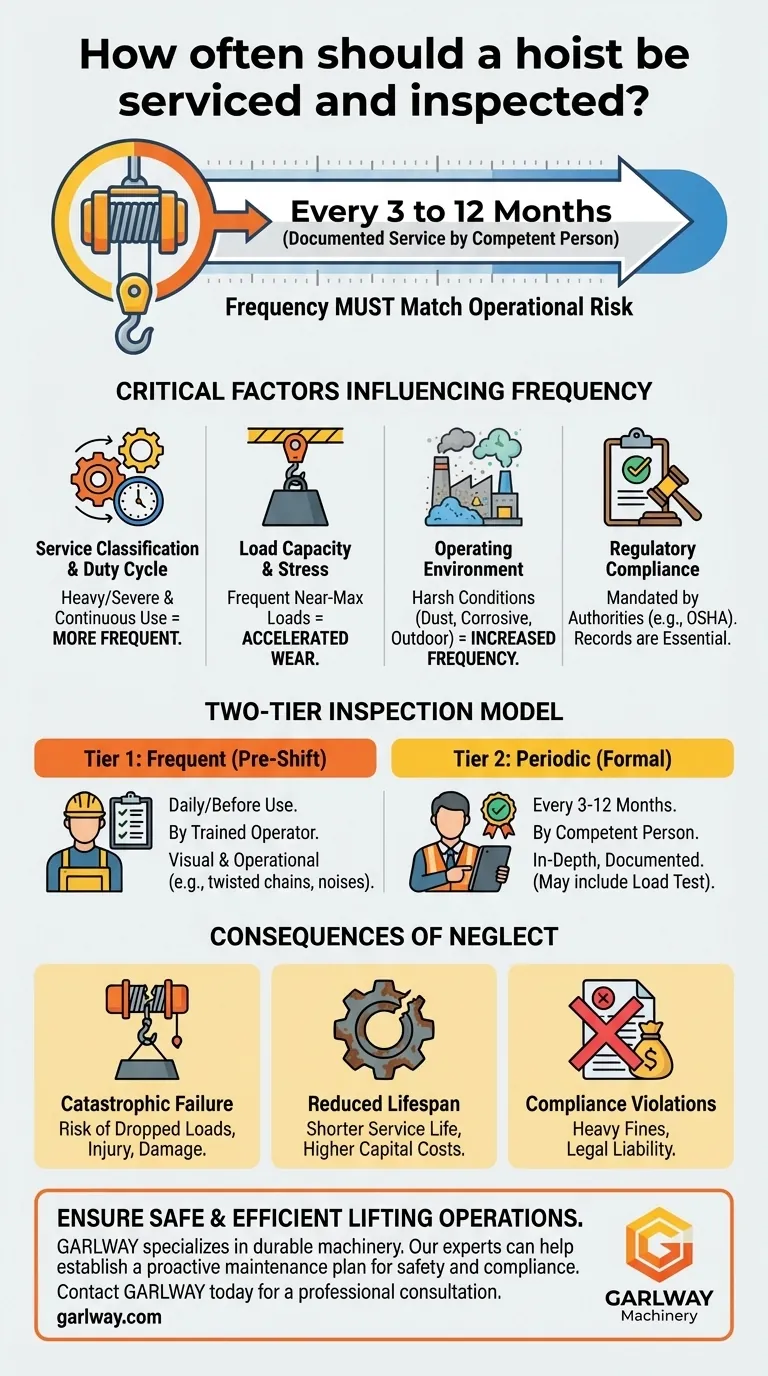
At a minimum, a hoist requires a formal, documented service and inspection by a competent person every three to twelve months. The exact frequency within this range is not arbitrary; it is critically dependent on the hoist's specific application, intensity of use, and operating environment.
The core principle is that hoist inspection frequency must match operational risk. A hoist used constantly in a demanding production environment requires more frequent attention than one used occasionally for light maintenance tasks.
Why "Depending on Usage" is the Critical Factor
The wide "3 to 12 month" window exists because no two hoists experience the same level of stress. A thorough assessment of its working life is the only way to determine a safe and compliant inspection schedule.
Understanding Service Classifications
Hoists are often categorized by their intended service duty (e.g., light, moderate, heavy, severe). A hoist designed for infrequent maintenance tasks will wear out dangerously fast if used in a continuous, 24/7 production cycle. Aligning your inspection frequency with the hoist's service class is the first step.
The Role of Duty Cycle
The duty cycle defines how long a hoist can operate before it needs a rest period to prevent the motor from overheating. Consistently exceeding the duty cycle leads to accelerated wear on all components and is a primary reason for increasing inspection frequency.
Load Capacity and Operating Stress
A hoist's rated capacity is the absolute maximum weight it can safely lift. A unit that frequently lifts loads near this maximum limit is under significantly more stress than one lifting only small percentages of its capacity. This increased stress on the motor, brakes, and load chain or wire rope necessitates more frequent checks.
Environmental Conditions
The operating environment plays a major role. A hoist in a clean, temperature-controlled room will require less frequent inspection than one in a dusty foundry, a corrosive chemical plant, or an outdoor yard exposed to the elements. Abrasive particles, moisture, and extreme temperatures all accelerate component degradation.
The Two Tiers of Hoist Inspection
A comprehensive safety plan relies on two distinct types of inspections working in tandem. Relying solely on the formal periodic check is insufficient.
Tier 1: Frequent (Pre-Shift) Inspections
These are visual and operational checks performed by the trained operator before each shift or before first use each day. This is the first line of defense, designed to catch obvious issues like twisted chains, damaged hooks, or unusual noises.
Tier 2: Periodic (Formal) Inspections
This is the formal, in-depth inspection conducted every 3 to 12 months. It must be performed by a competent and qualified person and requires detailed, written records. This inspection looks for less obvious issues like wear, cracks, and deformation in critical components. A full load test may also be recommended as part of this process to verify lifting performance.
Understanding the Trade-offs of Neglect
Stretching the time between formal inspections beyond what is appropriate for the hoist's usage introduces significant and unacceptable risks.
Increased Risk of Catastrophic Failure
The most severe consequence is equipment failure under load. This can result in dropped loads, causing severe injury, death, and catastrophic damage to property.
Reduced Equipment Lifespan
Proper servicing identifies and corrects minor issues before they become major problems. Neglecting inspections guarantees a shorter service life for the hoist, leading to higher long-term capital costs.
Regulatory and Compliance Violations
In virtually all jurisdictions, periodic hoist inspections are a legal requirement mandated by workplace safety authorities (like OSHA in the United States). Failure to maintain proper records and perform these inspections can result in heavy fines and legal liability.
Establishing Your Inspection Schedule
Use the hoist's real-world application to determine the correct frequency within the 3-to-12-month range.
- If your hoist is in heavy, near-continuous production: You must adopt a more frequent schedule, likely quarterly (every 3 months).
- If your hoist is used for intermittent, light-duty maintenance: A semi-annual or annual (6 to 12 month) schedule may be appropriate, following an initial assessment by a qualified professional.
- If your hoist operates in a harsh or corrosive environment: Increase the inspection frequency, moving toward a 3- or 6-month interval regardless of the duty cycle.
Proactive and diligent maintenance is the foundation of safe and reliable lifting operations.
Summary Table:
| Factor | Impact on Inspection Frequency |
|---|---|
| Service Classification | Heavy/severe use requires more frequent checks than light duty. |
| Duty Cycle | Frequent use near maximum capacity shortens the interval. |
| Operating Environment | Harsh conditions (dust, moisture, chemicals) necessitate more inspections. |
| Regulatory Compliance | Mandated by authorities like OSHA; proper records are essential. |
Ensure your lifting operations are safe and efficient.
Unsure about the right inspection schedule for your specific hoists? GARLWAY specializes in providing durable construction machinery, including winches and concrete equipment, for contractors and construction companies worldwide. Our experts can help you establish a proactive maintenance plan to maximize safety, extend equipment lifespan, and ensure regulatory compliance.
Contact GARLWAY today for a professional consultation and keep your worksite safe.
Visual Guide
Related Products
- Electric Hoist Winch Boat Anchor Windlass for Marine Applications
- Electric and Hydraulic Winch for Heavy Duty Applications
- Hydraulic Winding Engine Harbor Freight Winch
- Portable Cement Mixer with Lift Concrete Machine
- 12000 lb Electric Boat Trailer Winch with Windlass Anchor Warn
People Also Ask
- How does an electric anchor winch work? Power, Safety, and Reliable Operation Explained
- What are the advantages of installing an electric anchor winch on a boat? Boost Safety & Ease for Boaters
- What are the operational differences between electric hoists and winches? A Guide to Safe Lifting vs. Pulling
- What are the main benefits of a boat anchor winch? Boost Safety & Efficiency for Your Vessel
- How does a boat anchor winch work? A Guide to Reliable Anchor Handling