
At its most fundamental level, a winch is a mechanical device designed to pull heavy objects by winding a cable, rope, or strap around a rotating drum. It uses this winding action to create powerful tension, allowing it to move loads that would otherwise be impossible to shift by hand.
A winch is not just a spool; it is a force multiplier. By using a power source and a gear system, it converts low-power rotational energy into a high-tension pulling force, enabling you to move loads far beyond your own strength.
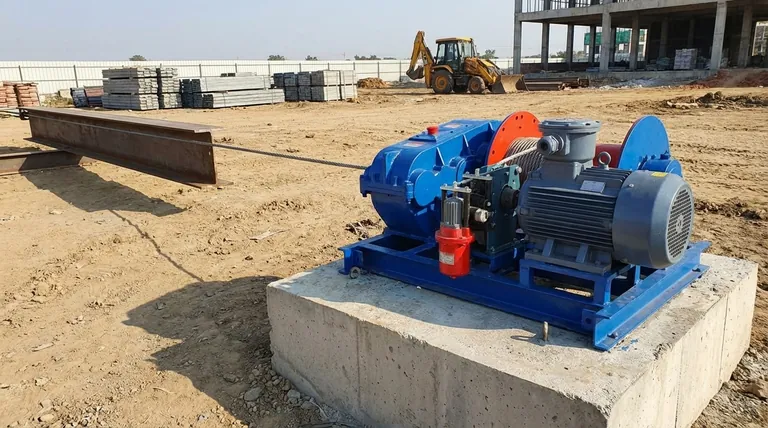
How a Winch Achieves Its Pulling Power
To understand a winch's function, it's best to look at its core components and the principles that allow it to generate such immense force.
The Core Components
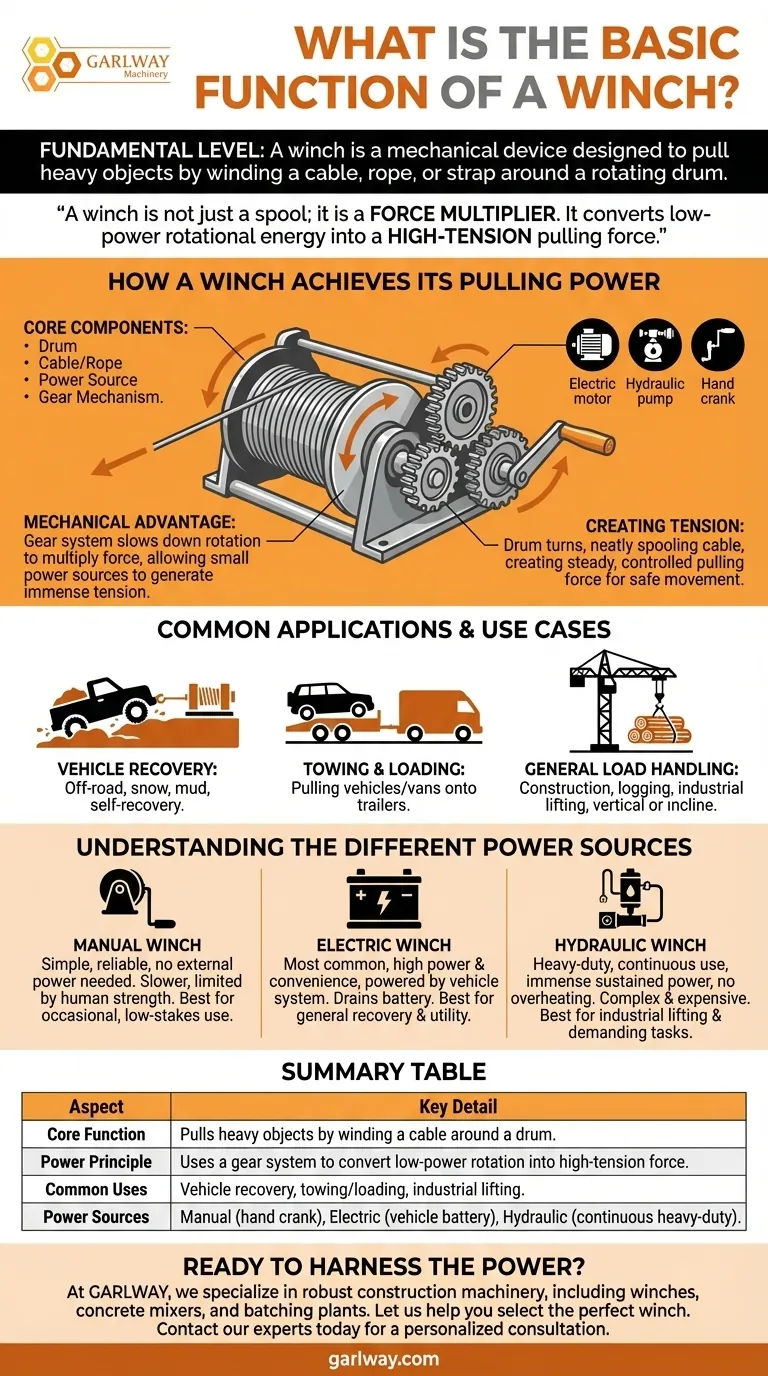
A winch is a system of simple parts working together. The primary components are the drum (the spool), the cable or rope that winds around it, a power source, and a gear mechanism.
The Principle of Mechanical Advantage
The true power of a winch comes from its reduction gear system. The motor or hand crank turns quickly with low force, but the gears slow this rotation down significantly.
This trade-off—sacrificing speed for power—is what multiplies the force. It allows a small electric motor or manual effort to generate thousands of pounds of pulling force at the cable.
Creating and Maintaining Tension
As the drum turns, it neatly spools the cable, creating a steady and continuous pulling force on the object attached to the other end. This controlled tension is the key to safely moving a heavy vehicle or load without jerking or slipping.
Common Applications and Use Cases
While the principle is simple, the applications for a winch are incredibly diverse, ranging from vehicle recovery to industrial load handling.
Vehicle Recovery
This is the most widely known use. A winch is used to pull a vehicle out of a difficult situation, such as being stuck in mud, snow, or a ditch. For off-road and overlanding enthusiasts, an electric winch is often considered an essential "insurance policy" for self-recovery.
Towing and Loading
Towing winches are designed specifically to pull vehicles, vans, or small trucks onto the bed of a trailer or tow truck. The consistent tension ensures a safe and controlled loading process.
General Load Handling
Beyond vehicles, winches are used to move various heavy loads. They can pull horizontally across the ground, lift loads vertically, or manage objects on an incline, making them a versatile tool in construction, logging, and other industries.
Understanding the Different Power Sources
The function remains the same, but the power source dictates the winch's capability and limitations. This is the most important trade-off to consider.
Manual Winches
Powered by a hand crank, these are the simplest form. They are reliable and don't depend on an external power source, but they are much slower and limited by the physical strength of the operator.
Electric Winches
These are the most common type, especially for vehicle applications. They are powered by the vehicle's electrical system, offering significant power and convenience at the push of a button. Their main limitation is the drain on the battery.
Hydraulic Winches
Powered by a hydraulic system running off the vehicle's power steering pump or a dedicated pump, these winches are built for heavy-duty, continuous use. They generate immense power and won't overheat like an electric motor, but they are more complex and expensive to install.
Making the Right Choice for Your Goal
Understanding the core function helps you select the right tool for the job.
- If your primary focus is occasional, low-stakes recovery: A manual hand-crank winch offers a reliable and budget-friendly solution.
- If your primary focus is general vehicle recovery or utility work: An electric winch provides the best balance of power, convenience, and accessibility.
- If your primary focus is heavy industrial lifting or continuous operation: A hydraulic winch delivers the sustained power required for the most demanding tasks.
Ultimately, a winch is a tool that translates controlled power into the raw force needed to overcome a physical obstacle.
Summary Table:
| Aspect | Key Detail |
|---|---|
| Core Function | Pulls heavy objects by winding a cable around a drum. |
| Power Principle | Uses a gear system to convert low-power rotation into high-tension force. |
| Common Uses | Vehicle recovery, towing/loading, industrial lifting. |
| Power Sources | Manual (hand crank), Electric (vehicle battery), Hydraulic (continuous heavy-duty). |
Ready to harness the power of a reliable winch for your next project?
At GARLWAY, we specialize in providing robust construction machinery, including a full range of winches, concrete mixers, and batching plants, designed for the demanding needs of construction companies and contractors worldwide.
Let us help you select the perfect winch for your specific application—whether it's for vehicle recovery, industrial lifting, or heavy-duty towing.
Contact our experts today for a personalized consultation and discover the GARLWAY difference in quality and performance.
Visual Guide
Related Products
- Warn Winch Windlass Boat Trailer Winch
- Electric and Hydraulic Winch for Heavy Duty Applications
- Small Electric Winch 120V and 240V for Compact Applications
- Quick Windlass Portable Winch for Truck and Boat Best Boat Winch
- Hydraulic Winding Engine Harbor Freight Winch
People Also Ask
- What are the main components of a boat trailer winch? A Guide to Safe & Efficient Boat Loading
- What factors should be considered when choosing a boat trailer winch? Ensure Safe and Effortless Boat Loading
- What is the purpose of boat trailer winches? Safely and Efficiently Load Your Boat
- What are the two main types of boat trailer winches? Manual vs. Electric Explained
- How often should a boat trailer winch be replaced? Your Guide to Safety and Longevity





