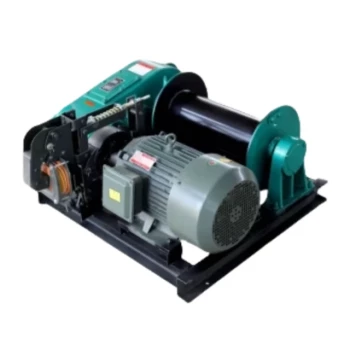
At the most fundamental level, boat trailer winches are divided into two primary categories: manual and electric. Manual winches rely on your physical effort via a hand crank to retrieve the boat, while electric winches use a 12-volt motor powered by your towing vehicle to automate the process.
The choice between a manual and electric winch is not about which is "better," but which is appropriate for your specific needs. The decision hinges on a clear trade-off between the upfront cost and simplicity of manual winches versus the convenience and power of electric models, which is directly tied to the size and weight of your boat.
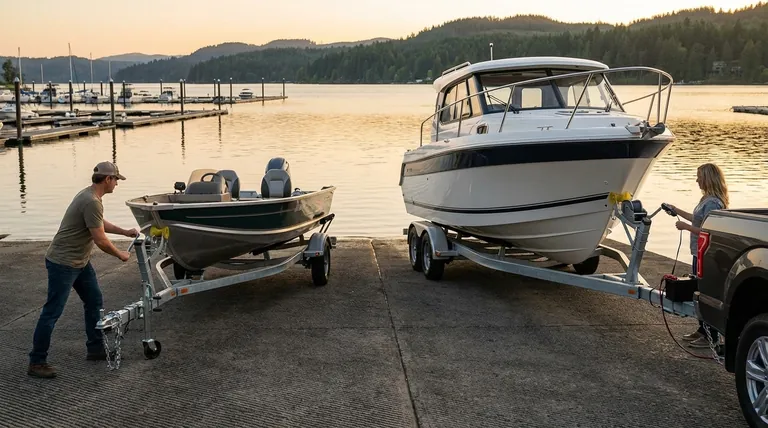
The Two Core Categories: Manual vs. Electric
Understanding the operational differences between the two main types is the first step in making an informed decision. Each serves a distinct purpose and is suited to different scenarios.
Manual Winches: The Standard Workhorse
A manual winch is the most common type found on trailers for small-to-medium-sized boats. It operates using a simple hand crank and a set of gears to provide a mechanical advantage.
Their design is straightforward, making them highly reliable and easy to maintain. They require no external power source, ensuring you can always load your boat regardless of your vehicle's battery status.
Electric Winches: Power and Convenience
An electric winch replaces muscle power with a 12-volt electric motor. It connects directly to your towing vehicle's battery and is operated with a simple switch, often on a wired remote.
This type is ideal for larger, heavier boats where manual cranking would be excessively strenuous or time-consuming. It offers a consistent and effortless retrieval speed, making the boat launching and loading process significantly easier.
Beyond the Basics: Other Winch Distinctions
While "manual vs. electric" is the primary classification, you will encounter other terms that describe specific features or less common types.
Single-Speed vs. Two-Speed Manual Winches
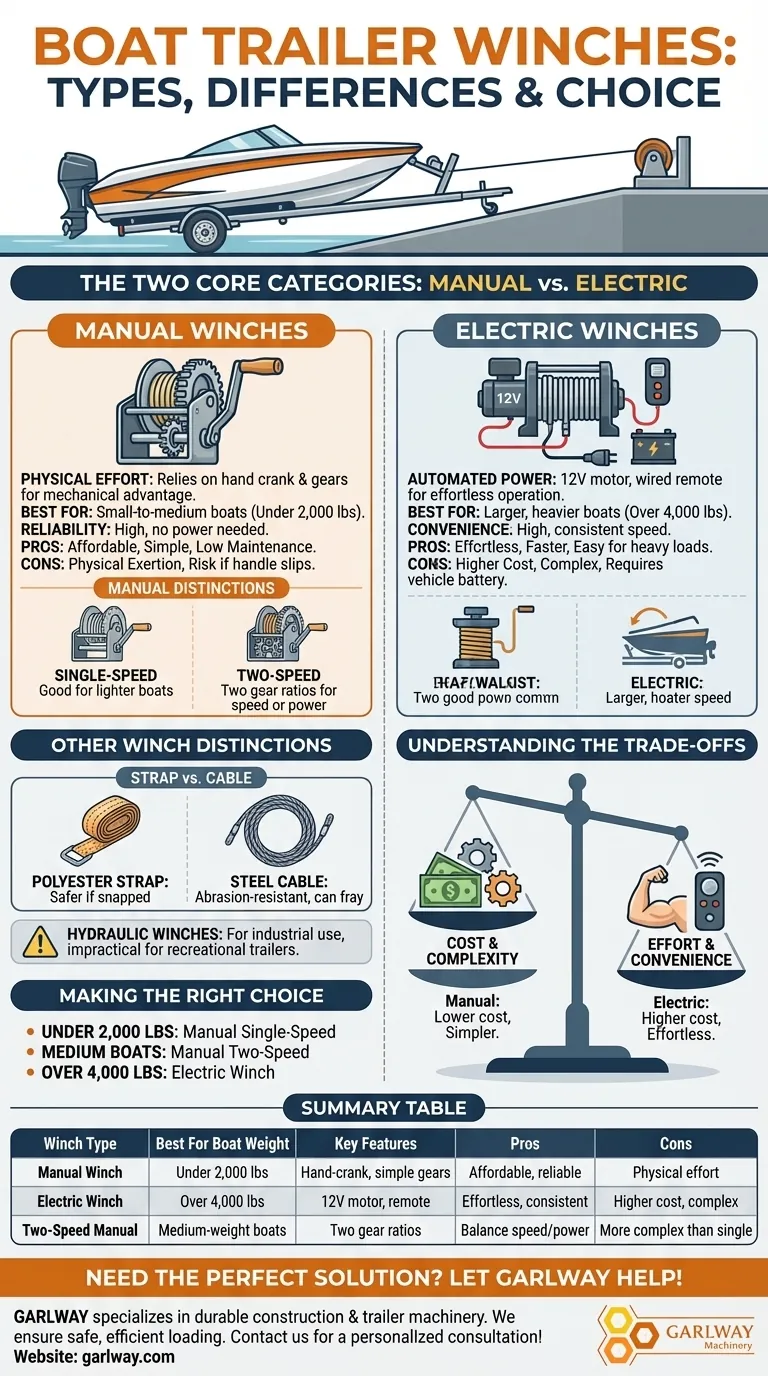
Manual winches often come in two configurations. Single-speed models have one gear ratio, offering a good balance for lighter boats. Two-speed models provide two gear ratios: a higher gear for fast retrieval with light loads and a lower gear for more power and easier cranking with heavy loads.
Strap vs. Cable
This distinction refers to the line used to pull the boat, not the winch type itself. Straps are flat, woven polyester and are less likely to cause injury if they snap. Steel cables are more abrasion-resistant but can develop broken strands that are sharp and can rust.
What About Hydraulic Winches?
Hydraulic winches exist but are typically used in heavy industrial or commercial applications. They are powered by a hydraulic system and offer immense pulling power, but their cost, weight, and complexity make them impractical and unnecessary for a standard recreational boat trailer.
Understanding the Trade-offs
Choosing the right winch means weighing the practical benefits and drawbacks of each type against your specific situation.
Cost and Complexity
A manual winch is significantly less expensive than an electric model. With fewer parts—essentially just a frame, gears, and a handle—it is also far simpler to maintain and repair.
Effort and Safety
The most obvious trade-off is physical effort. An electric winch virtually eliminates the strain of loading a boat. Manual winches require physical exertion, and there is a risk of injury if the crank handle slips from your grip under load.
Speed and Efficiency
For heavy boats, an electric winch is almost always faster and more efficient. It pulls at a steady rate, whereas manual cranking can slow down considerably as the boat moves up the trailer bunks and resistance increases.
Reliability and Maintenance
Manual winches are exceptionally reliable due to their simplicity. An electric winch introduces more potential points of failure, including the motor, wiring, solenoids, and switches, and is dependent on a charged vehicle battery.
Making the Right Choice for Your Boat
Your decision should be guided by your boat's size, your budget, and how you value convenience.
- If your primary focus is affordability and simplicity for a small, lightweight boat (under 2,000 lbs): A single-speed manual winch is the most reliable and cost-effective solution.
- If you have a medium-sized boat and want more mechanical advantage without added complexity: A two-speed manual winch offers an excellent balance of speed and power.
- If your primary focus is convenience, or you have a large, heavy boat (over 4,000 lbs): An electric winch is the superior choice, as it eliminates physical strain and makes loading significantly easier.
Ultimately, selecting the right winch comes down to matching its capabilities to the weight of your vessel and your personal preference for convenience.
Summary Table:
| Winch Type | Best For Boat Weight | Key Features | Pros | Cons |
|---|---|---|---|---|
| Manual Winch | Under 2,000 lbs | Hand-crank operation, simple gears | Affordable, reliable, no power needed | Requires physical effort |
| Electric Winch | Over 4,000 lbs | 12V motor, remote control | Effortless operation, consistent speed | Higher cost, more complex maintenance |
| Two-Speed Manual | Medium-weight boats | Two gear ratios (fast/powerful) | Good balance of speed and power | Slightly more complex than single-speed |
Struggling to load your boat? Let GARLWAY provide the perfect solution.
Choosing the right winch is critical for safety and ease of use. GARLWAY specializes in durable and reliable construction and trailer machinery, including winches designed for demanding applications. Our expertise ensures you get a product perfectly matched to your needs.
We can help you:
- Select the ideal winch for your boat's size and weight.
- Ensure safe and efficient loading every time.
- Access reliable equipment built for long-term performance.
Don't let the wrong winch slow you down. Contact GARLWAY today for a personalized consultation and quote!
Visual Guide
Related Products
- 12000 lb Electric Boat Trailer Winch with Windlass Anchor Warn
- Warn Winch Windlass Boat Trailer Winch
- Electric 120V Boat Winch by Badlands
- 12000 lb Heavy Duty Electric Boat Winch
- Quick Windlass Portable Winch for Truck and Boat Best Boat Winch
People Also Ask
- How does an electric boat trailer winch differ from a manual one? Effort vs. Control Explained
- What size winch do I need for my boat? Get the Right Capacity for Safe Hauling
- How should a boat trailer winch be properly used? A Step-by-Step Guide for Safe Loading
- What maintenance steps are specific to boat trailer winches? Ensure Safety & Reliability at the Ramp
- How strong of a winch do I need for my boat? Get the Right Pulling Power for Trailering & Anchoring